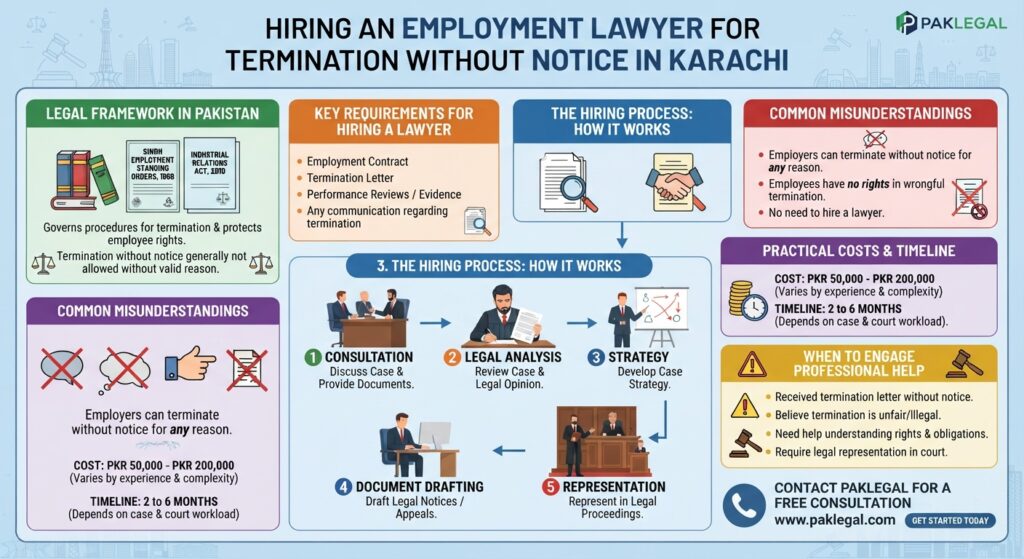

In Karachi, unfair termination without notice violates the Sindh Industrial Employment (Standing Orders) Act, 1953. Section 22 mandates a formal inquiry, a written charge sheet, and a fair hearing before an employer can dismiss an employee for misconduct. If these procedural safeguards are skipped, the dismissal is legally void, and the employee is entitled to reinstatement or substantial compensation.
What constitutes unfair termination without notice in Karachi?
Unfair termination occurs when an employer bypasses the mandatory disciplinary procedures outlined in the Sindh Industrial Employment (Standing Orders) Act, 1953. In Karachi’s private sector, this law governs most industrial and commercial establishments. Section 22 explicitly requires that any dismissal for misconduct must be preceded by a specific charge sheet and a hearing where the employee can present a defense.
Statutory Procedural Safeguards
The law strictly distinguishes between “termination” for misconduct and “discharge” for non-misconduct reasons like redundancy or health. Termination without notice is only permissible for grave offenses such as theft, violence, or habitual insubordination. For lesser infractions, the employer must issue a show-cause notice and allow the worker to respond. Skipping this fair hearing renders the action illegal under Section 22(1).
Which laws govern employment termination in Sindh?
The primary legislation is the Sindh Industrial Employment (Standing Orders) Act, 1953, applicable to establishments with more than ten workers. The Industrial Relations Act, 2012, provides the procedural framework for filing complaints and defines the jurisdiction of Labour Courts. It is crucial to note that the 2012 Act is the current operative law for dispute resolution, superseding older procedural references.
Distinction Between Discharge and Termination
“Discharge” applies to exits due to resignation, retirement, or operational needs. “Termination” is a disciplinary penalty. Confusing these terms leads to incorrect legal strategies. If you were let go for performance issues without a misconduct charge, it is a discharge, governed by different notice period rules than a disciplinary termination.
What documents must you gather before consulting a lawyer?
You need to compile a complete record of your employment relationship to prove the terms of your contract and the sequence of events. This includes your signed offer letter, service confirmations, recent salary slips, and the specific termination or discharge letter. If you received a charge sheet, keep the original, as it is critical evidence of whether the employer followed due process.
- Signed Employment Contract or Offer Letter
- Termination or Discharge Notice
- Any Charge Sheet or Show Cause Notice
- Payslips and Bank Statements for the last six months
- Communication records (emails, letters) regarding the dismissal
How does the dispute resolution process work in Karachi?
The process begins at the Labour Court, where you must file a complaint within 60 days of the termination date. The court first attempts conciliation to settle the matter amicably. If that fails, a full hearing is held where both sides present evidence. The court can order reinstatement with back wages or monetary compensation for wrongful termination.
- File a complaint at the Labour Court within 60 days of dismissal.
- Attend the mandatory conciliation session with the employer’s representative.
- Present evidence and witnesses if conciliation fails to resolve the issue.
- Receive a final order from the Labour Court
Step-by-Step Process for Filing a Wrongful Termination Claim in Karachi
Filing a claim for unfair termination in Karachi requires strict adherence to procedural timelines and specific evidentiary standards. The following steps outline the legal pathway from initial assessment to final enforcement of a Labour Court order.
- Verify the statutory limitation period immediately. Under the Industrial Relations Act, 2012, you must file your complaint within 60 days of the termination date. Missing this deadline typically results in the case being dismissed as time-barred, regardless of merit.
- Compile a comprehensive evidence file. Gather your signed employment contract, all salary slips for the preceding six months, the termination letter, and any charge sheets. Ensure all digital communications are exported and printed for physical submission.
- Draft the formal complaint or plaint. This document must clearly state the facts of your employment, the specific procedural violations by the employer, and the relief sought. Relief options include reinstatement with back wages or monetary compensation.
- Submit the complaint to the Labour Court with jurisdiction over your workplace location. Pay the required court fees, which are nominal for industrial disputes, and obtain a receipt and case number for tracking.
- Attend the mandatory conciliation hearing. The Labour Officer will attempt to mediate between you and the employer. If a settlement is reached, it is recorded as a consent decree. If not, the case proceeds to trial.
- Present your case at trial. Submit primary evidence, call witnesses if applicable, and cross-examine the employer’s evidence. The employer must prove they followed the standing orders; failure to do so supports your claim of unfair termination.
- Receive the final judgment. If the court rules in your favor, it will issue an order for reinstatement or compensation. If the employer fails to comply, you must apply for execution of the decree under the Civil Procedure Code.
Frequently Asked Questions About Unfair Termination in Sindh
What is the statute of limitations for filing a termination case?
The statute of limitations for filing a wrongful termination complaint in Karachi is 60 days from the date of dismissal. This deadline is strict under the Industrial Relations Act, 2012. Filing after this period generally leads to rejection of the case unless you can prove valid reasons for the delay, such as being out of the country or ill, though courts rarely extend this limit.
Can I claim both reinstatement and back wages simultaneously?
Yes, you can claim reinstatement with back wages. However, if the court finds that the relationship has irreparably broken down, it may award monetary compensation in lieu of reinstatement. The amount for back wages is calculated based on your last drawn salary, including allowances, for the entire period from termination until the date of the order or actual reinstatement.
Does the Sindh Industrial Employment Act apply to small offices?
The Sindh Industrial Employment (Standing Orders) Act, 1953, applies to establishments employing more than ten workers. If your office has ten or fewer employees, this specific standing order may not apply, and your rights are governed primarily by the general contract law and the Industrial Relations Act, 2012. You must verify the headcount at the time of termination.
What happens if the employer does not appear in court?
If the employer fails to appear in the Labour Court after being served with notice, the court may proceed ex parte. This means the judge hears your side of the case without the other party. An ex parte order is often
Need to Discuss Your Specific Situation?
This guide is for educational purposes to help you understand the general legal process. If you need to discuss how these principles apply to your specific circumstances, you may contact the author’s office.
Contact the Author’s OfficePlease note: This contact is for a discussion of legal principles only and does not create an advocate-client relationship until a formal engagement is confirmed.