

Quick Answer
You can consult a Pakistani family lawyer online by sharing your documents through WhatsApp, email, or a secure portal and discussing your matter by video or voice call. Initial consultation, document review, strategy advice, and drafting can be handled remotely. However, formal divorce registration (talaq through the Union Council), khula proceedings before a Family Court, custody applications, and dower recovery suits involve court or administrative processes that cannot be completed entirely online. For overseas clients, a properly attested Special Power of Attorney allows a lawyer to represent you before Pakistani courts without your physical presence for many steps, though specific formalities — identity verification, attestation, or particular testimony — may still require attendance.
What the Law Says
Family-law matters in Pakistan are governed primarily by the West Pakistan Family Courts Act, 1964 (as adapted and amended by each province), the Muslim Family Laws Ordinance, 1961, the Guardians and Wards Act, 1890, the Dissolution of Muslim Marriages Act, 1939, and the Qanun-e-Shahadat Order, 1984. The Family Courts have exclusive jurisdiction over matters listed in the Schedule to the 1964 Act, including dissolution of marriage, dower, maintenance, and custody.
There is no statutory provision that creates a separate “online family lawyer” category in Pakistan. An online consultation is simply a consultation conducted through remote means; the lawyer remains subject to the same professional and procedural rules. The Pakistan Bar Council regulates legal practice, and a lawyer consulted remotely must be a licensed advocate enrolled with a provincial bar council.
Who This Applies To
This information applies to:
-
Residents of Pakistan who prefer to begin a family-law matter with a remote consultation before deciding on representation.
-
Overseas Pakistanis dealing with dissolution, maintenance, custody, or dower matters in Pakistan.
-
Individuals who have received notices — talaq notice, khula summons, or maintenance claims — and need to understand their position.
-
Parties seeking to understand which Family Court has jurisdiction and what documents are needed.
It does not apply to criminal family matters, which follow a different procedure, or to matters already before an appellate court.
Online Consultation Process
A structured online consultation in Pakistan typically involves the following stages:
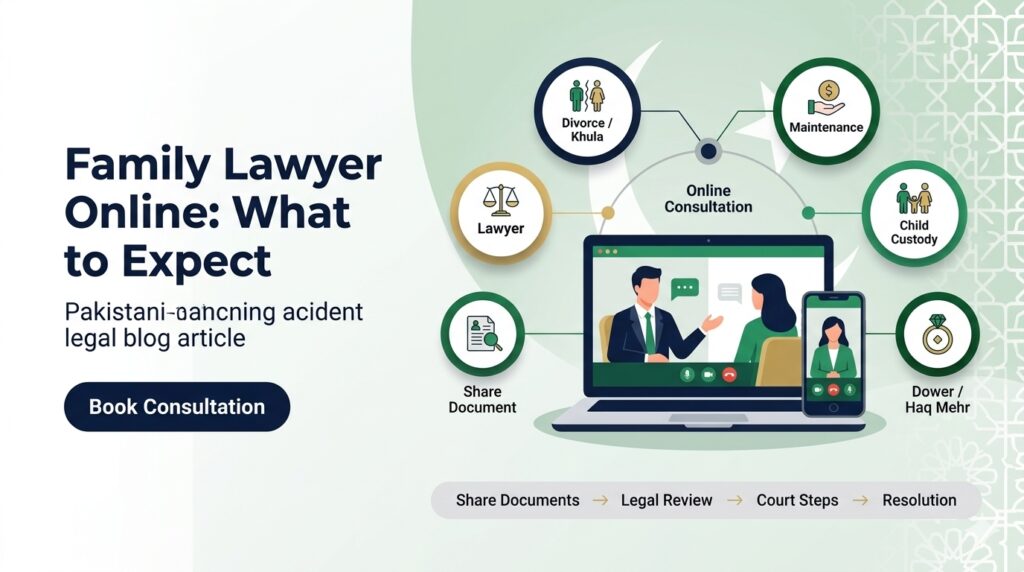
Stage 1 — Initial contact and document sharing. You send your case details and documents — CNIC, nikahnama, notices, court orders, and correspondence — by WhatsApp, email, or the firm’s portal.
Stage 2 — Video or voice consultation. A lawyer reviews the material and conducts a consultation by video call (Zoom, Google Meet, or WhatsApp) or voice call. For overseas clients, sessions are scheduled around time-zone differences.
Stage 3 — Preliminary assessment. The lawyer explains which legal route appears appropriate, what can begin remotely, and which steps will require formal court involvement. No responsible lawyer will promise a particular outcome at this stage.
Stage 4 — Engagement and next steps. If you proceed, the lawyer may prepare a petition, draft notices, or plan representation. For overseas clients, a Special Power of Attorney is often required for court representation without travel.
Confidentiality Considerations
Communications between a lawyer and client in Pakistan are protected under Article 9 of the Qanun-e-Shahadat Order, 1984. An advocate’s advice to a client and communications between an advocate and client are privileged, and their production in evidence cannot be compelled by a court. The privilege is not absolute — it excludes communications made in furtherance of an illegal purpose, crime, or fraud.
Responsible firms conduct conflict checks before accepting a matter, to ensure they do not act for both sides of a dispute. Formal advice typically begins only after identity verification, conflict clearance, and a written engagement scope.
Documents to Prepare
Having the right documents ready makes the first consultation more productive. Commonly required documents include:
-
CNIC of the client (and the spouse’s CNIC if available)
-
Nikahnama — original or certified copy, including the column showing dower terms
-
Marriage registration certificate (if separate from the nikahnama)
-
Proof of residence — for jurisdictional purposes
-
Any notices received — talaq notice, khula summons, or Union Council correspondence
-
Existing court orders — interim or final
-
Financial records — where maintenance is in issue
-
Evidence supporting the stated grounds — where applicable
For overseas clients, documents may need attestation from Pakistani embassies or consulates before they can be used in Pakistani proceedings.
Divorce and Khula Issues
Talaq (husband’s pronouncement). Under Section 7 of the Muslim Family Laws Ordinance, 1961, the husband must give written notice of talaq to the Chairman of the relevant Union Council. The Chairman constitutes an Arbitration Council within thirty days to attempt reconciliation. If reconciliation fails, the divorce becomes effective upon expiration of ninety days from the notice, after which a Certificate of Effectiveness is issued. The Union Council with jurisdiction is that of the Union or Town in which the wife was residing at the time of the pronouncement of talaq. Where the wife resides outside Pakistan, the Pakistan Mission or Embassy abroad may conduct divorce proceedings under an SRO issued under Section 2 of the Ordinance.
Khula (wife’s judicial dissolution). Under Section 10(4) of the West Pakistan Family Courts Act, 1964, a wife may file for khula before the Family Court. The court must first make a genuine attempt at reconciliation. If reconciliation fails, the court may pass a decree for dissolution of marriage forthwith. Khula is a right of the wife to seek divorce by returning her dower to the husband, and the husband’s consent is not required.
Dower in khula. Section 10(5) and (6) were introduced in 2015 to regulate the surrender of dower in khula. The court may direct the wife to surrender up to fifty per cent of her deferred dower or up to twenty-five per cent of her admitted prompt dower to the husband. However, where the husband’s conduct — cruelty, arrogance, or obnoxious behaviour — compelled the wife to seek khula, she may be entitled to retain her benefits along with dissolution.
Judicial limitation on conversion. The Supreme Court of Pakistan has ruled that family courts cannot convert a suit for dissolution of marriage into one for khula without the wife’s clear and informed consent. This is particularly important where conversion would result in forfeiture of dower and other financial rights.
Maintenance
Under Pakistani family law, a husband is obligated to maintain his wife and children. The Family Court has jurisdiction over maintenance claims. Section 17-A of the West Pakistan Family Courts Act, 1964 empowers the Family Court to pass an interim order for maintenance at any stage of proceedings. Payment is to be made by the fourteenth day of each month, failing which the court may strike off the defence of the defendant and decree the suit.
Children’s maintenance is a separate obligation: the father remains legally obligated to maintain his children after divorce, regardless of who has custody. This includes food, clothing, shelter, education, and medical expenses. The amount is determined by the husband’s financial capacity and the reasonable needs of the dependants.
A Family Courts (Amendment) Bill, 2024 was approved by a Senate sub-committee in April 2025. The Bill proposes that the court shall, at the first hearing, fix a maintenance amount for the divorcee and her children, and that failure to pay by the fourteenth of each month would result in the defendant’s right to present a defence being withdrawn. As at the date of this article, this remains a Bill and has not been enacted as law.
Child Custody
Child custody in Pakistan is governed by the Guardians and Wards Act, 1890, with Family Courts exercising jurisdiction under the Family Courts Act, 1964. Under the rules of hizanat (custody under Hanafi Muslim personal law as applied in Pakistan), the mother has a preferential right to custody of a male child until the age of seven and of a female child until she reaches puberty.
However, the welfare of the child is the paramount consideration. The Supreme Court of Pakistan has held that the decision regarding custody of a child is governed by the fundamental principle that the paramount and overarching consideration is the welfare of the child — to ascertain the course which is in the child’s best interest. Courts have repeatedly departed from strict age rules where the child’s welfare required it.
Section 17(3) of the Guardians and Wards Act provides that a child who has attained sufficient maturity has the right to express a preference in custody matters. Family Courts may issue interim visitation orders, including directing video-call access on non-visitation days.
Guardianship
Guardianship is distinct from custody. A guardian is appointed for a minor’s person or property under Section 7 of the Guardians and Wards Act, 1890. The father has an inherent right of guardianship under Hanafi law, even where the mother is awarded custody. Guardianship matters may involve property management, consent for travel, or financial decisions on behalf of the minor. The court prioritises the minor’s welfare in guardianship decisions, with Section 17 of the Act requiring consideration of the child’s age, sex, and the guardian’s character and financial capacity.
Dower (Haq Mehr)
Dower is a sum payable by the husband to the wife as part of the marriage contract, recorded in the nikahnama. It may be prompt (payable immediately) or deferred (payable on demand or at dissolution). The Family Court has exclusive jurisdiction over dower claims.
Under Article 103 of the Limitation Act, 1908, a claim for prompt dower is subject to a three-year limitation period running from the date of demand and refusal. Under Article 104, a claim for deferred dower is subject to a three-year limitation period running from the date of dissolution of marriage by divorce or death. However, the superior courts of Pakistan have not taken a consistent view on the precise starting point of the limitation period, and some decisions have held that the period runs from the date of refusal by the husband rather than the date of divorce.
In khula, the wife typically forgoes or returns a portion of her dower as part of the dissolution, subject to the court’s discretion under Section 10(5) and (6).
Notices
Family-law proceedings in Pakistan involve formal notices at several stages:
-
Talaq notice — written notice of divorce to the Union Council Chairman under Section 7 of the Muslim Family Laws Ordinance, 1961
-
Khula summons — sent by the court to the husband after a khula petition is filed
-
Legal notice before suit — in some matters, a notice may be sent to the other party before formal proceedings
A lawyer can explain which notices are required in your matter and how to respond if you have received one.
Court Proceedings
Family Court proceedings in Pakistan follow the procedure set out in the West Pakistan Family Courts Act, 1964 and the Family Court Rules. Key stages include:
-
Filing of plaint/petition in the Family Court with jurisdiction
-
Service of summons on the other party
-
Reconciliation efforts — the court must make a genuine attempt at reconciliation before proceeding to trial
-
Framing of issues and evidence
-
Final arguments and decree
-
Registration of the decree with the Union Council where relevant
Jurisdiction. Under Rule 6 of the West Pakistan Family Court Rules, 1965, for suits for dissolution of marriage or dower, the court within the local limits of which the wife ordinarily resides also has jurisdiction, in addition to the court where the cause of action arose or where the parties reside or last resided together.
When Physical Attendance May Be Required
Online consultation can handle document review, strategy, drafting, and preliminary advice. However, several formal steps may still require physical attendance:
-
Identity verification — originals of CNIC and marriage documents may need to be presented
-
Personal appearance — in some proceedings, the court may require a party’s personal appearance. However, the court can dispense with this for a pardahnashin lady and allow representation through an authorised agent under Section 18 of the Family Courts Act.
-
Recording of evidence — witnesses may need to appear physically, unless video-link facility is approved
-
Court hearings — the Lahore High Court launched a video-link facility across district and ex-cadre courts in Punjab in November 2025. Applications must be submitted using a dedicated form available on the Punjab district judiciary’s official website at least seven days prior to the hearing date. The service is primarily aimed at individuals unable to attend due to illness, disability, geographic distance, travel restrictions, or security concerns. Overseas witnesses can participate through Pakistan’s embassies, high commissions, or consulates.
-
Execution proceedings — enforcement of decrees may require appearances
For overseas clients, a Special Power of Attorney executed and attested at a Pakistani embassy or consulate allows a lawyer to represent you in court without your physical presence for many matters. The court may still require the party to give evidence personally in some cases.
Questions to Ask a Lawyer
When consulting a family lawyer online, these questions help you assess the advice and plan realistically:
-
Which legal route applies to my situation — talaq, khula, or another process?
-
Which Family Court has jurisdiction over my matter?
-
What documents do I need to provide, and in what form?
-
What can be handled online, and what will require court or in-person steps?
-
How long does this type of matter typically take in this court?
-
What are the likely costs, and how are fees structured?
-
Do you handle cases for overseas clients, and if so, what authority do you need?
-
What are the strengths and weaknesses of my case on the facts I have described?
How Fees May Work
There is no statutory schedule of lawyer’s fees for family-law matters in Pakistan. Fees may be structured in different ways:
-
Fixed fee for a defined scope — such as drafting a khula petition, filing a maintenance claim, or handling a custody matter through to decree
-
Consultation fee — some firms offer a free initial review, while others charge for the first consultation
-
Hourly or stage-based fees — where the matter involves multiple hearings or complex issues
-
Separate charges for court fees, documentation, attestation, and travel
Court fees in family matters are comparatively modest and fixed; the professional fee is the main variable, driven by whether the matter is contested, how many ancillary claims are involved, the city, and the number of appearances. Published fee ranges vary, with simple uncontested khula matters commonly quoted between PKR 50,000 and 80,000, and contested divorce matters between PKR 100,000 and 200,000 or more, exclusive of court fees. These figures are indicative only and are not verified as official fee schedules.
Transparent firms provide a written scope of work and fee arrangement before formal engagement. Ask specifically what is included and what will be charged separately.
How to Select an Appropriate Lawyer
-
Family-law focus — a lawyer who regularly appears before Family Courts and understands the specific statutes and procedures
-
Jurisdictional knowledge — the correct Family Court depends on where the wife ordinarily resides, where the marriage was solemnised, or where the parties last lived together
-
Experience with overseas clients — if you are abroad, the lawyer should be familiar with Power of Attorney requirements and video-link procedures
-
Female lawyers — some firms offer female lawyers, which may be preferred in sensitive matters
-
Transparent fees and scope — avoid anyone who promises specific outcomes or cannot clearly explain costs
-
Professional conduct — a lawyer who listens carefully, asks for documents, and explains both the strengths and risks of your position
Frequently Asked Questions
Can I consult a family lawyer online in Pakistan?
Yes. Online consultation is available. You can share documents by WhatsApp or email and consult by video or voice call. Initial reviews can be conducted remotely, though certain formal steps — identity verification, attestation, or specific court appearances — may still require in-person involvement.
Can divorce be handled completely online?
No. While initial consultation, document drafting, and strategy can be handled online, formal divorce proceedings — whether talaq registration through the Union Council or khula through the Family Court — involve court or administrative processes that cannot be completed entirely online. A Special Power of Attorney can allow a lawyer to represent you in court without your physical presence for many steps.
What documents does a family lawyer need?
Typically: CNIC, nikahnama, marriage registration certificate, proof of residence, any notices received, existing court orders, and evidence supporting your stated grounds. Overseas clients may need documents attested by Pakistani embassies.
How does an online family-law consultation work?
You send case papers by WhatsApp or email. A lawyer reviews them and conducts a video or voice consultation. The lawyer explains the applicable legal route, what can be handled remotely, and what will require court or in-person steps. If you proceed, a written engagement scope is agreed.
Can an online lawyer represent me in court?
A lawyer consulted online can represent you in Pakistani courts if properly engaged and, where you are overseas, if a Special Power of Attorney authorises them to act on your behalf. The lawyer physically appears before the court; you do not need to travel for every hearing. Video-link facilities are available in Punjab district and ex-cadre courts, and overseas witnesses can participate through Pakistani embassies.
How much does a family lawyer cost?
Costs vary by matter, court, and lawyer. Some firms offer a free initial review; others charge a consultation fee. For defined matters like khula petitions or maintenance claims, fixed-fee arrangements are common. Published ranges for uncontested khula matters commonly start around PKR 50,000 to 80,000, but these are indicative and not official. Always ask for a written scope of work and fee breakdown before engagement.
Can a court convert my divorce suit into khula without my consent?
No. The Supreme Court of Pakistan has held that family courts cannot convert a suit for dissolution of marriage into one for khula without the wife’s clear and informed consent, particularly where such conversion would result in forfeiture of dower and other financial rights.
What is the age limit for a mother’s custody of her child?
Under Hanafi principles as applied in Pakistan, the mother has a preferential right to custody of a son until approximately seven years of age and of a daughter until puberty. However, the welfare of the child is the paramount consideration, and courts may depart from these age guidelines where the child’s best interest requires it.
How long does maintenance take to be ordered?
Under Section 17-A of the West Pakistan Family Courts Act, 1964, the Family Court can pass an interim maintenance order at any stage of proceedings. A Family Courts (Amendment) Bill, 2024, currently before Parliament, proposes that maintenance be fixed at the first hearing, but this has not yet become law.
What is the limitation period for recovering dower?
Under Article 103 of the Limitation Act, 1908, a claim for prompt dower is subject to a three-year limitation period from the date of demand and refusal. Under Article 104, a claim for deferred dower is subject to three years from the date of dissolution of marriage by divorce or death. The precise starting point has been the subject of conflicting judicial views.
Can overseas Pakistanis file for khula remotely?
Yes. Through a Special Power of Attorney executed and attested at a Pakistani embassy or consulate, a lawyer in Pakistan can file and pursue a khula suit on your behalf. The court may still require you to give evidence personally in some cases, but many overseas clients complete the process without travelling to Pakistan.
Final Takeaway
An online family-law consultation in Pakistan can provide you with a clear understanding of your legal position, the correct procedural route, and a realistic assessment of what can and cannot be handled remotely. The key limitations are procedural: talaq must be registered through the Union Council, khula and custody matters require Family Court proceedings, and dower claims are subject to limitation periods. For overseas clients, a properly attested Special Power of Attorney is the foundation for remote representation. A shorter, well-documented consultation with a family-law specialist is more useful than a prolonged exchange of general information.
Pak Legal Desk CTA
If you are dealing with a family-law matter in Pakistan — whether dissolution, maintenance, custody, or dower — Pak Legal Desk can review your documents and advise on the correct legal route. Book a consultation to discuss what can be handled remotely and what will require court involvement.
Book Consultation | Share Your Case Details for a Confidential Review
References
-
West Pakistan Family Courts Act, 1964. https://punjabcode.punjab.gov.pk
-
Muslim Family Laws Ordinance, 1961. https://pakistancode.gov.pk
-
Guardians and Wards Act, 1890. https://pakistancode.gov.pk
-
Dissolution of Muslim Marriages Act, 1939. https://pakistancode.gov.pk
-
Qanun-e-Shahadat Order, 1984. https://pakistancode.gov.pk
-
Limitation Act, 1908. https://pakistancode.gov.pk
-
West Pakistan Rules under the Muslim Family Laws Ordinance, 1961. https://pakistancode.gov.pk
-
Lahore High Court. (2025, November). Video link facility for district and ex-cadre courts. https://dsj.punjab.gov.pk
-
Supreme Court of Pakistan. (2024). Ruling on conversion of dissolution suits to khula.
-
Law Library of Congress. (2022). Pakistan: International Child Custody. https://tile.loc.gov
Legal Information Disclaimer
This article is for general information only and does not constitute legal advice. Family-law matters depend on individual facts, documents, and jurisdiction. The law and procedure may have changed since the date of publication. Consult a licensed family lawyer about your specific circumstances before taking any legal step. No lawyer-client relationship is created by reading this article or by submitting an enquiry through this website.