

Quick Answer
A maintenance decree passed by a Pakistani Family Court does not become unenforceable merely because the person ordered to pay maintenance lives abroad. The principal statutory mechanism for enforcing a money decree of a Family Court is Section 13 of the Family Courts Act, 1964. Where the decretal amount remains unpaid within the period specified by the Family Court, the Act provides for execution by the Family Court or another Civil Court designated in accordance with the Act, and permits recovery in the manner provided for arrears of land revenue where the statutory conditions are satisfied.
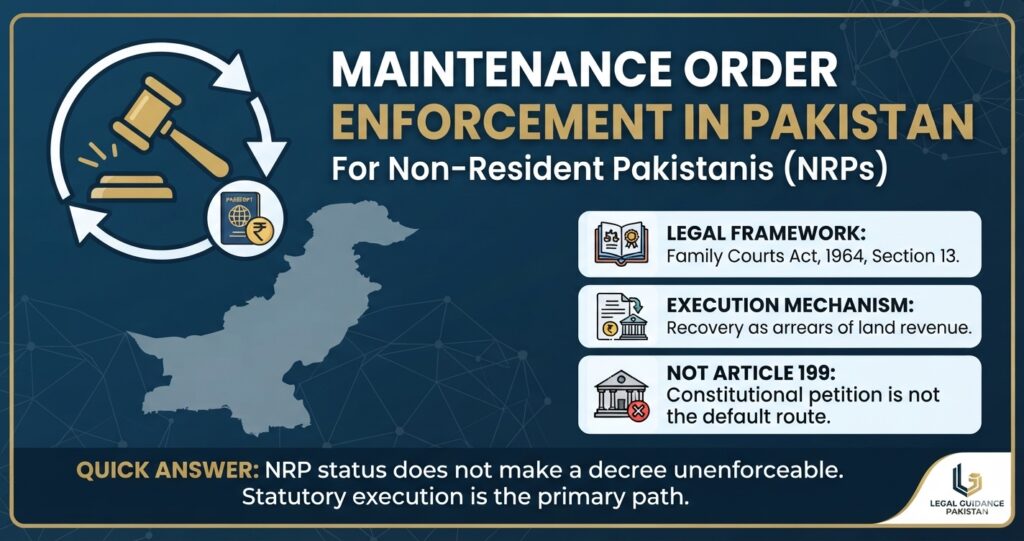
The fact that the judgment-debtor is a non-resident Pakistani (NRP) may create practical difficulties—particularly where the person’s assets and income are outside Pakistan—but it does not, by itself, replace the statutory execution process with a constitutional petition under Article 199.
A High Court’s constitutional jurisdiction under Article 199 is not an automatic substitute for execution proceedings before the competent Family Court. Pakistani case law also demonstrates that where an adequate statutory remedy exists, a constitutional petition may not be maintainable.
Accordingly, a person seeking unpaid maintenance should ordinarily begin by examining the Family Court decree, the execution mechanism available under Section 13, and the judgment-debtor’s assets or recoverable interests within Pakistan.
What the Law Says
Section 13 of the Family Courts Act, 1964
The Family Courts Act, 1964 extends throughout Pakistan and establishes the statutory framework governing Family Courts. The current Pakistan Code text identifies the Act as W.P. Act XXXV of 1964.
Section 13 deals specifically with enforcement of decrees.
Where a decree concerns payment of money and the decretal amount is not paid within the period specified by the Court—subject to the statutory maximum—the Act provides a mechanism for recovery as arrears of land revenue if the Family Court so directs. It further provides that the decree is to be executed by the Court that passed it or by another Civil Court where the District Judge directs execution.
This statutory provision is particularly important when discussing maintenance enforcement because it means that enforcement should not ordinarily be described as a fresh constitutional proceeding merely because the judgment-debtor has defaulted.
The Supreme Court on execution of maintenance decrees
In Amjad Iqbal v. Mst. Nida Sohail and others, 2015 SCMR 128, the Supreme Court considered execution of a maintenance decree under the Family Courts Act.
The case concerned a maintenance decree followed by execution proceedings. The Supreme Court explained that the technical execution machinery of the CPC does not simply govern Family Court maintenance execution because Section 17 of the Family Courts Act excludes the application of the CPC, subject to the statutory exceptions. The Court recognised the Family Court’s statutory power under Section 13(3) to execute a money decree by adopting the modes available for recovery of arrears of land revenue.
The judgment also upheld attachment of immovable property in the circumstances of that case. It therefore provides substantially stronger authority for discussing enforcement of a maintenance decree than cases concerning only the assessment of interim maintenance.
Does Living Abroad Prevent Enforcement?
Not necessarily.
An NRP’s residence outside Pakistan and the location of assets are separate questions from the existence of the Pakistani maintenance decree.
Where the judgment-debtor has property or other interests capable of being reached through Pakistani execution proceedings, the decree-holder may seek appropriate relief from the competent executing court under the applicable statutory framework.
However, the available authorities reviewed for this article do not establish a general proposition that every Pakistani maintenance decree can automatically be enforced against an NRP’s foreign salary, foreign bank account or foreign property merely because the decree was issued in Pakistan.
Enforcement against assets situated outside Pakistan may raise additional questions concerning the law and enforcement procedures of the country where those assets are located. The appropriate procedure therefore depends on the foreign jurisdiction and the nature of the asset.
Why Article 199 Should Not Be Presented as the Normal Execution Route
Article 199 gives the High Courts constitutional jurisdiction in specified circumstances. It is not, however, a general statutory substitute for execution proceedings.
This distinction matters because a Family Court decree may have its own statutory execution mechanism.
In Naveed Ahmed v. Family Judge, Panjgur and another, 2023 CLC 1489, the Balochistan High Court considered a constitutional petition concerning an execution order of a Family Court. The Court held that where the Family Courts Act provided an adequate statutory appellate remedy, the petitioner could not bypass that remedy simply by invoking Article 199. The judgment expressly treated the statutory remedy and constitutional jurisdiction as non-concurrent in those circumstances.
Accordingly, an article should not tell a reader that:
“When a maintenance order is ignored, simply file a writ petition under Article 199.”
That formulation is too broad.
The legally safer formulation is that the appropriate execution or appellate remedy must first be determined under the Family Courts Act and the circumstances of the particular case.
What If the Maintenance Order Is Only an Interim Order?
This distinction is particularly important.
Several of the cases cited in the original draft concern interim maintenance, rather than execution of a final maintenance decree.
Dr. Aqueel Waris v. Ibrahim Aqueel Waris
In Dr. Aqueel Waris v. Ibrahim Aqueel Waris, 2020 CLC 131, the Islamabad High Court considered a constitutional petition challenging an interim maintenance order concerning a minor.
The petitioner was a doctor settled and working in Ireland. The judgment records competing evidence concerning his overseas employment and income and discusses the principles relevant to fixing interim maintenance. The Court ultimately held that the adequacy or inadequacy of interim maintenance involved factual inquiry and could not ordinarily be determined through constitutional jurisdiction in that manner.
This case is therefore useful for explaining that overseas employment may be relevant evidence when maintenance is assessed, but it should not be cited as authority for a general proposition that an Article 199 petition is the ordinary mechanism for enforcing a final maintenance decree against an NRP.
Muhammad Touseeq Danial Bhatti v. Ayesha Naeem
In Muhammad Touseeq Danial Bhatti v. Ayesha Naeem and others, W.P. No. 1780 of 2020, reported as 2021 MLD 337, the Islamabad High Court dealt with a constitutional petition challenging an interim maintenance order. The Court’s discussion concerned the maintainability of constitutional proceedings against an interlocutory Family Court order.
Again, this is not authority for a proposition that Article 199 is the normal mechanism for executing an unpaid final maintenance decree against an NRP.
Enforcement of a Final Maintenance Decree
Where a final maintenance decree has been passed and payment is not made, the starting point should be the execution provisions of the Family Courts Act, 1964.
Section 13 provides that:
- the Family Court passes the decree;
- a money decree may be subject to recovery as arrears of land revenue where the statutory requirements are satisfied and the Court so directs;
- execution is undertaken by the Family Court or another Civil Court as directed under the Act; and
- the Family Court may direct payment by instalments.
The Supreme Court’s decision in Amjad Iqbal demonstrates that execution of a maintenance decree can involve recovery against property in appropriate circumstances. The Court upheld attachment of immovable property in the circumstances before it.
This provides a sound basis for discussing property-based execution without asserting that every possible asset can automatically be attached.
Can Pakistani Property Be Attached?
There is judicial authority supporting enforcement of maintenance decrees against property in appropriate circumstances.
In Amjad Iqbal v. Mst. Nida Sohail, the Supreme Court considered execution of a maintenance decree and the attachment of immovable property. The judgment debtor had attempted to transfer the property after the decree, and the executing court dealt with the transaction in the context of execution. The Supreme Court ultimately upheld the attachment in the circumstances of the case.
The important point is therefore:
A Pakistani maintenance decree can, in appropriate circumstances, be executed against property of the judgment-debtor through the statutory execution process.
The precise asset, ownership position, prior transfer, encumbrances and applicable execution procedure must be examined in the individual case.
Can a Salary Be Attached?
There is historical Sindh High Court authority concerning execution of a Family Court maintenance decree through attachment of salary.
In Parwaiz Ahmed v. District Judge, West Karachi and others, 1987 CLC 1277, the proceedings arose from execution of a Family Court money decree for maintenance, including an order concerning attachment of a portion of the judgment-debtor’s salary.
However, the fact that older case law considered salary attachment does not justify stating that every NRP’s foreign salary can automatically be garnished through a Pakistani Family Court.
A foreign employer and foreign salary ordinarily raise questions beyond the territorial operation of a Pakistani execution order. The specific enforcement mechanism must therefore be established from the applicable law and facts.
What About a Foreign Bank Account or Foreign Property?
The original article went too far in stating that a Pakistani High Court may simply freeze an NRP’s foreign bank account or execute against foreign assets.
The authorities verified for this article do not establish such a general proposition.
A Pakistani decree-holder should distinguish between:
- assets situated in Pakistan;
- income or employment situated in Pakistan;
- assets situated outside Pakistan; and
- income paid by an employer outside Pakistan.
The first category may fall within the domestic execution framework, subject to the applicable law and court orders.
The latter categories may require additional proceedings or recognition/enforcement mechanisms in the foreign jurisdiction concerned.
The precise procedure should therefore be confirmed for the relevant country before publication of any jurisdiction-specific guidance.
Can the Court Seize the NRP’s Passport?
No general passport-seizure rule has been verified.
The original article stated that a Pakistani court may issue a passport-seizure order where the NRP has no Pakistani assets.
I have removed that proposition from the verified article because the authorities reviewed do not establish a general statutory power under Section 13 of the Family Courts Act, 1964 allowing a Family Court automatically to seize or confiscate a judgment-debtor’s Pakistani passport merely because maintenance remains unpaid.
Similarly, Article 199 should not be presented as an automatic passport-seizure mechanism.
Restrictions concerning passports, travel, the Exit Control List and related executive authorities involve separate legal questions and should not be conflated with ordinary execution of a Family Court maintenance decree.
A case involving travel restrictions in a guardianship context demonstrates that such relief can raise distinct statutory and jurisdictional questions; it does not establish a universal maintenance-passport rule.
Accordingly, a Pakistani legal-content article should not tell readers to “request passport seizure” as a standard step in maintenance execution unless a specific current statutory or judicial authority supporting that remedy has been identified.
Evidence Concerning an NRP’s Overseas Income
Evidence of overseas employment and income can be relevant to maintenance proceedings.
In Dr. Aqueel Waris, the Islamabad High Court considered evidence concerning the petitioner’s employment and salary in Ireland when examining the interim maintenance dispute. The judgment records salary information, employment evidence and financial material placed before the Family Court.
The practical lesson is narrower than the original article suggested:
Where the amount of maintenance is disputed, reliable evidence of the respondent’s financial circumstances may be relevant to the Family Court’s assessment.
This does not mean that an overseas salary automatically determines the amount payable in Pakistan.
Practical Procedure for a Maintenance Decree Holder
The precise procedure depends upon the decree and the execution circumstances, but the following sequence reflects the verified statutory framework without inventing additional procedural requirements.
1. Obtain the decree
Keep the Family Court’s decree and relevant order in certified form and confirm the decretal amount, payment terms and any increase expressly provided by the Court.
2. Determine whether the amount has become payable
Review the payment schedule and calculate the unpaid decretal amount from the court record.
3. Identify assets or recoverable interests in Pakistan
Where the judgment-debtor has identifiable property or other interests within Pakistan, collect reliable documentary evidence concerning ownership and location.
4. Initiate execution before the competent forum
Section 13 provides for execution by the Family Court that passed the decree or by another Civil Court where execution is directed in accordance with the Act.
5. Seek an appropriate statutory mode of recovery
Where applicable, the decree-holder may seek recovery in accordance with the mechanisms available under Section 13 and the law governing recovery of arrears of land revenue.
6. Consider constitutional jurisdiction only where legally appropriate
If an issue arises that genuinely engages the High Court’s constitutional jurisdiction, the maintainability of an Article 199 petition must be assessed in light of the statutory remedies available under the Family Courts Act.
A constitutional petition should not simply be treated as an alternative execution application.
Documents and Evidence That May Matter
The exact requirements depend upon the proceedings, but useful material may include:
- the Family Court decree;
- relevant interim or final maintenance orders;
- the execution record, where proceedings have already commenced;
- evidence of unpaid maintenance;
- documents identifying property owned by the judgment-debtor in Pakistan;
- reliable evidence concerning the judgment-debtor’s financial circumstances where relevant to the underlying maintenance dispute; and
- documents relevant to any objection raised by the judgment-debtor.
The court may determine what additional evidence is required in the circumstances of the particular case.
Common Mistakes to Avoid
Treating Article 199 as the ordinary execution mechanism
The Family Courts Act contains specific execution provisions. Constitutional jurisdiction should not automatically replace those statutory remedies.
Citing an interim-maintenance case as an execution case
Cases such as Dr. Aqueel Waris and Muhammad Touseeq Danial Bhatti concern constitutional challenges to interim maintenance orders. They should not be presented as authority for general execution of final maintenance decrees against NRPs.
Assuming foreign income can automatically be recovered in Pakistan
Evidence of foreign employment is different from legal authority to execute against foreign income.
Assuming passport seizure is automatic
No general passport-seizure remedy has been verified under the statutory provisions relied upon in this article.
Treating CPC execution procedure as automatically applicable
Section 17 of the Family Courts Act contains specific rules concerning the application of the CPC to Family Court proceedings. The Supreme Court in Amjad Iqbal specifically addressed this issue in the context of maintenance execution.
Giving a fixed enforcement timeline
The time required for execution depends upon the nature of the decree, objections, assets, service, court workload and other circumstances. No universal 30–60 day or 2–4 month timetable should be represented as Pakistani law without a specific authoritative basis.
Practical Checklist
Before pursuing enforcement of a Pakistani maintenance decree against a person living abroad, consider whether you have:
- A copy of the relevant Family Court decree.
- The relevant payment schedule.
- A calculation of unpaid decretal amounts.
- Evidence identifying Pakistani assets, where available.
- Documents concerning ownership of those assets.
- Relevant evidence concerning the judgment-debtor’s financial circumstances.
- The appropriate execution forum identified.
- Advice on whether any separate constitutional issue genuinely arises.
- Country-specific advice if enforcement against foreign assets or income is contemplated.
Frequently Asked Questions
Can a Pakistani maintenance order be enforced if the husband or father lives abroad?
Potentially, yes. Residence abroad does not itself extinguish a Pakistani maintenance decree. The principal domestic mechanism for execution of a Family Court money decree is Section 13 of the Family Courts Act, 1964. The practical scope of enforcement will depend, among other things, upon assets or interests that can lawfully be reached through the applicable Pakistani or foreign enforcement mechanism.
Is Article 199 the normal way to enforce a maintenance decree against an NRP?
No such general rule has been established by the authorities reviewed. Section 13 provides a specific statutory execution framework, and constitutional jurisdiction under Article 199 is subject to its own requirements, including the availability of an adequate alternative remedy.
Can a Pakistani Family Court execute a maintenance decree against property in Pakistan?
Yes, Pakistani case law recognises execution against property in appropriate circumstances. In Amjad Iqbal v. Mst. Nida Sohail, 2015 SCMR 128, the Supreme Court upheld attachment of immovable property in the execution of a maintenance decree in the circumstances of that case.
Can an NRP’s foreign salary automatically be attached by a Pakistani court?
The authorities verified for this article do not establish such a general rule. Evidence of overseas income may be relevant to determining maintenance, but enforcement against income situated outside Pakistan may involve the law and procedures of the foreign jurisdiction concerned.
Can the court automatically seize the NRP’s Pakistani passport because maintenance is unpaid?
No general automatic passport-seizure power has been verified under the Family Courts Act provisions relied upon in this article. Passport or travel restrictions should therefore not be presented as a standard maintenance-execution remedy without identifying a specific current legal authority applicable to the circumstances.
Can a High Court interfere with a Family Court maintenance order?
The answer depends upon the nature of the order and the circumstances. Pakistani case law shows that constitutional jurisdiction is not ordinarily available merely to reconsider factual questions concerning interim maintenance where an adequate statutory remedy exists.
Does an overseas job matter when maintenance is assessed?
It can be relevant evidence concerning financial circumstances. In Dr. Aqueel Waris, the Islamabad High Court considered evidence concerning the petitioner’s employment and income in Ireland in the context of interim maintenance.
What should I do if the judgment-debtor has no identifiable assets in Pakistan?
The available Pakistani execution provisions should first be examined against the actual decree and circumstances. If the relevant assets or income are entirely outside Pakistan, country-specific advice may be necessary concerning recognition and enforcement of the Pakistani judgment in the jurisdiction where those assets are located.
Is there a fixed deadline for enforcing a maintenance decree?
No universal execution period has been established for this article. Any limitation issue should be examined against the applicable law and the specific decree and proceedings rather than stated as a generic fixed deadline.
Final Takeaway
A Pakistani Family Court maintenance decree does not become irrelevant merely because the judgment-debtor lives overseas. The starting point for domestic enforcement is Section 13 of the Family Courts Act, 1964, not an assumption that Article 199 automatically converts the matter into a constitutional enforcement proceeding.
The Supreme Court’s decision in Amjad Iqbal v. Mst. Nida Sohail, 2015 SCMR 128 provides important authority on execution of maintenance decrees and enforcement against property in appropriate circumstances.
Where the judgment-debtor lives abroad, the crucial practical question is what assets or legally enforceable interests are available in Pakistan and, if enforcement is sought abroad, what additional law applies in the foreign jurisdiction.
Pak Legal Desk
If you have an unpaid Pakistani Family Court maintenance decree and the judgment-debtor is living abroad, Pak Legal Desk can connect you with legal professionals who can review the decree, execution history, available evidence and the location of relevant assets and explain the appropriate legal route.
Where foreign assets or income are involved, the advice should be tailored to the jurisdiction in which those assets or income are situated.
References
Primary Legislation
Family Courts Act, 1964 (W.P. Act XXXV of 1964). Pakistan Code, Ministry of Law and Justice. The official Pakistan Code publication identifies the Act and its application throughout Pakistan.
Supreme Court of Pakistan
Amjad Iqbal v. Mst. Nida Sohail and others, Constitutional Petition No. 989 of 2014, decided 9 September 2014, reported as 2015 SCMR 128. The case concerns execution of a maintenance decree and attachment of immovable property.
Islamabad High Court
Dr. Aqueel Waris v. Ibrahim Aqueel Waris, W.P. No. 1475 of 2019, decided 31 May 2019, reported as 2020 CLC 131. The case concerns an interim maintenance order and evidence concerning the petitioner’s employment and income in Ireland.
Muhammad Touseeq Danial Bhatti v. Ayesha Naeem and others, W.P. No. 1780 of 2020, decided 25 August 2020, reported as 2021 MLD 337 / 2021 PLJ Islamabad 172. The case concerns constitutional challenge to an interim maintenance order.
Nosheen Agha v. Additional District Judge, etc., W.P. No. 3608 of 2013, decided 2 December 2014. The case concerns maintenance proceedings and an interim maintenance order; it is not relied upon here as authority for NRP enforcement.
Other Judicial Authority
Naveed Ahmed v. Family Judge, Panjgur and another, 2023 CLC 1489, Balochistan High Court. The judgment addresses execution proceedings and the relationship between the statutory appellate remedy under the Family Courts Act and Article 199 constitutional jurisdiction.
Parwaiz Ahmed v. District Judge, West Karachi and others, 1987 CLC 1277, Sindh High Court. The reported case concerns execution of a Family Court maintenance decree and salary attachment.
Legal Information Disclaimer
This article provides general legal information based on the Pakistani statutory and judicial sources identified above. It is not a substitute for advice on a particular maintenance decree, execution proceeding, foreign asset, foreign employer or foreign jurisdiction. The appropriate remedy depends upon the wording and status of the decree, the location and nature of the judgment-debtor’s assets, the applicable procedural law and the facts of the individual case.