
Quick Answer
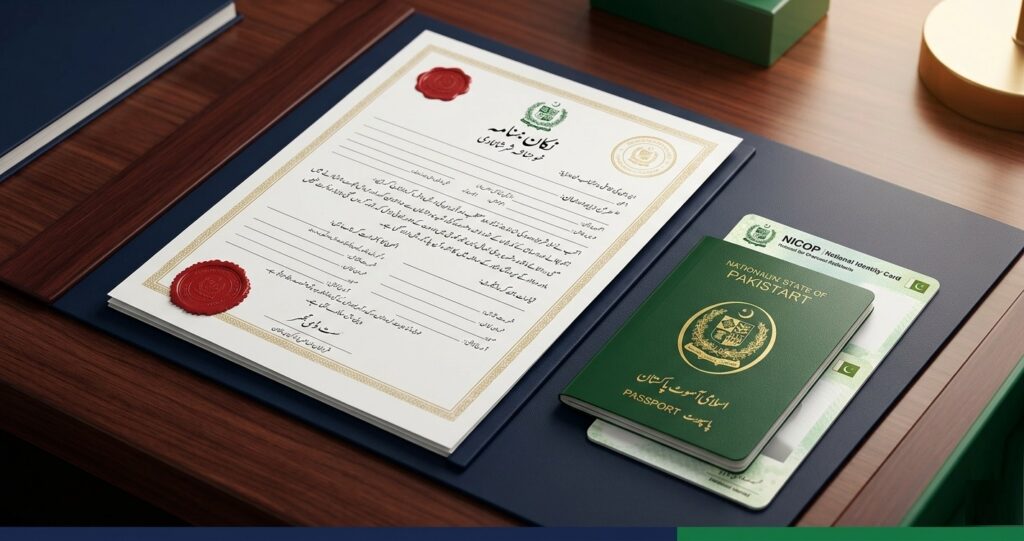
Overseas Pakistanis who execute or contract a marriage abroad must undergo a multi-step attestation and registration procedure for their marriage contract (Nikahnama) to be legally recognised in Pakistan. The core legal requirements entail:
-
Executing the Nikahnama with required signatures and witnesses under applicable Islamic and local laws.
-
Attestation of the document by the relevant Pakistani Embassy or Consulate General in the country of execution.
-
Final counter-attestation and verification by the Ministry of Foreign Affairs (MoFA) in Islamabad or its provincial headquarters in Pakistan.
-
Official entry into the local administrative records via the Union Council / Municipal Authority to secure a computerized NADRA Marriage Registration Certificate (MRC).
Failure to satisfy this chain of verification can render marital clauses—including dower (Mahr) enforcement, inheritance claims, and divorce rights—vulnerable to challenge in Pakistani courts.
What the Law Says
The legal framework governing Muslim marriages, registration obligations, and document authentication for Pakistani nationals includes the following primary statutes and procedural rules:
-
Muslim Family Laws Ordinance, 1961 (MFLO): Section 5 mandates that every marriage solemnised under Muslim Law shall be registered in accordance with the prescribed rules. Non-registration does not automatically invalidate a Nikah solemnised per Islamic rites, but it deprives the parties of conclusive administrative proof required by state institutions.
-
Diplomatic and Consular Officers (Oaths and Fees) Act, 1948: Authorises Pakistani diplomatic and consular officers abroad to administer oaths, take affidavits, and perform official attestations on documents executed outside Pakistan for use within the country.
-
Civil Procedure Code, 1908 (Section 78 & Order XXVI): Outlines the evidentiary value of foreign official documents and procedural requirements for court recognition of documents attested by diplomatic channels.
-
NADRA Marriage Registration Rules: Governs the issuance of the Computerised National Identity Card (CNIC/NICOP) record updates and standard Computerised Marriage Registration Certificates following registration at the local Union Council level.
Who Does This Apply To?
This authentication and registration process applies to:
-
Pakistani citizens residing abroad who execute a Nikahnama outside Pakistan.
-
Dual Pakistani nationals who wish to ensure their foreign-executed marriage is recognised under Pakistani family law.
-
Couples seeking to update their legal status with NADRA, apply for family visas, process inheritance, or enforce contractual rights (such as Mahr) within the jurisdiction of Pakistani Family Courts.
Step-by-Step Practical Procedure
Required Documents
To complete consular attestation and subsequent verification, applicants must generally present:
| Document | Requirement Details |
| Original Marriage Contract | Complete original Nikahnama or formal marriage certificate issued by an authorised body. |
| National Identification | Original and valid copies of CNIC / NICOP / Smart Card for both husband and wife. |
| Passports | Valid Pakistani or foreign passports of both spouses. |
| Witness Identification | Copies of identity documents of the two adult witnesses who signed the contract. |
| Consular Form & Fee Receipt | Duly filled diplomatic attestation form accompanied by proof of paid fee. |
Timelines & Official Fees
-
Pakistani Embassy / Consulate Attestation: Processing times typically range from same-day services to 3–5 working days, depending on the consular post’s appointment and walk-in schedules. Fees vary by jurisdiction based on official diplomatic fee schedules (typically charged in local foreign currency equivalent).
-
MoFA Counter-Verification (Pakistan): Generally processed within 1 to 3 working days via standard counter submission or authorised courier channels at MoFA offices.
-
Union Council Processing: Issuance of the computerized NADRA Marriage Certificate usually takes 3 to 10 working days following verified submission and payment of local municipal registration fees.
Note: Administrative and consular fee schedules are subject to periodic regulatory updates by the Ministry of Foreign Affairs and local government authorities.
Common Mistakes to Avoid
-
Relying Solely on Local Foreign Notarisation: A foreign local notary public stamp is insufficient for Pakistani legal administrative recognition; diplomatic chain-attestation via the Pakistani Embassy and MoFA is legally necessary.
-
Ambiguous Dower (Mahr) Columns: Leaving the Mahr column blank, writing ambiguous terms, or failing to differentiate clearly between prompt (Muarjal) and deferred (Muwajjal) dower can result in costly evidentiary disputes in Family Courts.
-
Missing or Unverified Witness Details: Incomplete witness entries, missing national ID references, or lack of signatures on primary pages may lead to immediate rejection by consular officers or Union Council registrars.
-
Discrepancy in Official Names/CNIC Numbers: Variations between the names printed on the Nikahnama and those appearing on national identity documents (CNIC/NICOP/Passport) delay registration until rectified.
Practical Compliance Checklist
-
[ ] Verify that all columns of the Nikahnama (especially dower, conditions, and witness details) are fully populated and signed.
-
[ ] Confirm both parties hold valid, unexpired national identity cards (NICOP/CNIC) matching the legal names used in the marriage document.
-
[ ] Schedule an attestation appointment at the appropriate Pakistani Embassy or Consulate in the country of marriage execution.
-
[ ] Obtain official consular attestation stamps and seals on the original contract.
-
[ ] Dispatch the attested original to Pakistan for MoFA counter-attestation in Islamabad or a regional office.
-
[ ] Present MoFA-verified documents to the local Union Council for official registry entry and NADRA Marriage Certificate issuance.
Frequently Asked Questions
What is the distinction between Embassy Attestation and MoFA Verification?
Embassy attestation confirms the authenticity of the signatures and execution of the document within the overseas jurisdiction. MoFA counter-verification in Pakistan confirms that the embassy’s seal and signature are genuine, enabling domestic government bodies and Family Courts to accept the document as authentic under Pakistani administrative law.
Can a foreign civil marriage certificate be attested at a Pakistani Embassy?
Yes. If an overseas Pakistani contracts a civil marriage under foreign law (e.g., in the UK, USA, or Canada), the local civil marriage certificate must first be apostilled or authenticated by the host country’s foreign ministry before being presented to the Pakistani Embassy for consular attestation.
What happens if an overseas Nikahnama is not attested or registered?
While non-registration does not automatically invalidate an otherwise valid Islamic Nikah, an unverified or unregistered document lacks conclusive evidentiary status under administrative law. Courts may refuse to rely upon an unattested Nikahnama in disputes concerning maintenance, dower recovery, custody, or legal inheritance.
Is an English translation required for registration in Pakistan?
If the original foreign marriage certificate or Nikahnama is in a language other than Urdu or English, an official, certified translation into Urdu or English is required prior to attestation by MoFA and submission to the Union Council.
Final Takeaway
For Overseas Pakistanis, proper chain-attestation—starting from the Pakistani diplomatic mission abroad, passing through the Ministry of Foreign Affairs in Pakistan, and terminating at the local Union Council—is the only recognized legal pathway to ensure a foreign marriage is fully enforceable and officially registered in Pakistan. Completing this process prevents future administrative blockages with NADRA and secures enforceable legal rights under Pakistani family laws.
How Pak Legal Desk Can Help
Navigating international legal document authentication, consular procedures, and Union Council registrations can be complex when managing affairs across jurisdictions.
Pak Legal Desk provides professional legal verification, documentation assistance, and court representation services for Overseas Pakistanis. Whether you require guidance on drafting a Nikahnama, resolving registration delays, or managing family court proceedings in Pakistan, our experienced legal team is here to assist.
[Contact Pak Legal Desk for Professional Family Law Assistance]
References
-
Muslim Family Laws Ordinance, 1961 (Act VIII of 1961), Section 5 — Registration of Marriages.
-
Diplomatic and Consular Officers (Oaths and Fees) Act, 1948 (Act XXI of 1948) — Statutory provisions for consular attestation and official authentication of foreign documents.
-
Ministry of Foreign Affairs (MoFA), Government of Pakistan — Consular Affairs & Document Attestation Directives.
-
National Database and Registration Authority (NADRA) — Marriage Registration Certificate (MRC) Guidelines & Administrative Regulations.
Legal Information Disclaimer
The information provided in this article is for general educational and informational purposes only and does not constitute formal legal advice. Legal procedures, administrative fees, and documentation requirements are subject to change by relevant legislative bodies and government authorities. Overseas Pakistanis should consult a qualified legal practitioner or contact the relevant diplomatic mission for advice tailored to their specific legal circumstances.