

Quick Answer
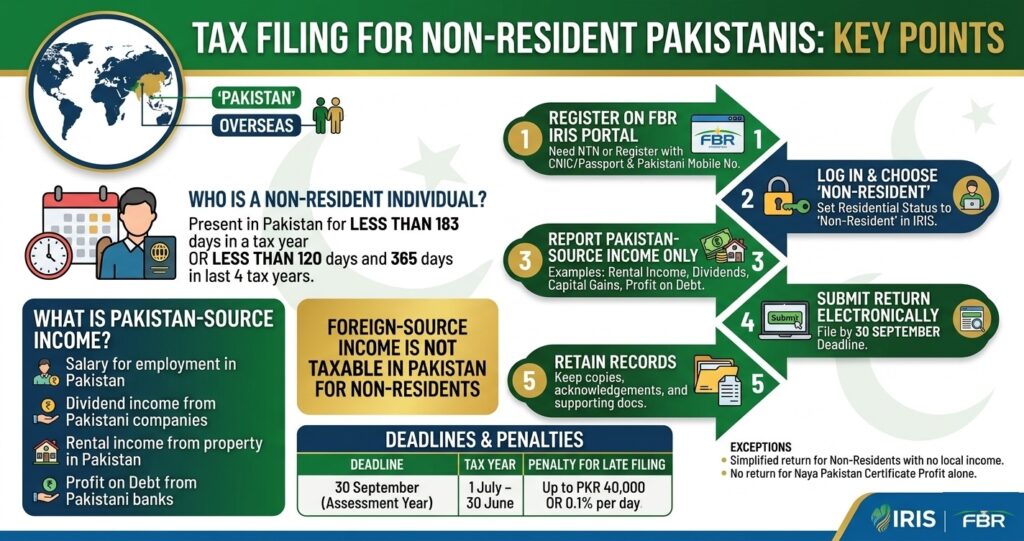
A non-resident Pakistani is required to file an income tax return with the Federal Board of Revenue (FBR) if they earn Pakistan-source income. The standard filing deadline is 30 September of the assessment year (the tax year runs from 1 July to 30 June). A non-resident is chargeable to tax in Pakistan only to the extent of Pakistan-source income — foreign-source income is not taxable in Pakistan for a non-resident.
What the Law Says
The taxation of individuals in Pakistan is governed by the Income Tax Ordinance, 2001. The Ordinance establishes a residence-based system: a resident person is chargeable to tax on both Pakistan-source and foreign-source income, while a non-resident person is chargeable only on Pakistan-source income.
Definition of a Non-Resident Individual
Under Section 82 of the Income Tax Ordinance, 2001, an individual is a resident for a tax year if:
-
They are present in Pakistan for 183 days or more in the tax year; or
-
They are present in Pakistan for 120 days or more in the tax year and have been present for 365 days or more in the preceding four tax years; or
-
They are an employee or official of the Federal Government or a Provincial Government posted abroad in the tax year.
Any individual who does not meet these criteria is a non-resident for that tax year.
For the purposes of determining residency, a tax year in Pakistan is the 12-month period ending on 30 June.
Pakistan-Source Income
Under Section 101 of the Income Tax Ordinance, 2001, Pakistan-source income for a non-resident includes:
-
Salary received for employment exercised in Pakistan, regardless of where payment is made; or paid by the Federal, Provincial or Local Government, even if duties are performed abroad.
-
Business income attributable to a permanent establishment in Pakistan, or linked to business activities in Pakistan, including significant economic presence.
-
Dividend income paid by a resident company.
-
Profit on debt paid by a resident person (except where the loan is used for a business outside Pakistan) or borne by a non-resident’s permanent establishment in Pakistan.
-
Royalty income paid by a resident person (unless used for an overseas permanent establishment) or borne by a non-resident’s permanent establishment in Pakistan.
-
Rental income derived from the lease of immovable property in Pakistan.
-
Capital gains from the sale of immovable property in Pakistan or shares in a resident company.
-
Pension or annuity paid by a resident or borne by a permanent establishment in Pakistan.
Foreign Tax Credit
Under Section 103 of the Income Tax Ordinance, 2001, a resident taxpayer who derives foreign-source income chargeable to tax in Pakistan and has paid foreign income tax may claim a tax credit. The credit is equal to the lesser of:
-
The foreign income tax paid; or
-
The Pakistan tax payable on that income.
However, as noted by the courts, a non-resident is not taxed on foreign-source income, so the foreign tax credit mechanism under Section 103 is primarily relevant to resident taxpayers. The credit must be claimed within the prescribed manner, and evidence of foreign tax paid must be produced.
Who Does This Apply To?
The filing obligation applies to non-resident individuals who have Pakistan-source income. This includes:
-
Overseas Pakistanis who own property in Pakistan and receive rental income.
-
Individuals who hold shares in Pakistani companies and receive dividends.
-
Individuals who have sold immovable property or shares in Pakistan and realised capital gains.
-
Individuals who receive profit on debt from Pakistani bank accounts or investments.
-
Individuals who have a permanent establishment or business connection in Pakistan through which they earn income.
If a non-resident has only foreign-source income and no Pakistan-source income, they are generally not required to file a return solely on that basis. However, holding a National Tax Number (NTN) or owning certain assets in Pakistan may still trigger a filing obligation under Section 114 of the Income Tax Ordinance, 2001.
Practical Procedure for Filing
The FBR has facilitated online filing for non-resident Pakistanis through the IRIS portal (https://iris.fbr.gov.pk). The process is as follows:
Step 1 – Register on the FBR IRIS Portal
If you do not already have a National Tax Number (NTN), you must register on the FBR’s IRIS portal. In the case of non-resident individuals who do not have a Computerised National Identity Card (CNIC), the passport number is used as the NTN or Registration Number. The registration process requires a valid CNIC or NICOP (National Identity Card for Overseas Pakistanis) and a Pakistani mobile number for OTP verification, although manual verification options may be available.
Step 2 – Log In and Select Non-Resident Status
Once registered, log in to the IRIS portal using your CNIC/NTN and password. Navigate to the income tax return section and correctly declare your residential status as “Non-Resident”. This selection determines which income heads apply to you.
Step 3 – Report Pakistan-Source Income Only
Complete the return by declaring only your Pakistan-source income — such as rental income from property in Pakistan, profit on debt from Pakistani banks, or dividends from Pakistani companies. Foreign-source income is not taxable for a non-resident and should not be included.
Step 4 – Submit the Return
Submit the return electronically before 30 September of the assessment year. The FBR has also introduced a separate form titled “Electronic Return for Non-Resident Having No Source of Income in Pakistan” for non-residents who are required to file a return despite not earning locally.
Step 5 – Retain Records
Retain copies of the filed return, acknowledgement, and supporting documents (such as bank statements, tenancy agreements, and dividend vouchers) for audit purposes.
Deadlines
| Category | Filing Deadline |
|---|---|
| Individuals (including non-residents) | 30 September of the assessment year |
| Companies | 31 December |
The tax year in Pakistan runs from 1 July to 30 June. The assessment year deadline for individuals is 30 September following the close of the tax year.
An extension of up to 15 days may be granted by the Commissioner under Section 119 of the Income Tax Ordinance, 2001, on grounds including absence from Pakistan, sickness, or any other reasonable cause. The application for extension must be submitted before the due date.
Penalties for Non-Compliance
Under Section 182 of the Income Tax Ordinance, 2001, failure to furnish a return of income within the due date attracts a penalty equal to 0.1% of the tax payable for each day of default, subject to a maximum penalty of 50% of the tax payable. If the penalty calculated is less than Rs. 40,000 or no tax is payable, a penalty of Rs. 40,000 applies.
Where 75% of income is from salary and the salary income is less than Rs. 5 million, the minimum penalty is Rs. 5,000.
In addition to penalties, default surcharge may be imposed under Section 205 of the Ordinance.
Exceptions
-
Non-resident with no Pakistan-source income: Generally not required to file a return solely on the basis of foreign income.
-
Non-resident individuals: Are generally not required to file a wealth statement under Section 116 unless specifically requested by the Commissioner through a written notice.
-
Naya Pakistan Certificate: Non-residents who earn profit on debt from Naya Pakistan Certificate are not required to file a tax return solely for the declaration of tax deduction on that profit, as the tax is final at 10%.
-
Non-resident with no source of income: A separate simplified return form exists for this category.
Common Mistakes to Avoid
-
Assuming foreign income is automatically exempt: While foreign-source income is not taxable for a non-resident, any Pakistan-source income — even minimal — creates a filing obligation.
-
Failing to register for an NTN: Registration on the IRIS portal is a prerequisite for filing.
-
Missing the 30 September deadline: Late filing triggers a penalty of 0.1% of tax payable per day, with a minimum penalty of Rs. 40,000.
-
Incorrectly selecting residency status: Selecting “Resident” instead of “Non-Resident” in the IRIS portal can expose foreign income to Pakistani tax.
-
Not claiming available foreign tax credits: Where applicable, foreign tax credits under Section 103 can reduce Pakistan tax liability.
-
Ignoring FBR notices: Failure to respond to FBR notices can result in adverse consequences, including enforcement action.
Practical Compliance Checklist
- Confirm your residency status under Section 82 (fewer than 183 days in Pakistan).
- Register on the FBR IRIS portal and obtain an NTN if you do not have one.
- Identify all Pakistan-source income (rent, dividends, profit on debt, capital gains).
- Gather supporting documents (bank statements, tenancy agreements, dividend vouchers).
- Log in to IRIS, select “Non-Resident” status, and complete the return.
- Submit the return before 30 September.
- Pay any tax due through the FBR’s online payment gateway.
- Retain copies of the return, acknowledgement, and supporting documents for at least five years.
Frequently Asked Questions
Q1: Do I need to file a return if I only have foreign income?
A1: If your foreign income is not sourced in Pakistan and you have no Pakistan-source income, you are generally not required to file a return. However, if you hold an NTN or own certain assets in Pakistan, a filing obligation may still arise under Section 114.
Q2: How can I obtain an NTN while living abroad?
A2: You can register on the FBR’s IRIS portal. Non-resident individuals who do not have a CNIC may use their passport number as the NTN or Registration Number.
Q3: What penalties apply for late filing?
A3: The penalty is 0.1% of the tax payable for each day of default, subject to a maximum of 50% of the tax payable. The minimum penalty is Rs. 40,000 (or Rs. 5,000 for salaried individuals with income below Rs. 5 million).
Q4: Can I claim foreign tax paid against my Pakistani tax liability?
A4: Foreign tax credit under Section 103 is available to resident taxpayers. As a non-resident, you are not taxed on foreign-source income, so this credit is generally not applicable to you.
Q5: Do I need to file a wealth statement as a non-resident?
A5: Non-resident individuals are generally not required to file a wealth statement under Section 116 unless specifically requested by the Commissioner through a written notice.
Q6: What is the tax rate on rental income for a non-resident?
A6: Rental income from property in Pakistan is taxable at progressive rates ranging from 0% to 25%, depending on the taxable income level.
Q7: What is the tax rate on dividends for a non-resident?
A7: Dividends paid to non-residents are subject to withholding tax at 15%, or a lower rate if provided under an applicable double taxation agreement.
Q8: Can I file my return without visiting Pakistan?
A8: Yes. The FBR’s IRIS portal allows overseas Pakistanis to file their returns online without visiting Pakistan.
Q9: What happens if I miss the 30 September deadline?
A9: You may apply for an extension under Section 119 before the due date, on grounds such as absence from Pakistan or other reasonable cause. The Commissioner may grant an extension of up to 15 days.
Q10: Is foreign-source salary taxable for a non-resident?
A10: No. A non-resident is chargeable to tax only on Pakistan-source income. Foreign-source salary is not taxable in Pakistan for a non-resident.
Final Takeaway
Non-resident Pakistanis are required to file an income tax return with the FBR if they earn Pakistan-source income. The filing deadline is 30 September each year. The tax liability is limited to Pakistan-source income, and foreign-source income is not taxable. The IRIS portal facilitates online filing, and penalties apply for late filing. Non-residents should correctly declare their residency status and report only Pakistan-source income.
Need Assistance?
If you are a non-resident Pakistani and need guidance on your FBR tax filing obligations, Pak Legal Desk can help. Our team can assist with NTN registration, return preparation, and compliance with FBR requirements. Contact us for a consultation.
References
-
Income Tax Ordinance, 2001 (Pak.). https://download1.fbr.gov.pk/Docs/2015102212102839406IncomeTaxOrdinance,2001latestcoorected16.10.15(updatedJune,2015).docx
-
Federal Board of Revenue. (2026). Section 182: Offences and penalties. https://ipv6.fbr.gov.pk/section-182/152727
-
Federal Board of Revenue. (2026). FAQs on filer rate under section 236C or 236K. https://fbr.gov.pk/overseas-faqs/174240/174248
-
Federal Board of Revenue. (2026). Frequently Asked Questions and Answers for Overseas Pakistanis. https://download1.fbr.gov.pk/Docs/2025731875237917FAQs.pdf
-
Federal Board of Revenue. (n.d.). FBR Issues Clarification on News Item – Authorities faces legal challenge on tax concession for Naya Pakistan Certificate. https://fbr.gov.pk/fbr-issues-clarification-on-news-item–authorities-faces-legal-challenge-on-tax-concession-for-naya/152638
-
KPMG. (2020). Investment in Pakistan. https://assets.kpmg.com/content/dam/kpmg/pk/pdf/2020/01/Investment%20in%20Pakistan.pdf
-
PwC. (2026). Pakistan – Individual – Residence. https://taxsummaries.pwc.com/pakistan/individual/residence
-
BDO. (2023). Expatriates Pakistan Tax Facts for International Assignees. https://www.bdo.global/getmedia/59e57e63-326e-4013-804e-1368a0c438cc/Pakistan-Tax-Facts-Country-Expatriates-2023.pdf
-
ECOVIS International. (2025). Tax Guide Pakistan. https://global.ecovis.com/pakistan/tax-guide/
-
OECD. (n.d.). Information on Tax Identification Numbers – Pakistan. https://www.oecd.org/content/dam/oecd/en/topics/policy-issue-focus/aeoi/pakistan-tin.pdf
-
RegFollower. (2025). Pakistan issues income tax return notifications for 2025. https://regfollower.com/pakistan-issues-income-tax-return-notifications-for-2025/
-
PKRevenue. (2025). FBR Defines Pakistan-Source Income Rules for Tax Year 2026. https://pkrevenue.com/fbr-explains-geographical-source-of-income-for-tax-year-2026/
-
PKRevenue. (2026). How to get Tax Year 2026 return filing extension under Section 119. https://pkrevenue.com/tax-year-2026-return-filing-extension-section-119/
-
Courting The Law. (2020). Impact of COVID-19 on Individuals’ Tax Residency Status. https://courtingthelaw.com/2020/06/16/commentary/impact-of-covid-19-on-individuals-tax-residency-status/
-
ICAP. (2026). Budget Proposals 2026-27: Seeking Wealth Statement by the Commissioner u/s 116(1). https://icap.org.pk/view/?add=per/budgetproposals/&file=ICAPBudgetProposals2026-27.pdf
-
Global Property Guide. (2025). Guide to Property Taxes in Pakistan. https://www.globalpropertyguide.com/asia/pakistan/taxes-and-costs
Legal Information Disclaimer
This article is provided for educational purposes only and does not constitute legal advice. The information is based on the Income Tax Ordinance, 2001, and official FBR guidance as available at the date of publication. Tax laws and procedures are subject to change. Readers should consult a qualified legal practitioner or tax adviser for advice specific to their circumstances. This article is not a substitute for professional legal consultation. The Pakistan Bar Council Act and applicable professional conduct rules govern the provision of legal services in Pakistan. Pak Legal Desk accepts no liability for any loss arising from reliance on the information contained herein.