

Quick Answer
A non-resident Pakistani (NRP) can file a civil suit in Pakistan without being physically present. The suit is filed through a licensed advocate enrolled with a provincial Bar Council, who acts as the plaintiff’s authorised representative before the district court having territorial and pecuniary jurisdiction. The plaint must comply with Order VII of the Code of Civil Procedure, 1908 (CPC), which governs its contents, return, and rejection. Service of summons on a defendant residing abroad is governed by Order V, Rule 25 of the CPC, which permits service through diplomatic channels or by other modes approved by the court. Court fees are payable under the Court Fees Act, 1870, generally on an ad valorem basis for money claims. An NRP does not need to travel to Pakistan to institute or prosecute a civil suit, provided a properly enrolled advocate is engaged and all procedural requirements are satisfied.
What the Law Says
The Governing Statute: Code of Civil Procedure, 1908
All civil proceedings in Pakistan are governed by the Code of Civil Procedure, 1908 (CPC). The CPC applies equally to residents and non-residents; there is no separate procedural regime for NRPs. The relevant provisions for filing a suit are contained in the First Schedule to the CPC, primarily in Orders IV to VII (institution of suits, issue and service of summons, and pleadings).
Order VII — The Plaint
Order VII of the CPC governs the plaint, which is the document by which a civil suit is instituted. Order VII, Rule 1 specifies the particulars that a plaint must contain: the name of the court, the names and descriptions of the parties, the facts constituting the cause of action, the facts showing that the court has jurisdiction, the relief claimed, and the amount of court fee paid.
Order VII, Rule 10 provides that the plaint shall be returned at any stage of the suit if the court finds that it does not have territorial or pecuniary jurisdiction, so that it may be presented to the court in which the suit should have been instituted. This provision is mandatory where the court lacks jurisdiction.
Order VII, Rule 11 provides that the plaint shall be rejected in the following cases: (a) where it does not disclose a cause of action; (b) where the relief claimed is undervalued, and the plaintiff fails to correct the valuation within the time fixed by the court; (c) where the relief claimed is properly valued but the plaint is insufficiently stamped, and the plaintiff fails to supply the requisite stamp-paper within the time fixed; (d) where the suit appears from the statement in the plaint to be barred by any law; and (e) where it is not filed in duplicate.
Order V — Issue and Service of Summons
Order V of the CPC governs the issue and service of summons on the defendant. Order V, Rule 25 deals specifically with service where the defendant resides outside Pakistan and has no agent in Pakistan empowered to accept service. In such cases, the summons is addressed to the defendant at the place where he is residing and sent to him by post, or by such other manner as the court directs. Service may also be effected through the Ministry of Foreign Affairs or through a Pakistani diplomatic mission abroad, where the court so orders and the receiving state permits such service.
Court Fees Act, 1870
Court fees on plaints are governed by the Court Fees Act, 1870. Schedule I prescribes ad valorem fees (calculated as a percentage of the value of the subject-matter) for money suits and certain other categories. Schedule II prescribes fixed fees for declaratory suits, injunction suits, and other specified documents. The exact rate varies by province and by the value of the claim. Under Section 4 of the Act, payment of the prescribed fee is a condition precedent to the court receiving or acting upon the plaint.
Legal Practitioners and Bar Councils Act, 1973
The right to practise law in Pakistan is regulated by the Legal Practitioners and Bar Councils Act, 1973. Only advocates enrolled with a provincial Bar Council (or the Islamabad Bar Council) are entitled to appear and act before the courts. An NRP cannot file or prosecute a civil suit personally; a licensed advocate must be engaged to act as the authorised representative.
Who This Applies To
This guide applies to:
-
Pakistani nationals holding a valid Pakistani passport or National Identity Card for Overseas Pakistanis (NICOP), who reside outside Pakistan and wish to institute a civil suit in Pakistan.
-
Persons of Pakistani origin who may not hold current Pakistani identity documents, but who can establish the requisite locus standi through a duly appointed advocate and, where necessary, a power of attorney executed and attested in the country of residence.
-
NRPs pursuing property disputes, recovery of money, specific performance of contracts, declarations of title, permanent or mandatory injunctions, or other civil claims cognisable by a district court in Pakistan.
It does not apply to criminal proceedings, family law matters governed by the Family Courts Act, 1964, or proceedings before specialised tribunals that have their own procedural rules. Those matters have distinct procedural requirements and should be assessed separately.
Practical Procedure
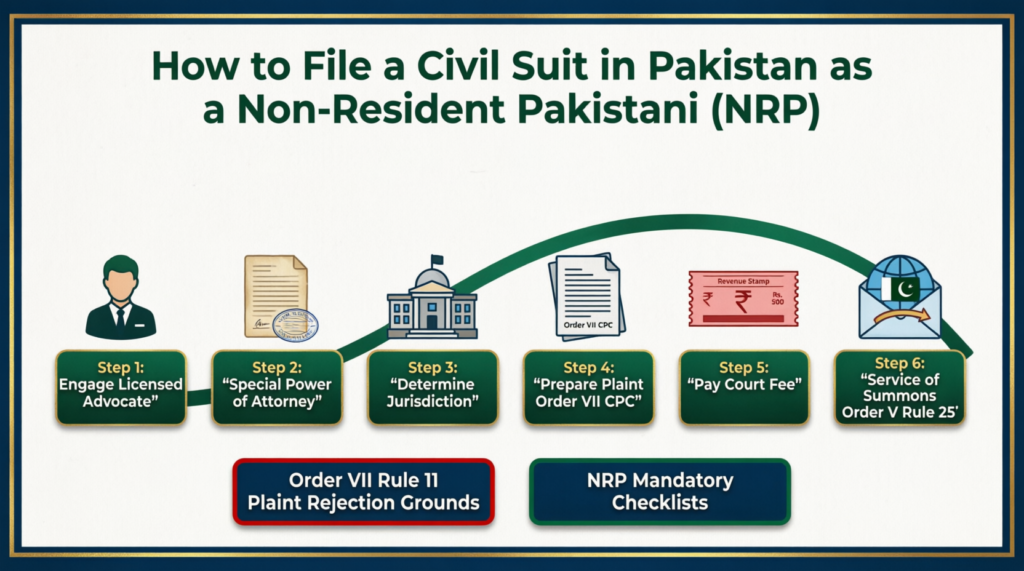
The following is a step-by-step account of the verified procedural steps for filing a civil suit as an NRP.
-
Engage a licensed advocate in Pakistan. The advocate must be enrolled with the relevant provincial Bar Council (or the Islamabad Bar Council) under the Legal Practitioners and Bar Councils Act, 1973. The advocate will act as the NRP’s authorised representative for all purposes before the court.
-
Execute a power of attorney, where required. If the advocate is to sign the plaint and pleadings on the plaintiff’s behalf, a special power of attorney is normally required. The power of attorney should be executed before a notary public or Pakistani diplomatic mission in the country of residence, and, where applicable, consularised or apostilled in accordance with the law of that country.
-
Determine the proper court. The suit must be filed in the district court having territorial jurisdiction (where the property is situated, where the cause of action arose, or where the defendant resides, as applicable) and pecuniary jurisdiction (based on the value of the subject-matter).
-
Prepare the plaint. The plaint must be drafted in accordance with Order VII, Rule 1 of the CPC. It must state the cause of action, the parties, the jurisdictional facts, the precise relief claimed, and the court fee paid. All documents relied upon must be listed and, where required, annexed.
-
Pay the court fee. Court fees are calculated and paid under the Court Fees Act, 1870. Payment is made at the court’s fee office. Underpayment may lead to rejection of the plaint under Order VII, Rule 11(b).
-
File the plaint. The plaint is presented before the appropriate district court, along with the court fee and supporting documents. The court will assign a suit number and issue a filing receipt.
-
Service of summons. The court issues summons to the defendant. Where the defendant resides abroad, service is effected under Order V, Rule 25 of the CPC, by post or through such other manner as the court directs, including through diplomatic channels.
-
Defendant’s response. The defendant may enter appearance, file a written statement, raise preliminary objections to jurisdiction or maintainability, or file a counter-claim.
-
Framing of issues and trial. If the suit proceeds, the court will frame issues and set the matter down for trial. Evidence is led by affidavits and oral testimony. The advocate appears on the plaintiff’s behalf at all hearings.
-
Decree and appeal. The court pronounces judgment and draws up a decree. If the NRP is dissatisfied with the decree, an appeal lies to the relevant High Court under the applicable provisions of the CPC and the relevant High Court Rules.
Requirements
The following verified requirements apply to an NRP filing a civil suit in Pakistan.
Engagement of an enrolled advocate. The plaintiff must be represented by an advocate enrolled with a provincial Bar Council or the Islamabad Bar Council under the Legal Practitioners and Bar Councils Act, 1973. The CPC does not permit a non-advocate to appear and plead on behalf of another person before a civil court, except in limited circumstances not applicable to NRPs.
Properly drafted plaint. The plaint must comply with Order VII, Rule 1 of the CPC. It must contain the name of the court, the names and descriptions of the parties, the facts constituting the cause of action, the facts showing jurisdiction, the relief claimed, and the amount of court fee paid.
Court fee payment. The prescribed court fee under the Court Fees Act, 1870 must be paid before the plaint is received or acted upon (Section 4).
Documents relied upon. Order VII, Rule 14 of the CPC requires the plaintiff to produce, at the time of filing the plaint, all documents upon which the plaintiff relies. Documents not produced at that stage are inadmissible at a later stage unless the court grants leave.
Power of attorney. Where the advocate is to sign the plaint and pleadings, a special power of attorney executed and attested in the manner required by law is necessary.
Deadlines
Limitation. Civil suits in Pakistan are subject to the Limitation Act, 1908. The limitation period varies by the nature of the claim: three years for suits for recovery of money, six years for suits for possession of immovable property, three years for suits for declaration, and so on. The period runs from the date on which the cause of action arises. An NRP must be particularly vigilant about limitation, as time continues to run regardless of the plaintiff’s residence abroad.
Appeal from decree. An appeal to the High Court from a decree of a district court must be filed within the period prescribed by the Limitation Act and the applicable High Court Rules. The raw article’s assertion of a uniform “30 days” deadline is not verified as a general rule and has been removed. The applicable period depends on the nature of the decree and the court appealed to.
Fees
Court fees on plaints in Pakistan are governed by the Court Fees Act, 1870. Schedule I prescribes ad valorem fees for money suits and certain other categories, calculated as a percentage of the value of the subject-matter. The rate varies by province and by the value of the claim. Schedule II prescribes fixed fees for declaratory suits, injunction suits, and other specified documents.
The raw article’s assertion that the fee is “typically 1% of the claim value, minimum PKR 2,000” is not verified as a general rule. Court fee rates are set by provincial schedules under the Court Fees Act and have been revised multiple times. NRPs should obtain a current fee calculation from the court’s fee office or from their advocate before filing.
Penalties and Consequences
Rejection of plaint. Under Order VII, Rule 11 of the CPC, the plaint shall be rejected where it does not disclose a cause of action, where the relief is undervalued and not corrected, where the plaint is insufficiently stamped and the stamp-paper is not supplied, where the suit appears from the plaint to be barred by any law, or where it is not filed in duplicate.
Return of plaint. Under Order VII, Rule 10 of the CPC, the plaint shall be returned for presentation to the proper court if the court lacks territorial or pecuniary jurisdiction.
Consequences of non-appearance. If the plaintiff fails to appear, the suit may be dismissed for default. If the defendant fails to appear after proper service, the court may proceed ex parte.
Common Mistakes
The following are verified pitfalls that NRPs should avoid.
Filing without an enrolled advocate. The CPC does not permit a non-advocate to act as agent for another in a civil suit. An NRP cannot file or prosecute a suit personally through an attorney who is not an enrolled advocate.
Incorrect valuation and court fee. Under Order VII, Rule 11(b) and (c), under-valuation or insufficient stamping can lead to rejection of the plaint. The valuation must be correct and the court fee must be fully paid at the time of filing.
Defective plaint. A plaint that omits the cause of action, the jurisdictional facts, or the specific relief claimed, or that is not filed in duplicate, is liable to rejection under Order VII, Rule 11.
Ignoring limitation. The Limitation Act, 1908 applies to all suits, including those filed by NRPs. Delay in filing can result in the suit being dismissed as time-barred.
Failure to serve summons properly. Where the defendant resides abroad, service must be effected in accordance with Order V, Rule 25 of the CPC. Improper service can delay the suit or lead to the decree being set aside.
Practical Compliance Checklist
- □ Engage an advocate enrolled with the relevant provincial Bar Council or the Islamabad Bar Council.
- □ Execute and attest a special power of attorney, where required, in the country of residence.
- □ Confirm the proper district court based on territorial and pecuniary jurisdiction.
- □ Draft the plaint in compliance with Order VII, Rule 1 of the CPC.
- □ List and annex all documents relied upon, as required by Order VII, Rule 14.
- □ Calculate and pay the correct court fee under the Court Fees Act, 1870 at the court’s fee office.
- □ File the plaint in duplicate and obtain the filing receipt.
- □ Ensure summons is served on the defendant in accordance with Order V, Rule 25 if the defendant is abroad.
- □ File the written statement or rejoinder within the time fixed by the court.
- □ Check the limitation period under the Limitation Act, 1908 before filing.
- □ If appealing, file the appeal within the period prescribed by the applicable High Court Rules and the Limitation Act.
Frequently Asked Questions
Can an NRP file a civil suit in Pakistan without travelling to Pakistan?
Yes. An NRP may institute and prosecute a civil suit through an advocate enrolled with a provincial Bar Council. The advocate acts as the plaintiff’s authorised representative. Physical presence in Pakistan is not a procedural requirement under the CPC.
Is a power of attorney necessary for an NRP to file a civil suit?
Where the advocate is required to sign the plaint and pleadings on behalf of the plaintiff, a special power of attorney is normally necessary. The power of attorney should be executed and attested in the country of residence, and, where required, consularised or apostilled.
Which court has jurisdiction over a property dispute in Pakistan?
The district court within whose territorial jurisdiction the property is situated has jurisdiction over a suit relating to that property. Pecuniary jurisdiction is determined by the value of the subject-matter, as prescribed by the relevant provincial law.
How is service of summons effected on a defendant living abroad?
Under Order V, Rule 25 of the CPC, where the defendant resides outside Pakistan and has no agent in Pakistan empowered to accept service, the summons is addressed to the defendant at the place where he is residing and sent by post or in such other manner as the court directs. Service through diplomatic channels may be ordered by the court where the receiving state permits it.
What is the court fee for a civil suit in Pakistan?
Court fees are prescribed by the Court Fees Act, 1870. Ad valorem fees apply to money suits and certain other categories under Schedule I. Fixed fees apply to declaratory and injunction suits under Schedule II. The exact amount depends on the value of the claim and the provincial schedule in force. NRPs should obtain a current calculation from the court’s fee office.
What happens if the plaint does not comply with Order VII of the CPC?
If the plaint does not disclose a cause of action, is undervalued, is insufficiently stamped, is barred by law, or is not filed in duplicate, it is liable to rejection under Order VII, Rule 11. If the court lacks jurisdiction, the plaint is returned under Order VII, Rule 10 for presentation to the proper court.
Can an NRP appeal a district court decree?
Yes. An appeal lies to the relevant High Court from a decree of a district court. The appeal must be filed within the period prescribed by the Limitation Act, 1908 and the applicable High Court Rules. The raw article’s reference to a uniform “30 days” deadline is not verified and should not be relied upon.
Does the Limitation Act, 1908 apply to NRPs?
Yes. The Limitation Act, 1908 applies to all civil suits in Pakistan, regardless of the plaintiff’s residence. The limitation period runs from the date the cause of action arises and is not extended by reason of the plaintiff being abroad.
Can an NRP file a suit through an attorney who is not an enrolled advocate?
No. The Legal Practitioners and Bar Councils Act, 1973 restricts the right to practise law to advocates enrolled with a provincial Bar Council or the Islamabad Bar Council. A non-advocate cannot act as agent for another in a civil suit before a Pakistani court.
What documents must an NRP produce when filing a plaint?
The plaint must be accompanied by all documents upon which the plaintiff relies, as required by Order VII, Rule 14 of the CPC. Where the claim involves a monetary transaction, the plaintiff should be prepared to produce evidence of the transaction, including any foreign exchange remittance records, where relevant.
Final Takeaway
An NRP can file and prosecute a civil suit in Pakistan without being physically present. The procedure is governed by the Code of Civil Procedure, 1908, and the substantive requirements by the Court Fees Act, 1870 and the Limitation Act, 1908. The essential steps are: engage an enrolled advocate, execute a power of attorney where required, determine the proper district court, draft a compliant plaint under Order VII, pay the correct court fee, file the plaint, and ensure proper service of summons on the defendant under Order V, Rule 25 if the defendant is abroad. The most common pitfalls are defective pleadings, incorrect valuation, non-payment of court fee, and limitation. NRPs should obtain current advice from a Pakistani advocate before instituting proceedings.
Pak Legal Desk CTA
If you are a non-resident Pakistani considering a civil suit in Pakistan, Pak Legal Desk can assist you in assessing your case, identifying the proper forum, and engaging a licensed advocate to act on your behalf. A consultation will help you understand the procedural requirements, the likely timeline, and the documents you will need to provide. Civil litigation is subject to strict procedural and limitation requirements; early legal advice can help you avoid costly mistakes.
References
Court Fees Act, 1870 (Act VII of 1870). Government of Pakistan. https://pakistancode.gov.pk/
Code of Civil Procedure, 1908 (Act V of 1908). Government of Pakistan. https://pakistancode.gov.pk/
Legal Practitioners and Bar Councils Act, 1973 (Act XXXV of 1973). Government of Pakistan. https://pakistancode.gov.pk/
Limitation Act, 1908 (Act IX of 1908). Government of Pakistan. https://pakistancode.gov.pk/
Peshawar High Court. (2025). Ali Asghar v. Mst. Farkhanda Rani and another, RFA No. 327-P of 2024. https://www.peshawarhighcourt.gov.pk/
Islamabad High Court. (2019). Ovex Technologies (Private) Limited v. PCM PK (Private) Limited and others, F.A.O. No. 140/2017. https://mis.ihc.gov.pk/
Sindh High Court. (2024). Civil Revisions No. 80 to 83 of 2019. https://caselaw.shc.gov.pk/
Legal Information Disclaimer
This article is provided for general informational and educational purposes only. It does not constitute legal advice and should not be relied upon as a substitute for consultation with a qualified Pakistani advocate. The law in Pakistan is subject to change, and the procedural requirements described in this article may be amended, supplemented, or superseded by subsequent legislation, rules, notifications, or judicial decisions. Nothing in this article creates an advocate-client relationship. Readers should consult an advocate enrolled under the Legal Practitioners and Bar Councils Act, 1973 for advice specific to their circumstances.