

Quick Answer
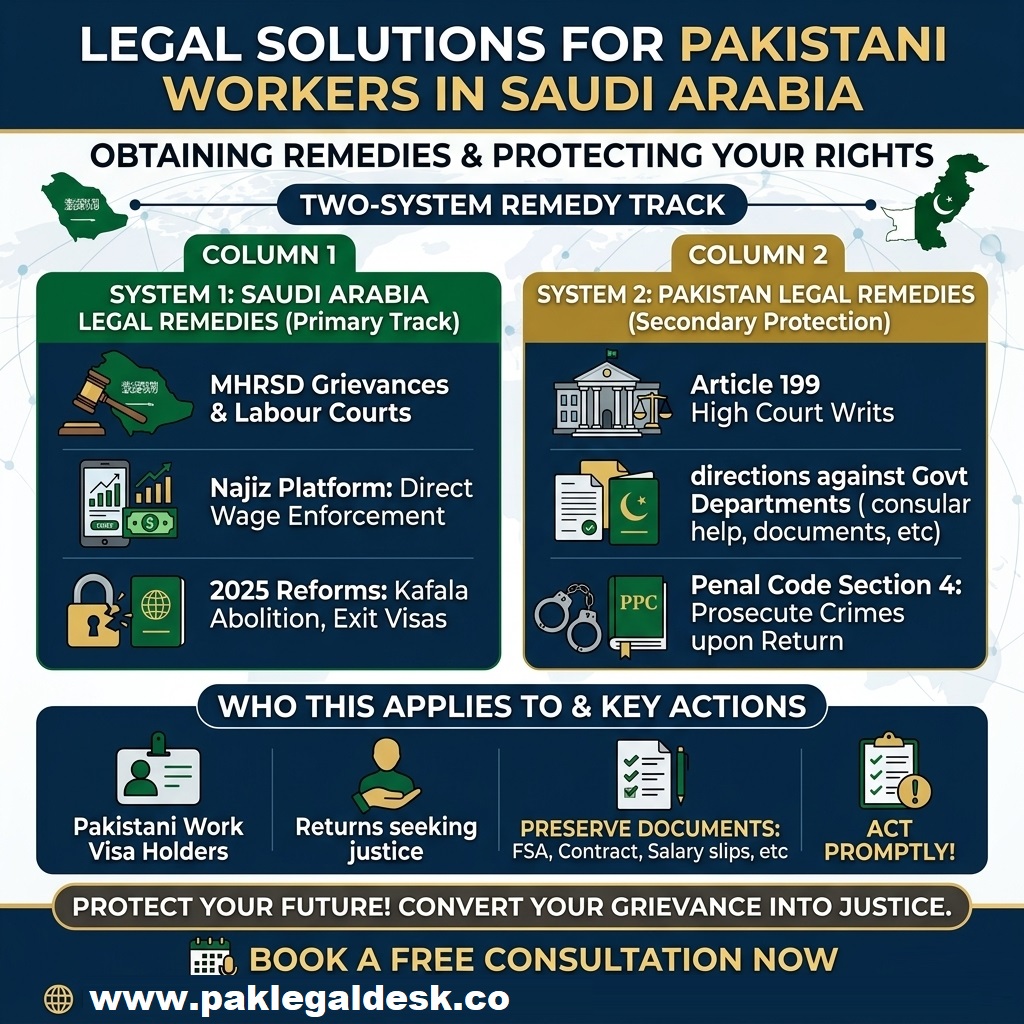
A Pakistani worker employed in Saudi Arabia who faces unpaid wages, passport confiscation, visa cancellation or abuse has two parallel legal systems available. The primary remedy lies within Saudi Arabia through the Ministry of Human Resources and Social Development (MHRSD) and the Saudi labour courts. A secondary layer of protection exists in Pakistan through the High Courts’ writ jurisdiction under Article 199 of the Constitution, which allows overseas workers or their representatives to seek directions against Pakistani government departments for failures such as non-issuance of travel documents, denial of consular assistance or refusal to credit EOBI contributions. Criminal conduct abroad by a Pakistani citizen can also be prosecuted in Pakistan upon return under Section 4 of the Pakistan Penal Code, 1860. The effectiveness of either remedy depends heavily on preserving written employment documentation, maintaining valid immigration status in Saudi Arabia, and acting promptly.
1. What the Law Says
1.1 The Pakistani Constitutional Remedy: Article 199
Article 199 of the Constitution of the Islamic Republic of Pakistan, 1973 empowers a High Court, on the application of an aggrieved party, to issue directions to a person performing functions in connection with the affairs of the Federation or a Province, or to a person within its territorial jurisdiction, for the enforcement of fundamental rights. The High Court may also issue writs of mandamus, prohibition, certiorari, habeas corpus and quo warranto.
For overseas workers, Article 199 is the principal mechanism for challenging administrative inaction or abuse by Pakistani authorities. This includes failures by the Ministry of Overseas Pakistanis and Human Resource Development, the Bureau of Emigration and Overseas Employment, the Overseas Pakistanis Foundation, or the relevant Pakistani diplomatic mission.
1.2 Extra-Territorial Application of the Pakistan Penal Code, 1860
Section 4 of the Pakistan Penal Code, 1860 extends the Code’s application to any offence committed by a citizen of Pakistan in any place outside Pakistan. This means that a Pakistani worker who commits an offence in Saudi Arabia — such as theft, assault or criminal breach of trust — can be prosecuted in Pakistan upon return, in the same manner as if the act had been committed within Pakistan.
The courts have applied this provision in practice. Criminal appeals involving convictions under Section 409 PPC (criminal breach of trust by a public servant or banker) have been heard by the High Courts, with sentences including imprisonment and fines.
1.3 EOBI and Social Security for Overseas Workers
The Employees’ Old-Age Benefits Institution (EOBI) was established by an Act of Parliament in July 1976 to provide long-term social security in the form of pensions and other benefits to retired workers and their dependents. Under the EOBI scheme, both employers and employees contribute to the fund.
The Ministry of Overseas Pakistanis and Human Resource Development has identified the introduction of a pension scheme for overseas Pakistani workers through EOBI as a strategic intervention. However, the practical position is that EOBI contributions are primarily designed for workers employed within Pakistan. The legal framework for extending compulsory EOBI coverage to workers employed abroad is not yet fully operational. Workers who have made voluntary contributions or whose employers have made contributions on their behalf may face administrative difficulties in having those contributions credited, and may need to seek judicial review of EOBI decisions.
1.4 Trade Union Rights for Contract Workers
The Industrial Relations Act, 2012 defines a “worker” or “workman” as a person employed directly or through a contractor for hire or reward, whether the terms of employment are express or implied. The Supreme Court of Pakistan has held that a contract between an employer and a labour contractor cannot be used as a device to deprive contract workers of their legitimate and fundamental right of forming or joining a trade union.
For workers employed by contractors — a common arrangement for Pakistani workers in Saudi Arabia — this principle means that the right to union membership is not extinguished by the interposition of a contractor. However, the practical application of this right abroad is limited, as Pakistani trade unions have no jurisdiction over employers operating in Saudi Arabia.
1.5 Saudi Labour Law Protections
Saudi Arabia’s Labour Law (Royal Decree No. M/51 of 2005, as amended) governs the employment relationship between foreign workers and their Saudi employers. Key protections include:
-
Working hours: A maximum of eight hours per day or 48 hours per week.
-
Overtime: Work performed beyond standard hours must be paid at a rate at least 50% higher than the regular wage.
-
Annual leave: At least 21 days’ paid annual leave, increasing to 30 days after five consecutive years with the same employer.
-
Wage protection: Employers must comply with the Wage Protection System.
-
End-of-service benefits: Workers are entitled to gratuity based on length of service.
The 2025 labour law reforms, which came into force on 19 February 2025, introduced further changes, including increased maternity leave and stricter rules on absenteeism. Separately, Saudi Arabia announced the abolition of the Kafala (sponsorship) system in 2025, allowing workers to apply for exit and re-entry visas electronically and leave the Kingdom without employer approval.
1.6 Wage Enforcement in Saudi Arabia
Saudi Arabia has introduced a direct enforcement mechanism for unpaid wages. Under the documented employment contract initiative, the wage clause is treated as an enforceable instrument. If a worker does not receive full wages within 30 days of the due date, or receives only partial payment after 90 days, the worker may file an electronic execution request directly through the Najiz platform to the Enforcement Court. The employer retains the right to object within five days of notification.
2. Who Does This Apply To?
This guide applies to:
-
Pakistani citizens employed in Saudi Arabia under a work visa.
-
Pakistani workers whose employment is arranged through an Overseas Employment Promoter (OEP) licensed by the Bureau of Emigration and Overseas Employment.
-
Workers who have returned to Pakistan and wish to pursue legal remedies against Pakistani authorities for failures related to their overseas employment.
-
Workers who face criminal allegations arising from conduct in Saudi Arabia and who may be prosecuted in Pakistan upon return.
The guide does not cover:
-
Workers who have acquired the nationality of another country and renounced Pakistani citizenship.
-
Disputes that fall exclusively within the jurisdiction of Saudi courts and have no connection to any Pakistani authority.
-
Workers who entered Saudi Arabia without a valid work visa and are in an irregular immigration status, though some protections may still apply.
3. Practical Procedure
3.1 Step 1: Document Everything Before Departure
Before leaving Pakistan, obtain and preserve:
-
The Foreign Service Agreement (FSA) signed between the worker and the foreign employer or OEP, counter-signed by the Protector of Emigrants.
-
A copy of the Saudi work visa and iqama (residence permit).
-
The employment contract, including terms on wages, working hours and end-of-service benefits.
-
Contact details of the employer and the Saudi labour office in the relevant city.
-
Contact details of the Community Welfare Wing at the Pakistani Embassy in Riyadh or the Consulate General in Jeddah.
3.2 Step 2: Preserve Evidence in Saudi Arabia
While in Saudi Arabia, retain:
-
Monthly salary slips and bank transfer records.
-
Any written communications with the employer regarding wages, working conditions or grievances.
-
A copy of the passport and iqama at all times.
-
Receipts for any expenses incurred as a result of employment (e.g., medical costs, travel).
3.3 Step 3: File a Complaint with the Saudi Ministry of Human Resources and Social Development
For unpaid wages or contractual violations, the first formal step is to file a labour complaint through the MHRSD. The Ministry operates a unified contact centre and an online portal for labour disputes. The complaint should be in Arabic or accompanied by an Arabic translation. Keep a dated copy of the complaint.
If the dispute is not resolved through friendly settlement, the claim may proceed to the competent Labour Court.
3.4 Step 4: Seek Consular Assistance
Contact the Community Welfare Wing at the Pakistani Embassy in Riyadh or the Consulate General in Jeddah. The Welfare Wing facilitates counselling on disputes with sponsors and contractual violations, and may assist in filing suits in Saudi labour courts. The Jeddah Consulate operates a 24/7 emergency line for Pakistani nationals.
The Pakistan Mission in Jeddah has received over 30,000 complaints from Pakistani workers, of which 3,449 were referred to labour courts. This demonstrates that consular assistance is an active channel, though capacity constraints may affect response times.
3.5 Step 5: File a Writ Petition in the Relevant Pakistani High Court
If a Pakistani government department — such as the Ministry of Overseas Pakistanis, the Bureau of Emigration, or a diplomatic mission — fails to perform a legal duty, or if EOBI refuses to credit contributions, a writ petition may be filed in the High Court with territorial jurisdiction.
The petition should:
-
Cite Article 199 of the Constitution.
-
Identify the specific administrative failure or constitutional violation.
-
Attach all documentary evidence (FSA, salary slips, correspondence with the Pakistani mission, EOBI records).
-
Include the employer’s Saudi labour licence number where available.
-
Be filed through a licensed advocate.
The High Courts have entertained collective grievances of overseas workers. In Qasim Khan and another v. Federation of Pakistan (W.P. No. 4283-P/2023), decided on 31 May 2024, the Peshawar High Court heard a writ petition involving multiple petitioners raising identical questions of law and fact. The judgment addressed issues of citizenship and documentation, demonstrating the court’s willingness to address systemic problems affecting overseas Pakistanis.
Similarly, in Muhammad Khan v. Federation of Pakistan (W.P. No. 3343/2025), the Peshawar High Court listed ten writ petitions, each challenging administrative actions of the Federation or its secretaries. Each petition was treated as a separate claim.
3.6 Step 6: Address Criminal Allegations
If a worker faces criminal allegations arising from conduct in Saudi Arabia, they may be prosecuted in Pakistan under Section 4 PPC upon return. In Wahab Khan v. Dawat Jan (Cr.A. No. 245/2025), the Peshawar High Court heard a criminal appeal involving a conviction under Section 409 PPC. The court’s role in such appeals is to assess the legality of the conviction and sentence, not to re-litigate the facts afresh.
A worker facing criminal allegations should engage a criminal defence advocate immediately upon return to Pakistan and cooperate with any investigation.
4. Documents and Requirements
| Document | Purpose | Where to Obtain |
|---|---|---|
| Foreign Service Agreement (FSA) | Proof of employment terms; required for Protector of Emigrants clearance | OEP or employer |
| Protector of Emigrants stamp | Validates the FSA | Protectorate of Emigrants office |
| Saudi work visa and iqama | Proof of legal immigration status | Saudi employer / Jawazat |
| Employment contract | Terms of employment | Saudi employer |
| Salary slips and bank records | Proof of wage payments or non-payment | Employer / bank |
| Passport copy | Identity and travel document | NADRA / Passport office |
| EOBI contribution records (if any) | Proof of social security contributions | EOBI |
| Complaint to MHRSD (dated copy) | Proof of formal grievance | MHRSD portal |
5. Deadlines
| Action | Time Limit | Source |
|---|---|---|
| Saudi wage enforcement (full non-payment) | 30 days from due date | MHRSD / Najiz |
| Saudi wage enforcement (partial payment) | 90 days from due date | MHRSD / Najiz |
| Employer objection to wage enforcement | 5 days from notification | MHRSD / Najiz |
For Pakistani writ petitions, there is no fixed statutory limitation period, but courts may dismiss a petition for laches (unreasonable delay). Prompt action is advisable.
6. Fees
No statutory fee is prescribed for filing a writ petition under Article 199 of the Constitution. However, court fees, advocate’s fees, and ancillary costs will apply. These vary by province and by advocate. The Saudi Najiz platform does not charge a fee for filing an enforcement request.
7. Penalties and Consequences
| Conduct | Consequence in Pakistan | Source |
|---|---|---|
| Criminal breach of trust (Section 409 PPC) | Imprisonment and fine | PPC, Section 409 |
| Other offences committed abroad by a Pakistani citizen | Prosecution in Pakistan upon return | PPC, Section 4 |
| Deportation from Saudi Arabia | Ban on re-entry; possible blacklisting | Saudi immigration law |
| Overstaying visa in Saudi Arabia | Fine, detention, deportation | Saudi immigration law |
In 2025, over 38,000 Pakistanis were deported from Gulf countries, with Saudi Arabia recording the highest number at 27,692. Reasons included absconding from employers, overstaying visas, illegal entry, and criminal offences.
8. Exceptions
-
Workers with a valid iqama and compliant employer: Enjoy the full protection of Saudi labour law, including access to the Wage Protection System and labour courts.
-
Workers who entered Saudi Arabia irregularly: May face deportation and limited access to formal remedies.
-
Workers who have acquired foreign nationality: May have different obligations and protections under Pakistani law.
-
Workers employed by diplomatic missions or international organisations: May be subject to special immunities and different legal regimes.
9. Common Mistakes to Avoid
-
Failing to preserve the original Foreign Service Agreement. Without the FSA, proving the terms of employment in a Pakistani writ petition becomes significantly harder.
-
Not reporting a dispute to the Saudi MHRSD within the statutory window. The 30-day and 90-day deadlines for wage enforcement are strict.
-
Assuming that a verbal promise from an employer is enforceable. Saudi labour law requires written, fixed-term contracts for expatriate employees.
-
Delaying the filing of a writ petition in Pakistan. Courts may dismiss a petition for laches.
-
Neglecting to inform the Pakistani embassy or consulate. Consular assistance is often the fastest route to resolving a dispute with a Saudi employer.
-
Overlooking the requirement to include the employer’s Saudi labour licence number in a writ petition. Courts frequently request this detail.
-
Returning to Pakistan without obtaining a police report or court order from Saudi Arabia. Such documents are valuable evidence in any subsequent Pakistani proceedings.
10. Practical Compliance Checklist
- Obtain and preserve the Foreign Service Agreement and Protector of Emigrants stamp before departure.
- Verify that the Saudi employer has a valid labour licence.
- Keep digital and physical copies of all salary slips and bank transfer records.
- Ensure the iqama is renewed before expiry.
- File a labour complaint with MHRSD within 30 days of non-payment of full wages.
- Contact the Pakistani Consulate Welfare Wing if the employer refuses to cooperate.
- If a Pakistani authority fails to act, consult a licensed advocate about filing a writ petition under Article 199.
- If facing criminal allegations, engage a criminal defence advocate immediately upon return to Pakistan.
11. Frequently Asked Questions
Q1: Can I file a writ petition in Pakistan if my Saudi employer withholds my passport?
A: Yes, in principle. A writ petition under Article 199 can be filed against a Pakistani authority for failure to provide consular assistance or for failing to act on a complaint. However, the High Court cannot directly order a Saudi employer to return a passport, as the employer is outside its territorial jurisdiction. The remedy against the Saudi employer lies in Saudi courts and through the Pakistani consular mission’s mediation.
Q2: Can I claim unpaid wages after returning to Pakistan?
A: Yes, but the primary forum is Saudi Arabia. The MHRSD and Saudi labour courts have jurisdiction over the employment relationship. A Pakistani High Court can entertain a writ petition only against a Pakistani authority, not against a Saudi employer.
Q3: Do I need to join a trade union to file a complaint?
A: No. Union membership is not mandatory for filing an individual labour complaint. However, the Industrial Relations Act, 2012 recognises the right of contract workers to union membership, and collective action may strengthen a claim.
Q4: Will a criminal conviction in Saudi Arabia affect my case in Pakistan?
A: Yes. Under Section 4 PPC, a Pakistani citizen who commits an offence abroad can be prosecuted in Pakistan upon return. A foreign conviction may also be considered in any subsequent Pakistani proceedings.
Q5: How can I ensure my EOBI contributions are recognised for work done in Saudi Arabia?
A: The legal framework for compulsory EOBI coverage of overseas workers is not yet fully operational. If contributions have been made, file a petition under Article 199 against EOBI if it refuses to credit them, attaching salary slips and employer letters.
Q6: What is the deadline for filing a wage claim in Saudi Arabia?
A: For full non-payment of wages, the worker may file an enforcement request through the Najiz platform 30 days after the due date. For partial payment, the deadline is 90 days.
Q7: Can I be deported from Saudi Arabia for filing a labour complaint?
A: Filing a legitimate labour complaint is a legal right. However, workers in irregular immigration status may face deportation independently of any complaint.
Q8: What should I do if my employer confiscates my passport?
A: Report the matter immediately to the Pakistani Consulate Welfare Wing and the Saudi MHRSD. Passport confiscation by an employer is generally not permitted under Saudi labour law.
12. Final Takeaway
Pakistani workers in Saudi Arabia operate within two overlapping legal systems. The Saudi system provides the primary remedies for employment disputes, including wage enforcement through the Najiz platform and access to labour courts. The Pakistani system provides a secondary layer of protection through Article 199 writ jurisdiction, which can be used to challenge administrative failures by Pakistani authorities.
The most important practical steps are to preserve written documentation, comply with Saudi immigration and labour rules, and act promptly if a dispute arises. While the legal framework offers protections, enforcement depends on the worker’s ability to navigate both systems effectively, often with professional legal assistance.
13. Pak Legal Desk CTA
If you are a Pakistani worker in Saudi Arabia facing unpaid wages, passport confiscation, visa cancellation, or any other legal issue, or if you have returned to Pakistan and need to pursue a remedy against a Pakistani authority, Pak Legal Desk can assist. We connect overseas Pakistanis with licensed advocates who can advise on both Saudi labour remedies and Pakistani constitutional remedies. Book a confidential consultation to discuss your situation and identify the most effective course of action.
14. References
-
Constitution of the Islamic Republic of Pakistan, 1973, Article 199.
-
Pakistan Penal Code, 1860 (Act XLV of 1860), Sections 3, 4 and 409.
-
Industrial Relations Act, 2012 (Act No. X of 2012).
-
Employees’ Old-Age Benefits Institution Act, 1976.
-
Saudi Arabia Labour Law (Royal Decree No. M/51 of 2005, as amended).
-
Ministry of Human Resources and Social Development (Saudi Arabia), “Notarized Employment Contract is an Enforceable Instrument” Initiative (January 2026). Available at: https://www.hrsd.gov.sa
-
Consulate General of Pakistan, Jeddah, “Community Welfare” (2020). Available at: https://parepjeddah.org
-
Qasim Khan and another v. Federation of Pakistan, W.P. No. 4283-P/2023, Peshawar High Court (31 May 2024).
-
Muhammad Khan v. Federation of Pakistan, W.P. No. 3343/2025, Peshawar High Court.
-
Wahab Khan v. Dawat Jan, Cr.A. No. 245/2025, Peshawar High Court.
15. Legal Information Disclaimer
This article provides general legal information and does not constitute legal advice. The legal position may change, and the application of the law depends on the specific facts of each case. Readers should consult a licensed Pakistani advocate or a qualified Saudi legal professional for advice on their individual circumstances. Pak Legal Desk is not a law firm and does not provide legal representation.