

Quick Answer
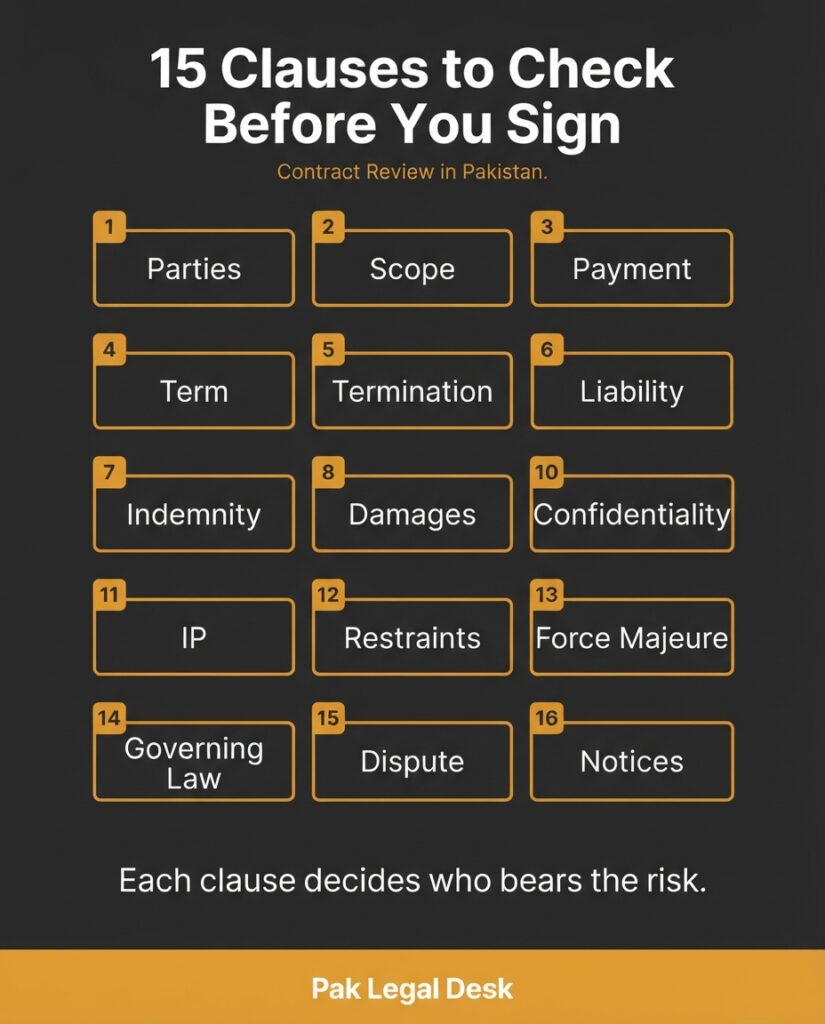
Before signing, check: parties, scope, payment, term, termination, liability and indemnity, damages and penalties, confidentiality, intellectual property, restrictive covenants, force majeure, governing law, dispute resolution, notices, and stamping formalities. These clauses decide who bears risk and how a dispute will be resolved. A qualified advocate can review how they apply to your facts.
Who This Guide Is For
Business owners, freelancers, landlords, tenants and managers who receive contracts, and anyone deciding whether to have an agreement reviewed.
What the Law Says
Contracts in Pakistan are governed mainly by the Contract Act, 1872, together with special laws for particular subjects. Courts generally enforce what parties agreed, subject to the Act and other law. What you sign is usually what you are held to.
The 15 Clauses
- Parties and capacity. Correct legal names, registration details and the authority of the person signing for a company.
- Scope and deliverables. What exactly is promised; acceptance criteria.
- Price and payment. Amount, currency, taxes, timing, late payment.
- Term and renewal. Start date, duration, automatic renewal and how to stop it.
- Termination. Who may end the contract, on what notice and for which reasons; what survives termination.
- Liability and limitation. Caps, exclusions and who bears which risks.
- Indemnity. Who pays for third-party claims; scope and conditions.
- Damages and penalties. Liquidated-damages or penalty clauses; check how the Contract Act treats stipulated sums.
- Confidentiality. What is protected, for how long, and exceptions.
- Intellectual property. Who owns work product; licences granted.
- Restrictive covenants. Non-compete or non-solicit terms; the Contract Act restricts agreements in restraint of trade, so check enforceability.
- Force majeure. Which events excuse performance and what notice is needed.
- Governing law and jurisdiction. Which law applies and which courts or forum decide disputes.
- Dispute resolution. Arbitration or court, seat, rules, language and costs; check the arbitration statutes that apply.
- Notices, stamping and formalities. How notices are given; whether stamp duty, registration or witnessing is required for this kind of document.
Pakistan-Specific Legal Position
- Contract Act, 1872: validity, performance, breach and damages.
- Stamp Act, 1899 and provincial amendments: stamp duty varies by instrument and province; an insufficiently stamped document may face difficulties as evidence. Verify the current schedule.
- Arbitration: domestic arbitration is governed by the Arbitration Act, 1940; foreign awards by the Recognition and Enforcement (Arbitration Agreements and Foreign Arbitral Awards) Act, 2011. Verify current status.
- Company contracts: check authority under the company’s constitutional documents.
- Special laws (for example employment, tenancy or consumer rules) may override terms.
Law and administrative procedures can change; verify the current position before acting.
Step-by-Step Review Process
- Read the whole document once for the commercial deal.
- Highlight the 15 clauses above.
- List what is missing.
- Compare the contract with what was negotiated.
- Mark clauses you do not understand.
- Ask for changes in writing.
- Check stamping and signing formalities.
- Keep signed copies and a record of amendments.
Common Mistakes
Signing a template without reading; relying on verbal promises not in the contract; ignoring termination and dispute clauses; wrong party names; forgetting stamp duty; no record of amendments.
When Professional Legal Advice Is Appropriate
Seek an advocate if the contract is high-value, long-term, unusual, involves restrictive covenants, foreign parties or arbitration, or if the other side’s draft is one-sided.
Pak Legal Desk Solution
Per its Services page (checked 8 October 2026), Pak Legal Desk offers free, form-based contract templates, including Pakistan versions of service, employment, non-disclosure, lease, partnership, shareholder and consultancy agreements. Each template is marked for review by a qualified lawyer before use. The page does not list a contract-review service, so if you want your own contract reviewed, consult a qualified advocate. See Pak Legal Desk’s services and templates.
Frequently Asked Questions
Do I need a lawyer to review a contract? Not always, but it is wise for important or complex agreements.
Is a verbal contract valid in Pakistan? Often yes, but proof is harder; some contracts require writing.
What does indemnity mean? A promise to cover another party’s loss under stated conditions.
Is a penalty clause enforceable? Courts look at the Contract Act’s treatment of stipulated sums; seek advice.
Do contracts need stamp paper? Depends on the instrument and province; check the current schedule.
Final Takeaway
A contract you sign is usually what you are held to. Read it, highlight the fifteen clauses above, and get an advocate’s review for anything high-value, long-term or unusual.
References
- Contract Act, 1872 (Pakistan Code)
- Stamp Act, 1899 and provincial amendments (Pakistan Code)
- Arbitration Act, 1940; Recognition and Enforcement (Arbitration Agreements and Foreign Arbitral Awards) Act, 2011 (Pakistan Code)
Legal Information Disclaimer
This article provides general legal information for educational purposes and does not constitute legal advice. For advice concerning a specific matter, consult a qualified advocate.