
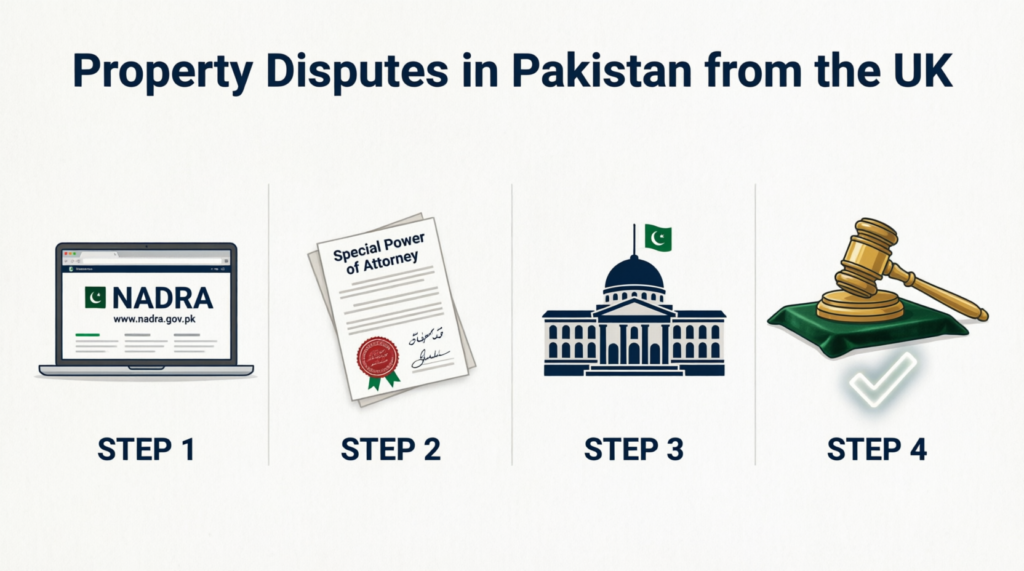

Quick Answer
You can file a property dispute case in Pakistan while living in the United Kingdom, but you cannot file it yourself. Pakistani law requires a licensed advocate enrolled with a provincial Bar Council to draft and file the plaint on your behalf. You must execute a Special Power of Attorney (SPOA) attested by the Pakistan High Commission in London or through NADRA’s online Power of Attorney system, appoint a local advocate in the province where the property is situated, and file a civil suit under the Code of Civil Procedure, 1908 (CPC) before the district court with territorial jurisdiction. Since 2024, special courts have also been established in Islamabad and certain provinces under the Establishment of Special Court (Overseas Pakistanis Property) Act, 2024 to hear property disputes involving overseas Pakistanis.
What the Law Says
The primary statute governing civil suits in Pakistan is the Code of Civil Procedure, 1908. Order VII of the CPC sets out the requirements for a plaint, including the name of the court, the names and addresses of the parties, the facts constituting the cause of action, the jurisdiction of the court, and the relief claimed. Section 115 of the CPC grants the High Court supervisory jurisdiction to call for the record of any case decided by a subordinate court where no appeal lies, if the subordinate court appears to have exercised jurisdiction not vested in it, failed to exercise jurisdiction so vested, or acted illegally or with material irregularity. This is the provision under which a civil revision petition may be filed.
For women’s property disputes, separate statutory mechanisms operate at federal and provincial levels. The Enforcement of Women’s Property Rights Act, 2020 (federal) empowers the Federal Ombudsperson for Protection against Harassment (FOSPAH) to adjudicate matters relating to movable or immovable property owned by women. In Khyber Pakhtunkhwa, the Khyber Pakhtunkhwa Enforcement of Women’s Property Rights Act, 2019 (Act No. XLIV of 2019) provides for protection of women’s rights of ownership and possession of property, with an Ombudsperson empowered to hear complaints and direct delivery of possession. Punjab has enacted the Punjab Enforcement of Women’s Property Rights Act, 2021, and Sindh has its own provincial legislation.
The Specific Relief Act, 1877 governs specific performance of contracts. Section 12 of the Act provides that specific performance of a contract is a discretionary relief, and there is a legal presumption that a breach of a contract to transfer immovable property cannot be adequately relieved by compensation in money. The Limitation Act, 1908 prescribes the periods within which suits must be filed. Article 113 provides a three-year limitation period for suits for specific performance, running from the date fixed for performance or, if no such date is fixed, from the date the plaintiff has notice that performance is refused. Article 120 provides a six-year limitation period for suits for which no period is specifically provided elsewhere, including suits for declaration of title.
Who Does This Apply To?
This guidance applies to Pakistani nationals and dual nationals residing in the United Kingdom who own immovable property in Pakistan and wish to initiate a civil suit to protect, recover, or enforce rights over that property. The property may be residential, commercial, or agricultural.
The procedure differs depending on whether the dispute involves a woman’s property rights. If the plaintiff is a woman who has been deprived of ownership or possession of her property, she may have the option of filing a complaint before the relevant Ombudsperson under provincial or federal women’s property rights legislation, in addition to or instead of a civil suit, depending on whether court proceedings are already pending.
Since 2024, overseas Pakistanis — including those holding NICOP — may file property disputes before designated Special Courts under the Establishment of Special Court (Overseas Pakistanis Property) Act, 2024. The jurisdiction of these courts extends to disputes concerning immovable property involving overseas Pakistanis, including ownership, possession, and matters arising from agreements for sale or purchase.
Practical Procedure
The following steps reflect the verified statutory requirements and official court procedures. Exact practices may vary by province and district court.
Step 1: Engage a licensed advocate. The advocate must be enrolled with the relevant provincial Bar Council — the Punjab Bar Council, Sindh Bar Council, Khyber Pakhtunkhwa Bar Council, or Balochistan Bar Council — depending on where the property is situated. A foreign-qualified lawyer cannot file the plaint directly.
Step 2: Execute a Special Power of Attorney (SPOA). The SPOA must be executed in the United Kingdom and attested by the Pakistan High Commission in London. Alternatively, the Government of Pakistan has launched an online Power of Attorney system through NADRA, which allows overseas Pakistanis to apply online without physically appearing at the embassy. The SPOA should be narrowly drafted to authorise the advocate to file and pursue the specific property dispute.
Step 3: Collect documents. The advocate will require the original title deed, tax clearance certificates, utility bills, any prior agreements relating to the property, and correspondence with the defendant.
Step 4: Prepare the plaint. The plaint must be drafted in accordance with Order VII of the CPC and the forms in Appendix A of the CPC. It must state the name of the court, the names and addresses of the parties, the facts constituting the cause of action and when it arose, the facts showing the court has jurisdiction, the relief claimed, and a statement of the value of the subject matter for jurisdiction and court fee purposes.
Step 5: Pay the court fee. Court fees in Pakistan are governed by the Court Fees Act, 1870. Schedule I prescribes ad valorem fees calculated on the value of the subject matter, and Schedule II prescribes fixed fees for certain documents. The ad valorem fee typically ranges from 0.5 per cent to 5 per cent of the suit value, depending on the jurisdiction and the amount claimed. For suits involving immovable property, the court fee is calculated on the market value of the property as determined by the plaintiff. Court fees are subject to provincial variation and periodic revision.
Step 6: File the plaint. The advocate files the plaint at the civil registry of the district court having territorial jurisdiction over the property. Under Section 17 of the CPC, suits for immovable property situated within the jurisdiction of different courts may be filed in any court within whose jurisdiction any portion of the property is situated.
Step 7: Service of summons. The court issues a summons to the defendant. Service may be effected through a local process server or by registered post. The plaint must be accompanied by as many copies as there are defendants for service upon them.
Step 8: Written statement and rejoinder. If the defendant files a written statement, the advocate prepares a rejoinder and any supporting affidavits.
Step 9: Pre-trial conference and mediation. The court may schedule a pre-trial conference and direct the parties to attempt mediation. In Punjab, mediation committees have been established under Section 151(2) of the Punjab Land Revenue Act, 1967, led by Assistant Commissioners, to resolve land disputes within 30 days. In Khyber Pakhtunkhwa, the Khyber Pakhtunkhwa Alternate Dispute Resolution Act, 2020 provides a framework for referring civil disputes to alternate dispute resolution.
Step 10: Trial and judgment. During the trial, both sides present evidence, and the judge may order a site inspection. After hearing, the court delivers its judgment. If either party is dissatisfied, an appeal or civil revision may be filed under the CPC.
Documents Required
-
Original title deed or registered sale deed
-
Tax clearance certificates
-
Utility bills for the property
-
Any prior agreements relating to the property (sale agreements, lease agreements, etc.)
-
Special Power of Attorney attested by the Pakistan High Commission in London or executed through NADRA’s online system
-
Copy of CNIC or NICOP
-
Any correspondence with the defendant regarding the dispute
Deadlines
The Limitation Act, 1908 prescribes the following periods:
-
Suits for specific performance of a contract: three years from the date fixed for performance or, if no date is fixed, from the date the plaintiff has notice that performance is refused (Article 113).
-
Suits for declaration of title: six years from the date the right to sue accrues (Article 120).
-
Suits for recovery of possession of immovable property: twelve years from the date of dispossession, where the plaintiff was in possession and has been dispossessed (Article 120 read with the Schedule).
A civil revision petition under Section 115 of the CPC must be filed within 30 days of the decree or order being challenged, unless the High Court extends the time.
Court Fees
Court fees are governed by the Court Fees Act, 1870. The fee is calculated on the value of the subject matter, which for immovable property suits is the market value of the property as determined by the plaintiff. The ad valorem fee typically ranges from 0.5 per cent to 5 per cent of the suit value. In addition, a one-time process fee of twenty-five rupees is payable for service of summons upon the defendant. Court fee schedules are subject to provincial variation and periodic revision; the exact fee applicable should be confirmed with the advocate at the time of filing.
Common Mistakes to Avoid
Failing to execute a valid Special Power of Attorney. Without an SPOA attested by the Pakistan High Commission or executed through NADRA, the advocate cannot act on your behalf and the plaint may be rejected.
Engaging an advocate not enrolled with the relevant provincial Bar Council. Only advocates enrolled with the Bar Council of the province where the property is situated can file the plaint.
Filing in the wrong court. The suit must be filed in the district court having territorial jurisdiction over the property. Filing in the wrong court can result in the plaint being returned or the suit being dismissed.
Under-valuing or over-valuing the suit for court fee purposes. The court fee is calculated on the value of the subject matter. Incorrect valuation can lead to objections and delays.
Ignoring the limitation period. If the suit is filed after the limitation period prescribed by the Limitation Act, 1908, it is liable to be dismissed as time-barred.
Practical Checklist
- □ Confirm the province where the property is situated
- □ Engage a licensed advocate enrolled with the relevant provincial Bar Council
- □ Execute a Special Power of Attorney attested by the Pakistan High Commission in London or through NADRA’s online system
- □ Collect the original title deed, tax receipts, utility bills, and any relevant agreements
- □ Confirm the applicable court fee with the advocate
- □ Verify the limitation period applicable to the relief sought
- □ Ensure the plaint complies with Order VII of the CPC
- □ File the plaint at the correct district court civil registry
- □ Attend mediation if directed by the court
- □ Keep the advocate informed of any change in address or contact details
Frequently Asked Questions
Can I file a property suit in Pakistan without a Pakistani lawyer?
No. The law requires a licensed advocate enrolled with a provincial Bar Council to appear and file the plaint on your behalf. A foreign-qualified lawyer cannot file directly in a Pakistani court.
Do I need to be physically present in Pakistan for the hearing?
Physical presence is not mandatory if your advocate is authorised to appear under a valid Special Power of Attorney. However, the court may require your testimony in certain cases, and you may need to attend if the court deems it necessary.
How long does a property dispute take in Pakistan?
Timelines vary significantly depending on the court’s backlog, the complexity of the dispute, and whether appeals are filed. A straightforward case may take 12 to 18 months from filing to judgment, but contested matters can take longer.
What is the court fee for a property suit in Pakistan?
Court fees are calculated ad valorem on the value of the subject matter, typically ranging from 0.5 per cent to 5 per cent of the suit value. The exact fee depends on the province and the value of the property. A one-time process fee of twenty-five rupees is also payable.
Can I appeal a decision if I lose?
Yes. An appeal may be filed under the relevant provisions of the CPC. A civil revision petition under Section 115 of the CPC may be filed before the High Court within 30 days of the decree or order being challenged, where no appeal lies.
What is a Special Power of Attorney and why do I need one?
A Special Power of Attorney is a legal document that authorises your chosen advocate in Pakistan to act on your behalf in the specific property dispute. It must be attested by the Pakistan High Commission in London or executed through NADRA’s online Power of Attorney system.
What is the role of the Ombudsperson in women’s property disputes?
Under federal and provincial women’s property rights legislation, an Ombudsperson is empowered to hear complaints from women who have been deprived of ownership or possession of their property. The Ombudsperson may direct delivery of possession and transfer of ownership. However, where proceedings in a court of law are already pending in relation to the same property, the Ombudsperson’s jurisdiction may be affected.
Can I file a property dispute in a Special Court for Overseas Pakistanis?
Yes, if you qualify as an overseas Pakistani under the Establishment of Special Court (Overseas Pakistanis Property) Act, 2024. These special courts have jurisdiction over disputes concerning immovable property involving overseas Pakistanis, including ownership, possession, and matters arising from agreements for sale or purchase.
What documents do I need to file a property dispute in Pakistan?
You will need the original title deed, tax clearance certificates, utility bills, any prior agreements relating to the property, a Special Power of Attorney, and copies of your CNIC or NICOP. The advocate may require additional documents depending on the nature of the dispute.
What is mesne profit and can I claim it?
Mesne profit is the compensation recoverable from a person who has been in unlawful possession of property. It is defined under Section 2(12) of the CPC. A plaintiff who succeeds in a suit for possession may also claim mesne profit for the period of unlawful occupation, at a rate determined by the court.
Is mediation mandatory before filing a property suit in Pakistan?
In several provinces, the court may refer the dispute to mediation or alternate dispute resolution before proceeding to a full hearing. In Punjab, mediation committees have been established under the Punjab Land Revenue Act, 1967 to resolve land disputes. In Khyber Pakhtunkhwa, the Alternate Dispute Resolution Act, 2020 provides a framework for referring civil disputes to ADR. The court may direct the parties to attempt mediation, but the outcome is not binding unless the parties agree.
What is the difference between a civil suit and a civil revision petition?
A civil suit is the original proceeding filed before a district court to establish a claim or enforce a right. A civil revision petition under Section 115 of the CPC is a supervisory proceeding filed before the High Court to challenge a decree or order of a subordinate court where no appeal lies.
Final Takeaway
Filing a property dispute case in Pakistan from the United Kingdom is procedurally possible but requires careful compliance with Pakistani civil procedure. The essential steps are: executing a valid Special Power of Attorney through the Pakistan High Commission in London or NADRA, engaging a licensed advocate enrolled with the relevant provincial Bar Council, filing a plaint that complies with Order VII of the CPC before the district court with territorial jurisdiction, and paying the applicable court fee under the Court Fees Act, 1870. The Limitation Act, 1908 prescribes strict periods within which suits must be filed, and failure to comply can result in dismissal. For women, additional remedies may be available through provincial and federal women’s property rights legislation. Since 2024, Special Courts for Overseas Pakistanis provide an additional forum for qualifying individuals. Every case turns on its specific facts, and the applicable provincial rules may vary.
Pak Legal Desk CTA
If you are a UK-based Pakistani facing a property dispute in Pakistan, Pak Legal Desk can arrange a consultation with a qualified advocate in the relevant province to assess your case, advise on the appropriate forum, and guide you through the filing process. We assist with document review, Special Power of Attorney execution, and coordination with local counsel.
References
-
Code of Civil Procedure, 1908 (Pakistan), Order VII, Section 115. Available at: https://www.pakistancode.gov.pk
-
Court Fees Act, 1870 (Pakistan), Schedules I and II. Available at: https://www.pakistancode.gov.pk
-
Limitation Act, 1908 (Pakistan), Articles 113 and 120. Available at: https://www.pakistancode.gov.pk
-
Specific Relief Act, 1877 (Pakistan), Section 12. Available at: https://www.pakistancode.gov.pk
-
Enforcement of Women’s Property Rights Act, 2020 (Pakistan). Available at: https://www.pakistancode.gov.pk
-
Khyber Pakhtunkhwa Enforcement of Women’s Property Rights Act, 2019 (Act No. XLIV of 2019). Available at: https://www.pakp.gov.pk
-
Punjab Enforcement of Women’s Property Rights Act, 2021 (Act No. X of 2021). Available at: https://www.punjabcode.punjab.gov.pk
-
Establishment of Special Court (Overseas Pakistanis Property) Act, 2024 (Pakistan). Available at: https://www.pakistancode.gov.pk
-
Khyber Pakhtunkhwa Alternate Dispute Resolution Act, 2020 (Act No. XLVIII of 2020). Available at: https://www.pakp.gov.pk
-
Punjab Land Revenue Act, 1967, Section 151(2). Available at: https://www.punjabcode.punjab.gov.pk
-
Legal Practitioners and Bar Councils Act, 1973 (Pakistan). Available at: https://www.pakistancode.gov.pk
-
Pakistan High Commission, London. Power of Attorney attestation services. Available at: https://www.phclondon.org
Legal Information Disclaimer
This article is provided for educational and informational purposes only. It does not constitute legal advice, and it does not create an advocate-client relationship. The information is based on Pakistani law as verified on 28 September 2026. Laws, regulations, court fees, and procedures are subject to change, and provincial variations exist. The Legal Practitioners and Bar Councils Act, 1973 and the rules framed thereunder by the Pakistan Bar Council regulate the professional conduct of advocates in Pakistan. Readers should consult a licensed advocate enrolled with the relevant provincial Bar Council before taking any action based on this article. Pak Legal Desk does not guarantee any particular outcome in any legal proceeding. No advocate-client relationship is created by reading this article or by contacting Pak Legal Desk through this website. Any reliance you place on the information in this article is strictly at your own risk.