

Quick Answer
An overseas Pakistani can protect property in Pakistan by ensuring the title deed is registered with the relevant provincial land-records authority, appointing a licensed Pakistani advocate under a properly attested power of attorney to monitor the property, and — if illegal occupation (qabza) occurs — filing a petition under Article 199 of the Constitution before the relevant High Court or approaching the Special Court for Overseas Pakistanis established under the Establishment of Special Court (Overseas Pakistanis Property) Act, 2024. The Illegal Dispossession Act, 2005 also provides a criminal remedy for forcible dispossession by land grabbers.
What the Law Says
Constitutional Protection of Property Rights
Article 23 of the Constitution of Pakistan, 1973 provides that every citizen shall have the right to acquire, hold and dispose of property in any part of Pakistan, subject to the Constitution and any reasonable restrictions imposed by law in the public interest. Article 24 further protects against deprivation of property save in accordance with law.
Writ Jurisdiction of the High Court
Under Article 199 of the Constitution, a High Court may, if satisfied that no other adequate remedy is provided by law, issue writs including mandamus, prohibition, and certiorari. However, this jurisdiction is discretionary and is not intended to substitute ordinary civil remedies where disputed questions of fact are involved.
Special Courts for Overseas Pakistanis
The Establishment of Special Court (Overseas Pakistanis Property) Act, 2024, promulgated on 28 October 2024, established dedicated special courts in Islamabad to ensure expeditious resolution of property disputes involving overseas Pakistanis. The Government of Khyber Pakhtunkhwa has approved the establishment of a Special Court for Overseas Pakistanis under this Act, with a mandate to dispose of property-related cases within 90 days. The Punjab Establishment of Special Courts (Overseas Pakistanis Property) Act, 2025 has been enacted to extend this mechanism across Punjab.
Illegal Dispossession Act, 2005
The Illegal Dispossession Act, 2005 was introduced to curb the activities of Qabza groups, property grabbers, and land mafia. The Act provides for prevention of illegal possession, power to attach property, eviction as an interim relief, and delivery of possession to the lawful owner. The Act applies to dispossession from immovable property by property grabbers or land mafia with credentials or antecedents of such activity.
Provincial Land Records Framework
Punjab: The Punjab Land Records Authority Act, 2017 established the Punjab Land Records Authority (PLRA) to reform and modernise the system of land records and improve service delivery. The PLRA operates Arazi Record Centres across all tehsils in Punjab for computerised land record management.
Sindh: The Sindh Land Revenue Act, 1967 governs the preparation and maintenance of record of rights in Sindh. Section 42 of the Act deals with the record of rights, and Section 53 provides for a suit for declaratory decree by persons aggrieved by an entry in the record.
Property Transfer Requirements
Under Section 54 of the Transfer of Property Act, 1882, a sale of tangible immovable property of the value of one hundred rupees and upwards can only be made by a registered instrument. The Registration Act, 1908 governs the registration of documents relating to immovable property.
Who Does This Apply To?
This guidance applies to:
-
Pakistani citizens residing abroad who own or have inherited immovable property in Pakistan.
-
Overseas Pakistanis who have purchased property in Pakistan but have not completed registration formalities.
-
Legal heirs of overseas Pakistanis who face disputes over inherited property.
-
Persons acting under a valid power of attorney on behalf of an overseas property owner.
The protections under the Establishment of Special Court (Overseas Pakistanis Property) Act, 2024 extend to overseas Pakistanis as defined under the Act, covering disputes related to immovable property including ownership, possession, and fraud allegations.
Practical Procedure
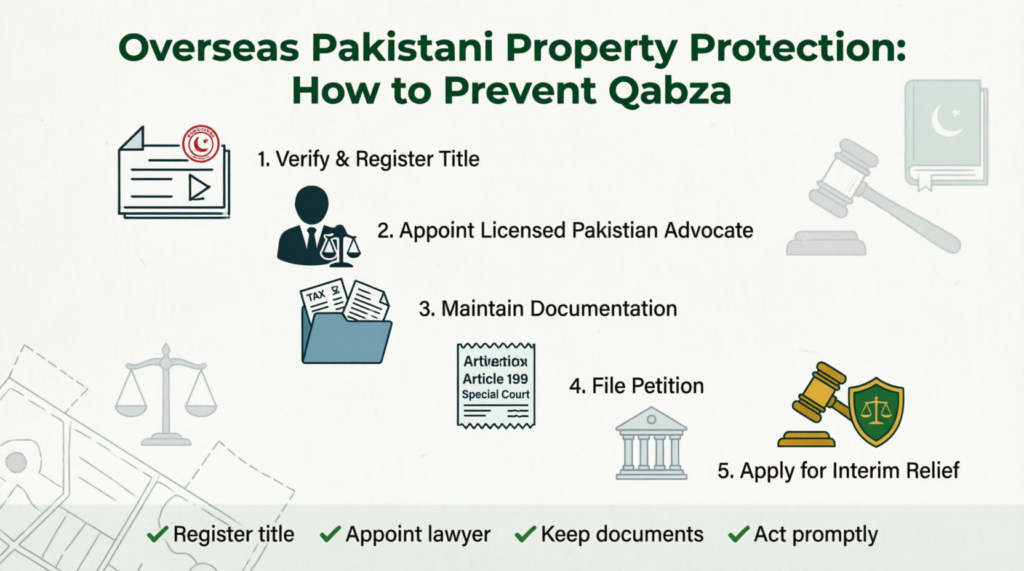
Step 1: Verify and Register Title
Confirm that the title deed is registered with the appropriate provincial land-records authority. In Punjab, the relevant authority is the Punjab Land Records Authority (PLRA), which operates through Arazi Record Centres. In Sindh, the Board of Revenue maintains land records under the Sindh Land Revenue Act, 1967. Obtain a certified copy of the registered deed and the latest Fard (record of rights).
Step 2: Appoint a Licensed Pakistani Advocate
Engage an advocate enrolled with a Provincial Bar Council and verified through the Pakistan Bar Council’s online verification portal. The advocate should be authorised under a special power of attorney executed before the Pakistani Embassy or High Commission in the country of residence and subsequently attested by the Ministry of Foreign Affairs in Pakistan.
Step 3: Maintain Documentation
Keep up-to-date tax receipts, customs clearance documents, and foreign-exchange proof for any imported assets linked to the property. For properties involving imported vehicles or goods, compliance with the Import Policy Order, 2016 and SRO 52(1)/2019 dated 15 January 2019 is required, which mandates that duties and taxes on imported vehicles under personal baggage or gift schemes be paid out of foreign exchange arranged by Pakistan nationals themselves.
Step 4: File a Petition
If illegal occupation occurs, the overseas owner may:
-
File a writ petition under Article 199 in the relevant High Court, seeking mandamus or prohibition, attaching title documents and evidence of unlawful occupation. Courts have held that a writ petition is maintainable where the petitioner is an aggrieved party and no other adequate remedy is available.
-
Approach the Special Court for Overseas Pakistanis established under the Establishment of Special Court (Overseas Pakistanis Property) Act, 2024, which has jurisdiction over the Islamabad Capital Territory and, in Punjab, across the province under the 2025 Act.
-
File a complaint under the Illegal Dispossession Act, 2005 if the dispossession is by a Qabza group or land mafia. The Act empowers the court to order eviction and restoration of possession as interim relief.
Step 5: Apply for Interim Relief
Request an interim injunction to preserve the status quo pending the court’s decision on the merits.
Documents / Requirements
-
Registered title deed (sale deed, gift deed, or inheritance mutation)
-
Latest Fard (record of rights) from the relevant land-records authority
-
Certified copy of the registered instrument
-
Valid special power of attorney attested by the Pakistani mission abroad and the Ministry of Foreign Affairs
-
Tax receipts and clearance certificates
-
Foreign-exchange remittance proof for imported assets (where applicable)
-
Bar Council enrolment certificate of the appointed advocate
Deadlines
There is no fixed statutory limitation period for filing a writ petition under Article 199 of the Constitution; however, Pakistani courts apply the equitable doctrine of delay and laches as a discretionary bar. Courts may decline relief where there has been unreasonable and unexplained delay. Reasonable time has been interpreted in some rulings as 120 days (four months).
The special courts established under the Establishment of Special Court (Overseas Pakistanis Property) Act, 2024 aim to dispose of property-related cases within 90 days.
Fees
Court fees for filing a writ petition are prescribed by the relevant High Court’s rules and are typically nominal, based on the value of the property. Specific fee schedules should be confirmed with the relevant High Court registry. The Pakistan Bar Council and Provincial Bar Councils provide online verification of advocate enrolment at no cost.
Penalties / Consequences
Under the Illegal Dispossession Act, 2005, persons found guilty of illegal possession or dispossession face imprisonment and fines. The Act provides for eviction and mode of recovery as interim relief, and delivery of possession of property to the lawful owner. Recent legislative proposals have introduced enhanced penalties, including imprisonment of up to ten years and fines up to Rs 10 million for illegal possession of immovable property.
Exceptions
-
The Illegal Dispossession Act, 2005 does not apply to run-of-the-mill cases of alleged dispossession by ordinary persons having no credentials or antecedents of being property grabbers or land mafia.
-
Writ jurisdiction under Article 199 is not available where disputed questions of fact require evidence and cross-examination.
-
The Special Court for Overseas Pakistanis in Islamabad has jurisdiction over the Islamabad Capital Territory; provincial special courts have jurisdiction within their respective provinces.
Common Mistakes
-
Neglecting to register the property in the provincial land-records system, leaving ownership unverified.
-
Relying on unregistered sale deeds or verbal agreements, which courts may deem unenforceable.
-
Delaying the filing of a petition beyond a reasonable period, risking dismissal on grounds of delay and laches.
-
Appointing an unlicensed advocate, which can invalidate legal actions.
-
Failing to keep foreign-exchange documentation compliant with SRO 52(1)/2019 when the property involves imported goods.
Practical Compliance Checklist
- □ Title deed registered with the relevant provincial land-records authority
- □ Certified copy of registered deed obtained
- □ Latest Fard (record of rights) obtained
- □ Licensed advocate appointed and Bar Council enrolment verified
- □ Special power of attorney executed and attested
- □ Tax receipts and customs documents up to date
- □ Foreign-exchange remittance proof available (if applicable)
- □ Contingency plan in place for filing writ petition or approaching special court
Frequently Asked Questions
Can I protect a property in Pakistan while living abroad?
Yes. Registration of the title in Pakistan and appointing a licensed local attorney under a properly attested power of attorney are sufficient to establish legal ownership and enable you to file a petition if needed.
What is the role of the Special Court for Overseas Pakistanis?
The Special Court (Overseas Pakistanis Property) Act, 2024 established dedicated courts in Islamabad to resolve property disputes involving overseas Pakistanis, with a target of disposing of cases within 90 days.
What if the occupier claims ancestral rights?
The court will examine documentary proof of title and may require the occupier to produce evidence of inheritance. Without such proof, the writ petition may succeed.
Do I need to pay court fees to file a writ petition?
Yes. Filing fees are prescribed by the relevant High Court’s rules and are typically nominal. Specific amounts should be confirmed with the High Court registry.
How long does an interim injunction last?
An interim order remains in force until the court issues a final judgment or lifts the injunction.
Is it possible to settle the dispute out of court?
Parties may negotiate a settlement, but any agreement should be reduced to writing and registered to ensure enforceability.
What is the limitation period for filing a writ petition?
There is no fixed statutory limitation period under Article 199, but courts apply the doctrine of delay and laches. Unreasonable delay may result in dismissal.
Can I file a complaint under the Illegal Dispossession Act if the occupier is a relative?
The Illegal Dispossession Act, 2005 applies to dispossession by property grabbers or land mafia. For disputes between co-owners or relatives without such credentials, ordinary civil remedies may be more appropriate.
What documents are required to prove ownership?
A registered title deed, latest Fard (record of rights), and tax receipts are essential. For inherited property, inheritance mutation and related revenue records are required.
What is the role of the Overseas Pakistanis Foundation (OPF)?
The OPF operates a complaint cell linked with the Pakistan Citizen Portal and coordinates with provincial authorities, including the Punjab Overseas Pakistanis Commission (POPC), to address property grievances of overseas Pakistanis.
Can I transfer property in Pakistan without visiting?
The Punjab Land Records Authority has introduced facilities allowing overseas Pakistanis to transfer property digitally without a power of attorney, using biometric verification linked with NADRA.
Final Takeaway
Overseas Pakistani property owners can significantly reduce the risk of qabza by ensuring proper registration of title, appointing a licensed and verified Pakistani advocate, maintaining complete documentation, and acting promptly if illegal occupation occurs. The Establishment of Special Court (Overseas Pakistanis Property) Act, 2024 provides a dedicated judicial forum, while the Illegal Dispossession Act, 2005 offers a criminal remedy against land grabbers. Early preventive steps and knowledge of the available legal remedies are essential to protecting property rights.
Pak Legal Desk CTA
If you own property in Pakistan and reside abroad, Pak Legal Desk can connect you with a licensed Pakistani advocate who can review your title documents, advise on registration compliance, and prepare any necessary petition to protect your asset from qabza. To schedule a consultation, contact Pak Legal Desk.
References
-
Constitution of the Islamic Republic of Pakistan, 1973. Articles 23, 24, and 199. Available at: https://rimap.unhcr.org/node/61784
-
The Establishment of Special Court (Overseas Pakistanis Property) Act, 2024 (Act No. XXVIII of 2024). Available at: https://pakistancode.gov.pk
-
The Illegal Dispossession Act, 2005. Available at: https://pakistancode.gov.pk
-
The Punjab Land Records Authority Act, 2017 (VI of 2017). Available at: https://pra-borpunjab.gov.pk
-
The Sindh Land Revenue Act, 1967. Available at: https://sja.gos.pk
-
The Transfer of Property Act, 1882. Section 54.
-
The Registration Act, 1908. Available at: https://pakistancode.gov.pk
-
The Punjab Establishment of Special Courts (Overseas Pakistanis Property) Act, 2025.
-
Import Policy Order, 2016. Ministry of Commerce, Government of Pakistan.
-
SRO 52(1)/2019 dated 15 January 2019. Federal Board of Revenue.
-
Pakistan Bar Council. Advocate verification portal. Available at: https://portal.pbbarcouncil.com
-
Overseas Pakistanis Foundation (OPF). Complaint cell. Available at: https://opf.org.pk
Legal Information Disclaimer
This article is provided for educational and informational purposes only and does not constitute legal advice. The information contained herein is based on Pakistani law as at the date of publication and may be subject to change. Laws, regulations, and procedures in Pakistan may vary by province and are subject to amendment. Readers should consult a licensed advocate enrolled with a Provincial Bar Council in Pakistan for advice specific to their circumstances. Pak Legal Desk does not provide legal advice and is not responsible for any action taken or not taken based on the information in this article. The Pakistan Bar Council Act, 1973 and the Legal Practitioners and Bar Councils Act, 1973 govern the enrolment and regulation of advocates in Pakistan. No attorney-client relationship is created by the reading of this article.