

Quick Answer
Non-resident Pakistanis can verify property title in Pakistan by obtaining certified copies of the title deed from the Sub-Registrar’s Office, securing the latest revenue record extract (Fard/Khata) from the Revenue Department, and conducting a court docket search to identify any pending suits, revision petitions, or injunctive orders affecting the property. Under Section 54 of the Transfer of Property Act, 1882, a sale of immovable property is only legally complete upon registration; therefore, no claim to ownership can be sustained without a registered instrument and a clear chain of title.
What the Law Says
Property title verification in Pakistan is governed by a framework of substantive and procedural statutes. The primary statute governing the transfer of ownership is the Transfer of Property Act, 1882, which provides under Section 54 that a sale of immovable property of a value exceeding one hundred rupees is only valid when made by a registered instrument. A mere agreement to sell does not confer legal title; ownership passes only upon execution and registration of the sale deed.
The Registration Act, 1908 prescribes the documents that must be compulsorily registered, including instruments that create, declare, assign, limit, or extinguish any right, title, or interest in immovable property. Registration is not merely procedural; it is a substantive requirement for the validity of property transactions.
The West Pakistan Land Revenue Act, 1967 governs the maintenance of revenue records, including the Khata and Khasra registers, and provides the mechanism for partition proceedings among co-owners under Section 135. The revenue record constitutes the official record of rights and is essential for establishing lawful ownership.
The Code of Civil Procedure, 1908 provides the procedural framework for civil litigation, including the High Court’s revisional jurisdiction under Section 115, which allows the High Court to call for the record of any case decided by a subordinate court to correct illegalities or irregularities in title determinations.
The Khyber Pakhtunkhwa Enforcement of Women’s Property Rights Act, 2019 (Act No. XLIV of 2019) provides a specialised mechanism for women deprived of ownership or possession of property to file a complaint with the Ombudsperson. Section 4 of the Act permits the Ombudsperson to exercise jurisdiction only if no proceedings are pending in a court of law regarding that property. However, the Peshawar High Court has clarified that the Ombudsperson does not have jurisdiction to adjudicate complex questions of title or direct partition of property; such matters must be determined by civil courts.
Who This Applies To
This guide is intended for:
-
Non-resident Pakistanis holding NICOP or CNIC who intend to purchase, sell, or inherit immovable property in Pakistan.
-
Overseas investors seeking to verify the title of a property before committing funds.
-
Heirs and legal representatives of deceased property owners who need to confirm ownership and identify encumbrances.
-
Purchasers who wish to avoid acquiring defective title or property subject to pending litigation.
The verification process applies across all provinces of Pakistan, though procedural details may vary by jurisdiction, particularly in Khyber Pakhtunkhwa where the 2019 Act provides an additional layer of protection for women’s property rights.
Practical Procedure for Title Verification
The following steps represent the standard verified procedure for verifying property title in Pakistan. Each step should be carried out by a licensed advocate engaged in the relevant jurisdiction.
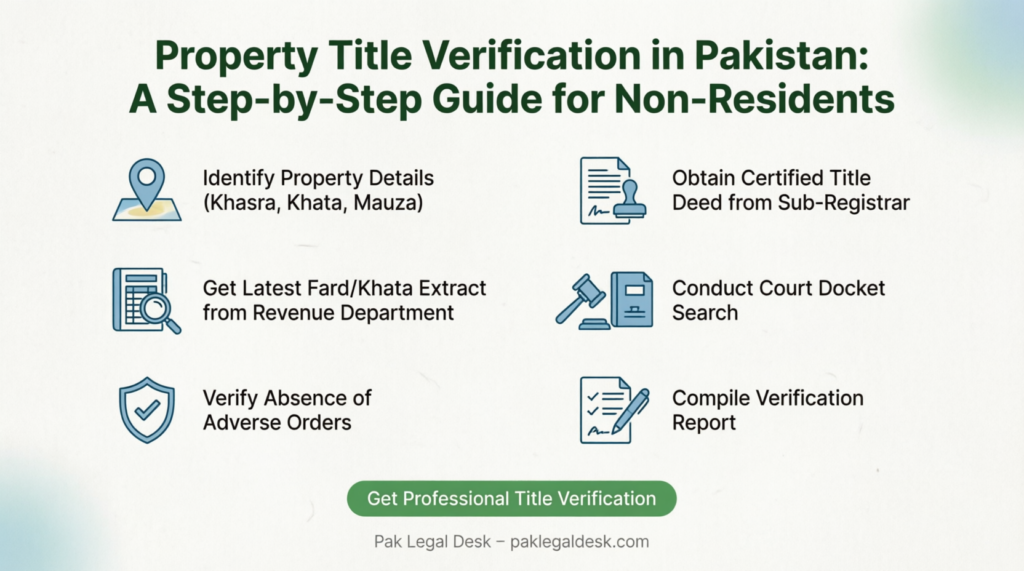
Step 1: Identify the Exact Property Description
Obtain the full property description, including Khasra number (plot number), Khata number, Mauza (revenue estate), and district. This information is required for all subsequent searches. For example, a property may be identified as Khasra No. 1097, Khata No. 299/437, Mauza Baghi Iram, District Mardan.
Step 2: Obtain Certified Copy of Title Deed
Engage a licensed advocate to request a certified copy of the registered sale deed from the Sub-Registrar’s Office in the relevant district. Under the Registration Act, 1908, a certified copy is the only admissible evidence of registration; a photocopy is insufficient for legal verification.
Step 3: Obtain Latest Revenue Record Extract (Fard/Khata)
The advocate should obtain the latest Fard (ownership extract) and Khata extract from the Revenue Department. The Fard confirms the name of the recorded owner and identifies any encumbrances, mutations, or entries affecting the property. The revenue record is maintained under the West Pakistan Land Revenue Act, 1967.
Step 4: Conduct Court Docket Search
A comprehensive search must be conducted in the district court and the relevant High Court for any pending suits, civil revision petitions under Section 115 of the Code of Civil Procedure, 1908, or injunctive orders affecting the property. Civil revision petitions are commonly used to challenge erroneous title determinations by subordinate courts.
Step 5: Verify Absence of Adverse Orders
Where any judgment or decree exists—for example, a civil revision under Section 115—obtain the full decree and verify whether it affects the title. Additionally, check for any orders issued under the Khyber Pakhtunkhwa Enforcement of Women’s Property Rights Act, 2019, which may restrict transfer or ownership.
Step 6: Compile Verification Report
The advocate should prepare a verification report summarising ownership, chain of title, encumbrances, pending litigation, and any adverse orders. This report forms the basis for proceeding with or declining the transaction.
Documents Required for Verification
| Document | Source | Purpose |
|---|---|---|
| Certified copy of registered sale deed | Sub-Registrar’s Office | Confirms registration and transfer of title |
| Latest Fard (ownership extract) | Revenue Department / Patwari | Confirms recorded owner and encumbrances |
| Khata extract | Revenue Department | Identifies Khasra numbers and shares |
| Court docket search report | District Court and High Court | Identifies pending suits or revision petitions |
| Full decree (if any) | Relevant court | Determines effect on title |
| NICOP / CNIC | NADRA | Identity verification for non-resident |
Common Mistakes to Avoid
-
Relying solely on a photocopy of the title deed. Only a certified copy from the Sub-Registrar’s Office is admissible for legal verification.
-
Neglecting to search for pending civil suits or revision petitions. A pending suit can cloud title and prevent transfer.
-
Assuming that an agreement to sell transfers title. Under Section 54 of the Transfer of Property Act, 1882, ownership passes only upon registration of the sale deed, not upon execution of an agreement.
-
Overlooking statutory restrictions under women’s property rights legislation. In Khyber Pakhtunkhwa, the Ombudsperson may have jurisdiction where a woman has been illegally deprived of property, and a pending complaint can affect transferability.
-
Attempting to verify title without professional legal assistance. The verification process requires court searches, revenue record examination, and interpretation of legal documents, which cannot be reliably performed without a licensed advocate.
Frequently Asked Questions
Q1: Can I verify a property title from abroad without a local lawyer?
You may request documents remotely, but a licensed Pakistani advocate is required to obtain certified copies from the Sub-Registrar’s Office, conduct court docket searches, and provide a legally reliable verification report. A power of attorney may be required for certain procedural steps.
Q2: What documents prove ownership in Pakistan?
A registered title deed, the latest Fard (ownership extract) from the Revenue Department, and a clear chain of title without adverse court orders constitute proof of ownership. Under Section 54 of the Transfer of Property Act, 1882, registration is mandatory for the transfer of ownership in immovable property.
Q3: Do court judgments automatically change the title?
No. A decree for recovery of money does not convey title. A separate registered conveyance deed is necessary to transfer ownership. Court judgments may declare rights or impose injunctions, but they do not substitute for registration under the Transfer of Property Act, 1882.
Q4: How long does the verification process take?
Obtaining certified copies and conducting a docket search typically takes two to four weeks, depending on the jurisdiction and court workload. Timelines may be longer where revenue record retrieval or court searches involve multiple districts.
Q5: What if an adverse order is found?
If an adverse order is identified, you may need to file a specific performance suit under the Specific Relief Act, 1877, or a declaration suit under Section 42 of the Specific Relief Act to clear the title. The procedural steps are governed by the Code of Civil Procedure, 1908.
Q6: Can a non-resident Pakistani buy property in Pakistan?
Yes. A non-resident Pakistani holding a valid NICOP or CNIC may acquire immovable property in Pakistan. The transaction must comply with the Transfer of Property Act, 1882, and the Registration Act, 1908. The purchaser’s identity documents must be verified through NADRA.
Q7: What is the role of the Ombudsperson under the Khyber Pakhtunkhwa Enforcement of Women’s Property Rights Act, 2019?
The Ombudsperson may inquire into complaints by women who have been illegally deprived of ownership or possession of property. However, the Peshawar High Court has held that the Ombudsperson has no jurisdiction to adjudicate complex title disputes or direct partition of property; such matters must be determined by civil courts.
Q8: What is a Khata and why is it important?
A Khata is a revenue record entry that identifies the holdings of a landowner, including Khasra numbers and shares. It is maintained under the West Pakistan Land Revenue Act, 1967, and forms part of the official record of rights. The Khata extract confirms the recorded owner and any encumbrances.
Q9: Can a civil revision petition affect property title?
Yes. A civil revision petition under Section 115 of the Code of Civil Procedure, 1908, may challenge a subordinate court’s judgment or decree concerning land ownership. The High Court exercises supervisory jurisdiction to correct illegalities or material irregularities in title determinations.
Q10: Is an agreement to sell sufficient to establish ownership?
No. Under Section 54 of the Transfer of Property Act, 1882, a contract for sale of immovable property does not create any interest in or charge on such property. Ownership is transferred only upon execution and registration of the sale deed.
Q11: What should I do if the property is subject to a pending suit?
A pending suit creates a lis pendens, and any transfer during the pendency of litigation may be subject to the outcome of the suit. You should obtain a copy of the plaint and any interim orders, and seek legal advice before proceeding.
Q12: How can I check for encumbrances on a property?
Encumbrances are disclosed in the Fard and Khata extracts maintained by the Revenue Department. Additionally, a court docket search will reveal any registered notices, mortgages, or charges affecting the property.
Final Takeaway
Property title verification in Pakistan requires more than a visual inspection of documents. It demands a systematic examination of the registered title deed, the revenue record, and the court docket. Under Section 54 of the Transfer of Property Act, 1882, registration is the cornerstone of valid ownership. Non-resident Pakistanis should engage a licensed advocate to obtain certified copies, conduct revenue and court searches, and prepare a verification report before committing to any transaction. A title that appears clear on the surface may conceal encumbrances, pending litigation, or statutory restrictions that can defeat ownership.
Pak Legal Desk — How We Can Help
If you are an overseas Pakistani planning to buy, sell, or inherit property in Pakistan, Pak Legal Desk can arrange a comprehensive title verification through its network of licensed advocates. Our services include:
-
Obtaining certified copies of title deeds from the Sub-Registrar’s Office.
-
Securing the latest Fard and Khata extracts from the Revenue Department.
-
Conducting district court and High Court docket searches.
-
Preparing a clear verification report identifying ownership, encumbrances, and adverse orders.
-
Advising on the appropriate legal remedy where title defects are identified.
Contact Pak Legal Desk to arrange a professional title verification and protect your investment in Pakistan.
References
-
Transfer of Property Act, 1882 (Pak.).
-
Registration Act, 1908 (Pak.).
-
West Pakistan Land Revenue Act, 1967 (Pak.).
-
Code of Civil Procedure, 1908 (Pak.).
-
Khyber Pakhtunkhwa Enforcement of Women’s Property Rights Act, 2019 (Act No. XLIV of 2019).
-
Specific Relief Act, 1877 (Pak.).
-
Ali Asghar vs Farkhanda (Ombudsperson), RFA No. 327-P/2024, Peshawar High Court.
-
Shehriyar Khan vs Mohammad Kareem, Civil Revision No. 282-P/2013, Peshawar High Court.
Legal Information Disclaimer
This article is provided for educational and informational purposes only. It does not constitute legal advice and should not be relied upon as a substitute for professional legal consultation. The laws of Pakistan are subject to change, and their application depends on the specific facts and circumstances of each case. Readers should consult a licensed advocate enrolled under the Pakistan Bar Council Act for advice tailored to their individual situation. Pak Legal Desk and its affiliates accept no liability for any loss or damage arising from reliance on the information contained in this article