

Quick Answer
If a person has been dispossessed of immovable property without their consent and otherwise than in due course of law, they may file a suit for recovery of possession under Section 9 of the Specific Relief Act, 1877. The suit must be brought within six months from the date of dispossession. Critically, the court in a Section 9 suit examines only the fact of possession and dispossession — the question of title is not relevant and cannot be raised as a defence. Where a plaintiff seeks possession on the basis of title rather than recent dispossession, a suit under Section 8 of the Specific Relief Act, or a suit for declaration and possession, may be appropriate, subject to the twelve-year limitation period under Article 142 of the Limitation Act, 1908. A civil revision under Section 115 of the Code of Civil Procedure, 1908 may be available to challenge a lower court’s decree in certain circumstances, though the revisional jurisdiction of the High Court is discretionary and limited.
What the Law Says
The recovery of possession of immovable property in Pakistan is governed principally by two statutes: the Specific Relief Act, 1877 and the Code of Civil Procedure, 1908.
Section 9 of the Specific Relief Act, 1877
Section 9 provides a summary remedy for a person who has been dispossessed of immovable property without their consent and otherwise than in due course of law. The provision states that such a person, or any person claiming through them, may by suit recover possession thereof, notwithstanding any other title that may be set up in such suit.
The essential ingredients that a plaintiff must establish in a suit under Section 9 are:
-
The plaintiff was in possession of the immovable property.
-
The plaintiff was dispossessed without consent.
-
The dispossession was otherwise than in due course of law.
-
The suit has been brought within six months from the date of dispossession.
The Peshawar High Court has confirmed that the question of title cannot be raised in a Section 9 suit and that the trial court’s decision must be based on a proper assessment of evidence regarding possession and dispossession. The remedy is independent and does not rest upon any title document.
Section 8 of the Specific Relief Act, 1877
Where a person has a title to property but is not in possession, and seeks to recover possession on the basis of that title, a suit under Section 8 of the Specific Relief Act may be appropriate. This remedy is distinct from Section 9 and is governed by the general law of limitation.
Article 142 of the Limitation Act, 1908
For a suit for possession of immovable property where the plaintiff, while in possession, has been dispossessed or has discontinued possession, Article 142 of the Limitation Act, 1908 prescribes a limitation period of twelve years from the date of dispossession or discontinuance. This longer limitation period applies to suits based on title, as distinct from the six-month limitation for a summary suit under Section 9 of the Specific Relief Act.
Section 115 of the Code of Civil Procedure, 1908
Section 115 of the CPC confers revisional jurisdiction on the High Court. The High Court may call for the record of any case decided by a subordinate court in which no appeal lies, and may interfere where the subordinate court appears to have exercised a jurisdiction not vested in it by law, or to have failed to exercise a jurisdiction so vested, or to have acted in the exercise of its jurisdiction illegally or with material irregularity. The jurisdiction under Section 115 is discretionary in nature and does not imply that it is not a right; the court cannot arbitrarily refuse to exercise its discretionary powers but must act according to law and the principles enunciated by superior courts.
The limitation for filing a revision petition under Section 115 of the CPC is 90 days, as amended in 1992.
Khyber Pakhtunkhwa Enforcement of Women’s Property Rights Act, 2019
In Khyber Pakhtunkhwa, the Enforcement of Women’s Property Rights Act, 2019 provides an additional mechanism for women deprived of ownership or possession of property. Section 3 of the Act delineates the powers of the Ombudsperson, which include passing orders for delivery of possession or title of the property to the complainant if the complainant has been illegally deprived of ownership or possession of her property. However, the Peshawar High Court has clarified that the Ombudsperson’s jurisdiction under the Act is limited and summary — the Act does not empower the Ombudsperson to decide intricate questions of law and fact, adjudicate title disputes, or grant actual (physical) possession of immovable property in cases of joint ownership.
Who Does This Apply To?
The remedies described in this article apply to:
-
Property owners in Pakistan whose land or house has been occupied by another person without legal right.
-
Persons in lawful possession (including tenants or licensees) who have been dispossessed without consent and otherwise than in due course of law.
-
Women in Khyber Pakhtunkhwa who have been deprived of ownership or possession of their property, who may file a complaint with the Ombudsperson under the 2019 Act.
-
Members of the Pakistani diaspora who own property in Pakistan and discover that it has been illegally occupied.
-
Legal heirs and persons claiming through a dispossessed person, who may also bring a suit under Section 9.
The Section 9 remedy applies regardless of the relationship between the parties — including where the occupier is a family member. However, courts may encourage mediation before proceeding in such cases.
Practical Procedure
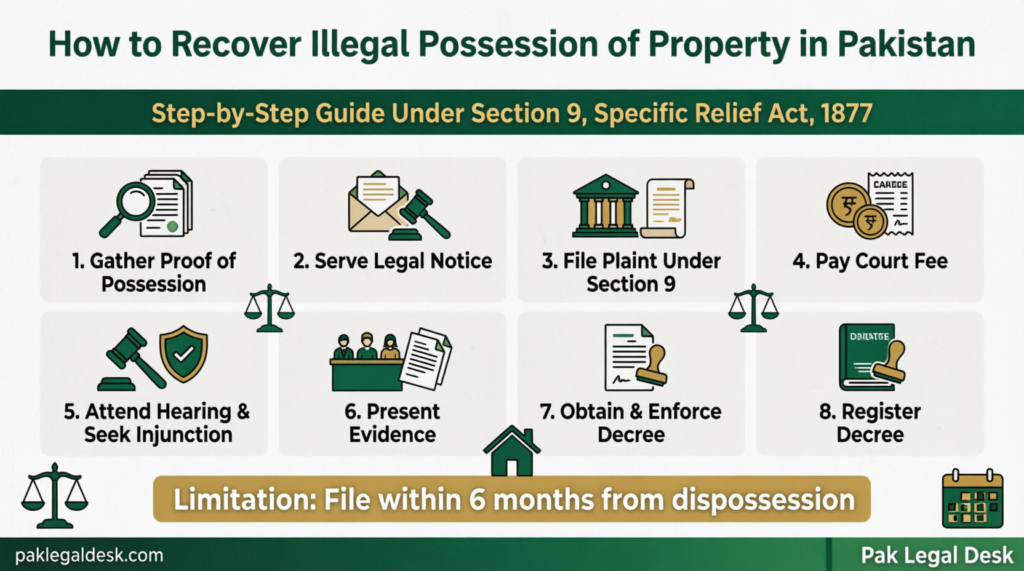
The following procedure applies to a suit for recovery of possession under Section 9 of the Specific Relief Act, 1877.
Step 1: Gather Proof of Possession
Collect all documents evidencing your possession of the property. While a Section 9 suit does not require proof of title, documentary evidence of possession is essential. Such evidence may include:
-
Mutation entries in the revenue record
-
Tax receipts
-
Utility bills
-
Rent receipts (if the property was let out)
-
Any prior court orders relating to possession
-
Witness statements from persons who can attest to your possession
Step 2: Serve a Written Legal Notice
Before filing suit, serve a written legal notice on the person in illegal possession, demanding that they vacate the property within a reasonable period. While Section 9 does not mandatorily require a prior notice, serving one is good practice and may lead to a resolution without litigation.
Step 3: Prepare and File the Plaint
Prepare a plaint for recovery of possession under Section 9 of the Specific Relief Act, 1877. The plaint must specifically allege:
-
That the plaintiff was in possession of the property.
-
The date on which the plaintiff was dispossessed.
-
That the dispossession was without the plaintiff’s consent.
-
That the dispossession was otherwise than in due course of law.
-
That the suit has been filed within six months of the dispossession.
The plaint must be filed in the civil court having jurisdiction over the location of the property. Under Section 16 of the CPC, suits for recovery of possession of immovable property must be instituted in the court within the local limits of whose jurisdiction the property is situated.
Step 4: Pay the Requisite Court Fee
Court fee for a suit for possession of immovable property is calculated under Section 7(v) of the Court Fees Act, 1870. The fee is determined on the basis of the market value of the property at the time of filing the suit. The specific amount varies depending on the province and the value of the property.
Step 5: Attend the First Hearing
At the first hearing, the court may issue a temporary injunction to prevent further interference with the property pending the outcome of the suit. The defendant will be given an opportunity to file a written statement.
Step 6: Present Evidence
If the defendant contests the suit, the plaintiff must present positive and cogent evidence to establish the essential ingredients of Section 9. Documentary evidence and witness testimony should be produced. The defendant may not raise the question of title as a defence.
Step 7: Obtain and Enforce the Decree
If the court decrees the suit in the plaintiff’s favour, it will order the defendant to hand over possession. If the defendant resists, the plaintiff may apply for a court-issued execution order, which may involve police assistance for enforcement.
Step 8: Register the Decree
After obtaining the decree, register it with the relevant land-registry office to update the official record and prevent future disputes.
Requirements
The following requirements must be satisfied for a successful suit under Section 9:
| Requirement | Details |
|---|---|
| Possession | The plaintiff must have been in possession of the property at the time of dispossession. |
| Dispossession | The dispossession must have occurred without the plaintiff’s consent. |
| Absence of due course of law | The dispossession must have been otherwise than in due course of law. |
| Limitation | The suit must be filed within six months of the date of dispossession. |
| Jurisdiction | The suit must be filed in the civil court having territorial jurisdiction over the property. |
For a suit based on title under Section 8, the plaintiff must additionally prove title to the property, and the suit must be filed within twelve years of dispossession under Article 142 of the Limitation Act, 1908.
Deadlines
| Deadline | Period | Source |
|---|---|---|
| Suit under Section 9, Specific Relief Act | Six months from dispossession | Section 9, Specific Relief Act, 1877 |
| Suit for possession based on title | Twelve years from dispossession | Article 142, Limitation Act, 1908 |
| Revision petition under Section 115, CPC | Ninety days | Section 115, CPC (as amended in 1992) |
Fees
The court fee for a suit for possession of immovable property is governed by Section 7(v) of the Court Fees Act, 1870. The fee is calculated on the market value of the property at the time of filing the suit. The precise amount depends on the value of the property and the province in which the suit is filed. Practitioners should consult the relevant provincial court-fee schedule for the current rate applicable to the specific suit.
Penalties and Consequences
A person found to be in illegal possession of property may face the following consequences:
-
Decree for possession: The court will order the illegal possessor to vacate the property and hand over possession to the rightful owner.
-
Damages: The court may award monetary compensation for loss suffered by the plaintiff, including loss of rent or income from the property.
-
Execution proceedings: If the defendant refuses to comply with the decree, the court may order enforcement through police-assisted eviction.
-
Costs: The court may order the defendant to pay the plaintiff’s legal costs.
Exceptions
-
Pending proceedings before a court of law: Under the Khyber Pakhtunkhwa Enforcement of Women’s Property Rights Act, 2019, a woman may file a complaint with the Ombudsperson even if legal proceedings regarding ownership or possession of the property are pending in a court of law, subject to the provisions of Section 7 of that Act.
-
Ombudsperson’s limited jurisdiction: The Ombudsperson under the 2019 Act cannot decide intricate questions of law and fact, adjudicate title disputes, or grant actual physical possession in cases of joint ownership.
-
Concurrent findings of fact: The High Court’s revisional jurisdiction under Section 115 of the CPC will not ordinarily be exercised to interfere with concurrent findings of fact by courts below.
Common Mistakes to Avoid
-
Failing to prove possession: A Section 9 suit requires proof of possession, not merely title. Plaintiffs who rely solely on title documents without proving actual possession risk dismissal.
-
Missing the six-month deadline: The six-month limitation period under Section 9 is strict. A suit filed after the expiry of this period will be barred by limitation.
-
Raising the question of title: In a Section 9 suit, the question of title is irrelevant. Raising title issues may distract from the essential ingredients of the suit.
-
Filing in the wrong court: The suit must be filed in the civil court having territorial jurisdiction over the property. Filing in the wrong court can lead to dismissal or transfer.
-
Neglecting to register the decree: After obtaining a decree, failing to update the mutation entry in the revenue record can cause future disputes.
-
Assuming a criminal complaint will resolve a civil possession issue: Criminal and civil remedies are separate. A criminal complaint does not automatically resolve a civil possession dispute.
Practical Compliance Checklist
- □ Gather all documents evidencing possession of the property.
- □ Serve a written legal notice on the illegal possessor demanding vacation of the property.
- □ Prepare a plaint alleging the essential ingredients of Section 9.
- □ File the plaint in the civil court having territorial jurisdiction over the property.
- □ Pay the requisite court fee under Section 7(v) of the Court Fees Act, 1870.
- □ Attend the first hearing and seek a temporary injunction if necessary.
- □ Present positive and cogent evidence of possession and dispossession.
- □ Upon a favourable decree, apply for an execution order.
- □ Register the decree with the relevant land-registry office.
- □ Consider consulting a qualified Pakistani advocate for assistance with the filing process.
Frequently Asked Questions
Q1. What is the limitation period for filing a suit for recovery of possession under Section 9 of the Specific Relief Act, 1877?
The suit must be filed within six months from the date of dispossession. The six-month period is a strict limitation, and a suit filed after its expiry will be barred by limitation.
Q2. Can the defendant raise the question of title in a suit under Section 9?
No. In a suit under Section 9, the court examines only the fact of possession and dispossession. The question of title is not relevant and cannot be raised as a defence.
Q3. What is the difference between a suit under Section 8 and a suit under Section 9 of the Specific Relief Act?
A suit under Section 9 is a summary remedy for recent dispossession and requires proof of possession, not title. A suit under Section 8 is based on title and seeks recovery of possession on the strength of that title. The limitation period for a Section 9 suit is six months, while a suit based on title is governed by Article 142 of the Limitation Act, 1908 (twelve years).
Q4. Can I recover possession if the occupier is a family member?
Yes. Family relationships do not bar a civil suit for recovery of possession under Section 9. However, courts may encourage mediation before proceeding.
Q5. What documents are required to file a suit for recovery of possession?
The documents required include proof of possession such as mutation entries, tax receipts, utility bills, rent receipts, and any prior court orders. For a suit based on title, title documents such as the sale deed or mutation entry confirming ownership are required.
Q6. What is the court fee for a suit for possession of immovable property?
The court fee is calculated under Section 7(v) of the Court Fees Act, 1870, on the basis of the market value of the property at the time of filing the suit. The specific amount varies depending on the province and the value of the property.
Q7. Can I challenge a lower court’s decree in a possession suit?
Yes. A civil revision under Section 115 of the Code of Civil Procedure, 1908 may be filed in the High Court to challenge a lower court’s decree in certain circumstances. The revision petition must be filed within 90 days of the decree. The High Court’s revisional jurisdiction is discretionary and limited.
Q8. How long does a possession suit usually take?
The duration of a possession suit depends on the court’s docket and the complexity of the case. A Section 9 suit, being summary in nature, may be concluded more quickly than a title-based suit. Practitioners often advise that timelines vary significantly across different courts and provinces.
Q9. Can I claim damages for loss of rent?
Yes. If the plaintiff can demonstrate loss of income due to illegal occupation, the court may award monetary compensation alongside possession.
Q10. What is the role of the Ombudsperson under the Khyber Pakhtunkhwa Enforcement of Women’s Property Rights Act, 2019?
The Ombudsperson is empowered to pass orders for delivery of possession or title of property to a woman who has been illegally deprived of ownership or possession. However, the Ombudsperson’s jurisdiction is limited and summary and does not extend to adjudicating intricate title disputes or granting actual physical possession in cases of joint ownership.
Q11. Is a legal notice mandatory before filing a suit under Section 9?
A legal notice is not mandatorily required under Section 9. However, serving a written notice demanding vacation of the property is good practice and may resolve the dispute without litigation.
Q12. Can a suit under Section 9 be filed in any court in Pakistan?
No. The suit must be filed in the civil court having territorial jurisdiction over the location of the property. Under Section 16 of the CPC, suits for recovery of possession of immovable property must be instituted in the court within whose local limits the property is situated.
Final Takeaway
The recovery of illegally possessed property in Pakistan is governed by a clear statutory framework. Section 9 of the Specific Relief Act, 1877 provides a swift, summary remedy for recent dispossession, requiring the plaintiff to prove possession and dispossession within six months. Where title is the basis of the claim, Section 8 of the Specific Relief Act and Article 142 of the Limitation Act, 1908 provide a longer twelve-year limitation period. The Khyber Pakhtunkhwa Enforcement of Women’s Property Rights Act, 2019 offers an additional mechanism for women in that province, though the Ombudsperson’s jurisdiction is limited. A civil revision under Section 115 of the CPC may be available to challenge a lower court’s decree, subject to a 90-day limitation period. Success in a possession suit depends on prompt action, proper documentation, and adherence to procedural requirements.
Pak Legal Desk CTA
If you are facing illegal possession of your property in Pakistan, the first step is to gather all documents evidencing your possession and consult a qualified Pakistani advocate. Pak Legal Desk offers a free initial assessment and can guide you through the filing process to protect your rights. Our team can assist with drafting the plaint, preparing the evidence, and representing your interests in court. Contact us today to discuss your case.
References
-
Specific Relief Act, 1877 (Act I of 1877), Section 9.
-
Code of Civil Procedure, 1908 (Act V of 1908), Section 115.
-
Limitation Act, 1908 (Act IX of 1908), Article 142.
-
Court Fees Act, 1870 (Act VII of 1870), Section 7(v).
-
Khyber Pakhtunkhwa Enforcement of Women’s Property Rights Act, 2019.
-
Mehfooz ur Rehman v. Jehangir Khan, WP No. 589-A/2016, Peshawar High Court, Abbottabad Bench, judgment dated 19 May 2025.
-
Amal Khan and others v. Gul Zaman, 2013 YLR 2738 (Peshawar High Court).
-
Shahzada Khurram & another v. Athar Naeem & others, R.A. No. 84 of 2021, High Court of Sindh, Karachi, order dated 12 March 2025.
-
Habib-ur-Rehman and others v. Abdul Karim (deceased) through L.Rs & others, Civil Petition No. 770-K of 2022, Supreme Court of Pakistan.
Legal Information Disclaimer
This article is provided for educational and informational purposes only and does not constitute legal advice. The information contained herein is based on Pakistani law, including the Specific Relief Act, 1877, the Code of Civil Procedure, 1908, and the Limitation Act, 1908, as applicable in Pakistan. The Pakistan Bar Council Act, 1973, governs the practice of law in Pakistan, and only a licensed advocate is authorised to provide legal advice and represent clients before the courts. Readers should consult a qualified Pakistani advocate for advice specific to their circumstances. The authors and Pak Legal Desk disclaim any liability arising from reliance on the information contained in this article. Laws and procedures are subject to change, and the position stated is current as at the date of publication.