

Quick Answer
Yes. An overseas Pakistani heir can sell inherited immovable property in Pakistan without travelling there, provided they hold a valid legal heirship certificate (or the relevant succession documentation), appoint a specific power of attorney attested by the Pakistani embassy or consulate in their country of residence, and ensure the sale deed is registered at the relevant sub-registrar’s office within four months of execution. A court order is not required where the share is undisputed and all co-heirs consent. Registration fees are typically 1% of the property value, while provincial stamp duty varies from 1% to 3% depending on the province. Federal advance tax under the Income Tax Ordinance, 2001 applies at 2.75% for the seller and 1.25% for the buyer (filers) under the Finance Act 2026.
What the Law Says
The sale of inherited immovable property in Pakistan is governed by a combination of succession law, property law, and registration law.
Succession. For Muslim heirs, succession to immovable property is governed by the West Pakistan Muslim Personal Law (Shariat) Application Act, 1962, which makes Islamic Shariat the rule of decision in matters of inheritance, overriding customary practices that previously excluded female heirs. Section 2 of the Act provides that notwithstanding any custom or usage, in all questions regarding succession (whether testate or intestate), the rule of decision shall be the Muslim Personal Law (Shariat) where the parties are Muslims. The Supreme Court of Pakistan has repeatedly held that daughters and widows cannot be deprived of their inheritance through purported gifts or informal family arrangements. In Atta Muhammad v. Mst. Munir Sultan (2021 SCMR 73), the apex court observed that extra vigilance must be exercised in cases where purported gifts are made to deprive daughters and widows of what would have constituted their share in the inheritance of an estate. In Ghulam Ali v. Mst. Ghulam Sarwar Naqvi (PLD 1990 SC 1), the Supreme Court held that customs depriving women of inheritance are void, reaffirming women’s absolute right under Islamic and Pakistani law.
For non-Muslim heirs (Christians, Parsis, and others), succession is governed by the Succession Act, 1925, which provides a statutory framework for the distribution of property upon intestacy. The Act applies to intestate and testamentary succession in Pakistan, excluding Hindus, Muslims, Buddhists, Sikhs, and Jains from Part II of the Act. The rules for determination of heirs of Pakistani Christians and their shares are set out in sections 31–49 of the Act.
Transfer. The Transfer of Property Act, 1882 governs the substantive transfer of immovable property by sale, gift, mortgage, or lease. Section 54 of the Act defines “sale” as the transfer of ownership in exchange for a price paid or promised, and in the case of tangible immovable property of the value of one hundred rupees and upwards, the transfer must be made by a registered instrument.
Registration. The Registration Act, 1908 makes the registration of documents that create, declare, assign, limit, or extinguish any right, title, or interest in immovable property compulsory. The sale deed must be presented for registration to the sub-registrar within whose territorial jurisdiction the property is situated. Under Section 23, no document other than a will shall be accepted for registration unless presented within four months from the date of its execution. Section 26 provides that a document executed out of Pakistan may be presented within four months from the date of its receipt in Pakistan.
Heirship documentation. A legal heir certificate (also referred to as a Shajra Nasab or heirship certificate) is issued by the Union Council or, in some cases, NADRA, and identifies the legal heirs of the deceased for the purpose of transferring immovable property in revenue records. A succession certificate, issued by a civil court under the Succession Act, 1925, is a separate document required for collecting debts and movable assets (bank accounts, shares, securities) and is not a substitute for a legal heir certificate where immovable property is concerned. The Letters of Administration and Succession Certificates Ordinance, 2019 provides for a streamlined issuance mechanism through NADRA’s Succession Facilitation Units, authorising NADRA to issue succession certificates within 15 days where there is no dispute among the legal heirs.
Who This Applies To
This guide applies to:
-
Overseas Pakistanis holding a NICOP or POC who have inherited immovable property in Pakistan;
-
Legal heirs of a deceased owner who died intestate (without a will) or whose will has been duly probated;
-
Co-heirs seeking to sell their individual shares in jointly inherited property.
It does not cover the sale of property held under a valid will (where the testator’s estate is being administered by an executor), nor the sale of property subject to an unresolved partition suit.
Prerequisites Before Sale
1. Legal Heirship Certificate
The first step is to obtain a legal heir certificate from the Union Council (or the relevant Tehsil Municipal Administration) where the property is situated. The application requires the deceased’s death certificate (from NADRA or the Union Council), CNICs of all legal heirs, and the Family Registration Certificate.
Where the deceased held property in the Islamabad Capital Territory, the Letters of Administration and Succession Certificates Ordinance, 2019 provides for a streamlined issuance mechanism through NADRA’s Succession Facilitation Unit. NADRA has established 186 Succession Facilitation Units across Pakistan, including in Islamabad, Punjab, Sindh, Khyber Pakhtunkhwa, Balochistan, and Gilgit-Baltistan. Legal heirs can complete biometric verification either at the nearest NADRA centre or remotely through the Pak ID app. Where no objections are received within fourteen days of publication of the notice, the certificate is issued.
2. Title Verification
Engage a licensed Pakistani advocate to:
-
Conduct a search at the land-registry office to verify the current title and confirm the absence of mortgages, liens, or pending litigation;
-
Obtain the latest Fard (record of rights) for the property;
-
Confirm whether the property was allotted by a development authority (such as the Capital Development Authority or a provincial housing authority), in which case the original allotment letter and possession certificate must be produced.
3. Clearance of Encumbrances
If the property is mortgaged to a bank, the bank must issue a No Objection Certificate or release letter before the sale can proceed. Outstanding property taxes and utility dues must also be cleared with the relevant revenue department or development authority.
The Role of Power of Attorney
An overseas Pakistani seller may execute a special power of attorney appointing a trusted attorney in Pakistan to sign the sale deed, present it for registration, and complete the mutation of revenue records.
Key requirements:
-
The POA must be specific — it must expressly identify the exact property and the exact acts authorised (sale, execution of the sale deed, presentation for registration, and receipt of sale proceeds). A general POA is not sufficient for the sale of immovable property.
-
The POA must be executed before the Pakistani embassy or consulate in the country of residence and attested by the consular officer. Online attestation facilities are available at many Pakistani missions through the automated power of attorney service.
-
After attestation, the POA should be sent to Pakistan, where it must be adjudicated and, where required for immovable property transactions, registered with the sub-registrar.
The Supreme Court of Pakistan has held that powers of attorney authorising transfer of immovable property must receive strict construction. In Pervaiz Akhtar v. Mst. Farida Bibi (PLD 2023 SC 628), the court emphatically held that an attorney must act strictly within the authority delegated by the principal. A general power of attorney is not sufficient to sell immovable property; a specific power of attorney limited to the exact property and transaction is required, and a registered sale deed must be executed.
Step-by-Step Process
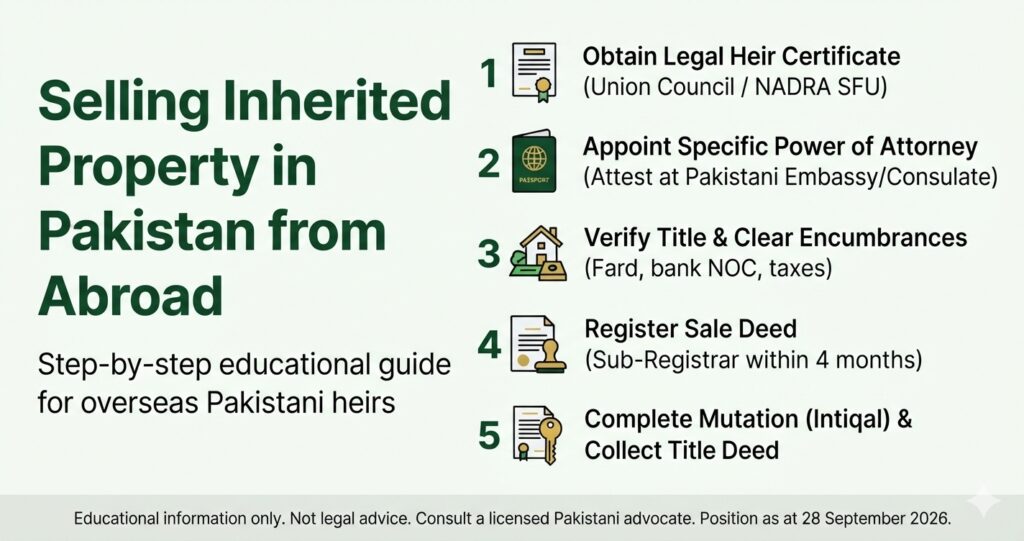
Step 1: Obtain the legal heir certificate. Apply to the Union Council where the property is situated, submitting the death certificate, CNICs of all heirs, and the Family Registration Certificate. Where the property is in ICT, apply through NADRA’s Succession Facilitation Unit.
Step 2: Engage a Pakistani advocate. Instruct a licensed advocate to verify title, conduct a land-registry search, and confirm the absence of encumbrances.
Step 3: Secure the original allotment letter (if applicable). If the property was allotted by a development authority, obtain the original allotment letter and possession certificate.
Step 4: Obtain banking clearance. If the property is mortgaged, obtain a No Objection Certificate from the financing bank. Clear all outstanding property taxes and utility dues.
Step 5: Draft the sale deed. The sale deed must contain full details of the seller, the buyer, the property description (including survey/khasra numbers), and the sale price. It must be executed on stamp paper of the appropriate value.
Step 6: Execute the power of attorney (if abroad). Appoint a specific power of attorney and have it attested by the nearest Pakistani embassy or consulate. Send the attested POA to Pakistan for adjudication and, if required, registration.
Step 7: Present the sale deed for registration. The sale deed must be presented to the sub-registrar within whose jurisdiction the property is situated, within four months of its execution. Where the document is executed outside Pakistan, the period is computed from the date of receipt in Pakistan.
Step 8: Pay stamp duty and registration fees. Stamp duty and registration fees must be paid before or at the time of registration.
Step 9: Complete mutation (Intiqal). After registration, apply to the revenue authority for mutation of the property records in the buyer’s name. This step transfers the revenue record ownership.
Step 10: Collect the new title deed and retain copies. Obtain the new Fard and title deed in the buyer’s name. Retain certified copies of all documents for future reference.
Fees and Taxes
Position verified as at 28 September 2026.
| Item | Rate | Notes |
|---|---|---|
| Registration fee | 1% of property value | Federal/ICT rate under the Registration Act, 1908; provincial rates may differ |
| Stamp duty (Punjab) | 1% of DC/FBR value | Reduced to 1% uniformly across Punjab by the Stamp (Amendment) Ordinance 2026 |
| Stamp duty (Sindh) | 2% of DC rate value | Provincial rate, subject to annual Finance Act updates |
| Stamp duty (KP) | 3% of DC rate value | Provincial rate |
| Stamp duty (Islamabad/ICT) | 1% of property value | Under the Finance Act 2025 |
| Capital Value Tax (CVT) | 2% of DC rate value | Federal levy applicable in most provinces |
| Advance tax — seller (S.236C) | 2.75% (filer) / 11.5% (non-filer) | Flat rate under Finance Act 2026 |
| Advance tax — buyer (S.236K) | 1.25% (filer) / 10.5%–18.5% (non-filer, by value slab) | Flat rate for filers under Finance Act 2026 |
Note: These figures are subject to change by annual provincial Finance Acts and federal Finance Acts. The position stated above was verified as at 28 September 2026. Readers should confirm current rates with the relevant provincial Board of Revenue and FBR before proceeding.
Consequences of Non-Compliance
Non-registration: A sale deed that is compulsorily registrable but is not registered does not affect the property as against a subsequent registered transferee, and does not confer the right to enforce the sale.
Late presentation: Under Section 25 of the Registration Act, 1908, a document presented after the statutory period may be accepted on payment of a penalty of up to ten times the registration fee, provided the delay was unavoidable.
Advance tax default: Failure to collect or pay advance tax under Sections 236C/236K may attract penalties under the Income Tax Ordinance, 2001.
Common Mistakes to Avoid
-
Relying on an informal family agreement without obtaining a formal legal heir certificate. Revenue authorities and banks will not act on informal arrangements.
-
Using a general power of attorney for the sale of immovable property. The Supreme Court has confirmed that a registered sale deed is required; a general POA is insufficient on its own.
-
Delaying registration. The statutory period is four months from execution. Failing to register promptly can create priority risks and attract penalties.
-
Selling mortgaged property without bank clearance. A No Objection Certificate from the financing bank is mandatory.
-
Neglecting provincial women’s property rights statutes. In Khyber Pakhtunkhwa, the Enforcement of Women’s Property Rights Act, 2019 provides a dedicated Ombudsperson mechanism to protect female heirs’ shares.
-
Confusing a legal heir certificate with a succession certificate. They serve different purposes and are issued by different authorities.
Practical Checklist
- □ Obtain death certificate from NADRA or Union Council
- □ Apply for legal heir certificate from the Union Council (or NADRA Succession Facilitation Unit for ICT)
- □ Engage a Pakistani advocate for title verification and land-registry search
- □ Obtain original allotment letter (if property allotted by a development authority)
- □ Obtain No Objection Certificate from any mortgage-holding bank
- □ Clear outstanding property taxes and utility dues
- □ Draft sale deed on appropriate stamp paper
- □ Execute specific power of attorney (if abroad) and obtain embassy/consulate attestation
- □ Send POA to Pakistan for adjudication and registration (if required)
- □ Present sale deed for registration within four months of execution
- □ Pay stamp duty, registration fee, CVT, and advance tax
- □ Complete mutation (Intiqal) in the revenue records
- □ Collect new title deed and retain certified copies
Frequently Asked Questions
Can I sell inherited property without travelling to Pakistan?
Yes. You can appoint a trusted attorney through a specific power of attorney attested by the Pakistani embassy or consulate in your country of residence. The POA must expressly authorise the sale, execution of the sale deed, and registration of the property.
Do I need a court order to sell my share of inherited land?
If your share is undisputed and you hold a valid legal heir certificate, a court order is not required. If there is a dispute among co-heirs, the matter may need to be resolved through a partition suit or, in Khyber Pakhtunkhwa, through the Ombudsperson mechanism under the Enforcement of Women’s Property Rights Act, 2019.
What is the deadline for registering a sale deed in Pakistan?
Under Section 23 of the Registration Act, 1908, a sale deed must be presented for registration within four months from the date of its execution. A document executed outside Pakistan may be presented within four months from the date of its receipt in Pakistan.
What fees are involved?
Registration fees are typically 1% of the property value. Stamp duty varies by province: Punjab 1%, Sindh 2%, Khyber Pakhtunkhwa 3%, Islamabad 1%. Federal Capital Value Tax of 2% applies in most provinces. Advance tax under Sections 236C and 236K applies at 2.75% (seller) and 1.25% (buyer) for filers under the Finance Act 2026.
Can female heirs be prevented from selling their inherited share?
No. The Supreme Court of Pakistan has consistently held that daughters and widows cannot be deprived of their inheritance by male relatives, and purported gifts or relinquishments that deprive female heirs are contrary to law and public policy. In Khyber Pakhtunkhwa, the Enforcement of Women’s Property Rights Act, 2019 provides a dedicated Ombudsperson to enforce these rights.
What if the property is jointly owned with other heirs?
All co-owners must sign the sale deed or provide written consent. If any co-owner objects, the matter may need to be resolved through a partition suit before the sale can proceed.
How long does the entire process take?
From obtaining the legal heir certificate to registration, the process typically takes 45 to 60 days, assuming no disputes or encumbrances arise. Where a succession certificate or letters of administration are required, the timeline may be longer.
What is the difference between a legal heir certificate and a succession certificate?
A legal heir certificate is issued by the Union Council/NADRA and identifies the deceased’s legal heirs for property mutation and pension purposes. A succession certificate is issued by a civil court under the Succession Act, 1925, and authorises heirs to collect debts, operate bank accounts, and transfer movable financial assets. Under the Letters of Administration and Succession Certificates Ordinance, 2019, NADRA is authorised to issue succession certificates within 15 days where there is no dispute among the legal heirs.
Is a general power of attorney sufficient to sell property in Pakistan?
No. The Supreme Court has held that a general power of attorney is not sufficient to sell immovable property; a specific power of attorney limited to the exact property and transaction is required, and a registered sale deed must be executed.
What are the tax consequences for an overseas seller?
The seller must pay advance tax under Section 236C at 2.75% (for active taxpayers) or 11.5% (for non-filers). Capital gains tax may also apply depending on the holding period. Overseas Pakistanis should obtain professional tax advice specific to their circumstances.
Final Takeaway
Selling inherited property in Pakistan as an overseas Pakistani is legally straightforward provided the correct documentation is in place. The critical steps are: (1) obtain a legal heir certificate, (2) verify title and clear encumbrances, (3) execute a specific power of attorney attested by the Pakistani embassy, and (4) register the sale deed within the statutory four-month period. Female heirs are protected by both Islamic inheritance law and provincial statutes, and their shares cannot be overridden without consent. Registration fees and stamp duty vary by province, and advance tax rates under the Finance Act 2026 apply to both seller and buyer.
Pak Legal Desk CTA
If you are an overseas Pakistani and need assistance with the sale of inherited property in Pakistan, Pak Legal Desk can help. Our team can assist with:
-
Drafting and reviewing sale deeds and powers of attorney
-
Obtaining legal heir certificates and succession certificates
-
Conducting title searches and verifying encumbrances
-
Coordinating with banks, development authorities, and sub-registrars
-
Advising on stamp duty, registration fees, and advance tax obligations
Contact Pak Legal Desk for a consultation.
References
Atta Muhammad v. Mst. Munir Sultan (2021 SCMR 73). Supreme Court of Pakistan.
Ghulam Ali v. Mst. Ghulam Sarwar Naqvi (PLD 1990 SC 1). Supreme Court of Pakistan.
Pervaiz Akhtar v. Mst. Farida Bibi (PLD 2023 SC 628). Supreme Court of Pakistan.
Finance Act, 2026 (Pak.) — Sections 236C and 236K, Income Tax Ordinance, 2001.
Khyber Pakhtunkhwa Enforcement of Women’s Property Rights Act, 2019 (Act No. XLIV of 2019).
Letters of Administration and Succession Certificates Ordinance, 2019 (Pak.).
Registration Act, 1908 (XVI of 1908) (Pak.). Pakistan Code.
Succession Act, 1925 (Pak.). Pakistan Code.
Transfer of Property Act, 1882 (Pak.). Pakistan Code.
West Pakistan Muslim Personal Law (Shariat) Application Act, 1962 (W.P. Act V of 1962).
Legal Information Disclaimer
This article is provided for general information and educational purposes only. It does not constitute legal advice and should not be relied upon as a substitute for consultation with a qualified legal practitioner. The legal position stated is based on sources available as at 28 September 2026 and may be subject to change by subsequent legislation, notification, or judicial decision. The practice of law in Pakistan is regulated by the Pakistan Bar Council and the provincial Bar Councils under the Legal Practitioners and Bar Councils Act, 1973. Readers should consult a licensed advocate for advice specific to their circumstances. Pak Legal Desk accepts no liability for any loss arising from reliance on this general information.