

Quick Answer
An overseas Pakistani woman can inherit property in Pakistan. Pakistani law does not bar overseas residents from inheriting. However, you must file your claim through a licensed Pakistani advocate in the civil court of the district where the property is situated. The process requires clear documentary proof of your relationship to the deceased and timely action, as delays can jeopardise your claim.
What the Law Says
Inheritance for Muslims in Pakistan is governed primarily by the Islamic law of succession, as applied through the West Pakistan Muslim Personal Law (Shariat) Application Act, 1962. This Act provides that matters of succession and inheritance for Muslims are to be decided according to Muslim Personal Law (Shariat). The Muslim Family Laws Ordinance, 1961, further supplements this framework, particularly regarding the rights of children of a pre-deceased son or daughter.
The Constitution of the Islamic Republic of Pakistan, 1973, provides an additional layer of protection. Article 199 empowers High Courts to issue orders against unlawful administrative actions, which can be relevant when bureaucratic obstacles affect property rights.
Provincial legislation has also been enacted to strengthen women’s property rights. The Khyber Pakhtunkhwa Enforcement of Women’s Property Rights Act, 2019 (Act No. XLIV of 2019) was passed on 14 October 2019 and came into force on 17 October 2019. The Act is designed to protect and secure women’s rights of ownership and possession of property in the province.
Relevant Case Law
Mst. Zarin Taja — CR No. 211-P/2014 (Peshawar High Court)
Mst. Zarin Taja filed a suit claiming she and 53 other defendants were legal heirs of the late Sardar Khan. The trial court had granted her a partial decree, but the Peshawar High Court set aside that decree and dismissed her suit. The judgment underscores the critical importance of clear documentary proof of lineage and share entitlement. The court examined evidence including inheritance mutation records and revenue documents.
Ali Asghar vs Mst. Farkhanda Rani — RFA No. 327-P/2024 (Peshawar High Court)
This judgment examined the jurisdiction of the Ombudsperson appointed under the Khyber Pakhtunkhwa Enforcement of Women’s Property Rights Act, 2019. The Peshawar High Court held that the Ombudsperson has limited jurisdiction in matters that do not require a complex factual probe. However, in matters that are complex in nature — such as title or partition disputes — and wherein the Civil Court and Revenue Court have taken cognizance, the Ombudsperson has no jurisdiction.
Who This Applies To
This guidance applies to:
-
Overseas Pakistani women who are legal heirs of a deceased person who owned property in Pakistan
-
Daughters, widows, and mothers who are entitled to inheritance shares under Islamic law
-
Legal heirs residing abroad who face obstacles in claiming their inheritance
Applicable Law by Province:
-
Khyber Pakhtunkhwa: The Khyber Pakhtunkhwa Enforcement of Women’s Property Rights Act, 2019 provides a specific mechanism for women to assert inheritance rights.
-
Other Provinces: Inheritance matters are governed by the West Pakistan Muslim Personal Law (Shariat) Application Act, 1962, and the Muslim Family Laws Ordinance, 1961.
Practical Procedure
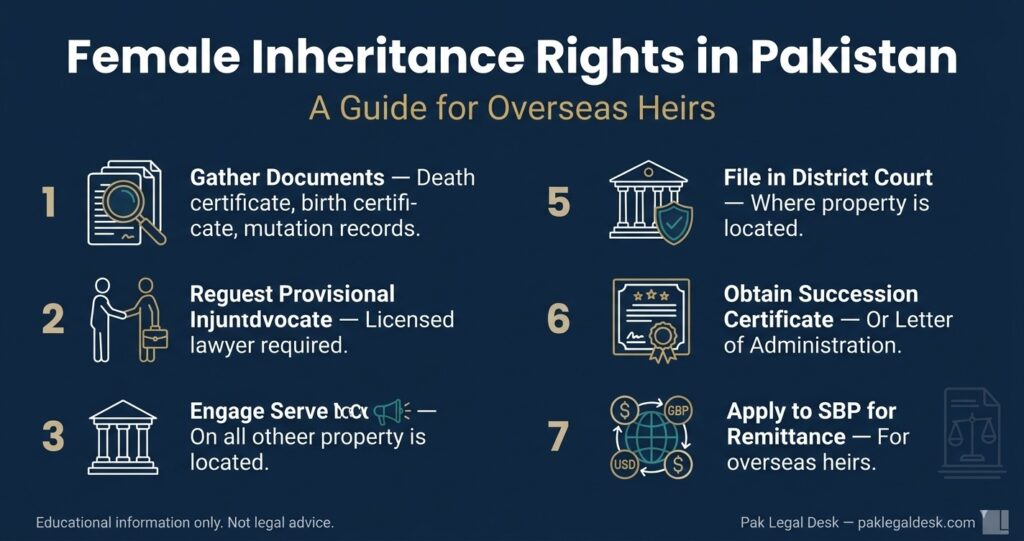
Step 1: Gather Primary Documents
Collect the death certificate of the deceased, your birth certificate, and any historic mutation or title deed linking you to the property. The Zarin Taja case demonstrated that the absence of such proof can defeat a claim.
Step 2: Engage a Licensed Pakistani Advocate
A licensed Pakistani advocate is mandatory for filing a plaint and representing you in court. Procedural rules require a Pakistani advocate to appear in court.
Step 3: File the Plaint
File the plaint in the civil court of the district where the immovable property is located. If the property lies in Khyber Pakhtunkhwa, you may invoke the provisions of the Khyber Pakhtunkhwa Enforcement of Women’s Property Rights Act, 2019.
Step 4: Serve Notice
Serve notice to all other legal heirs as required by the court rules. This step ensures that the claim is not dismissed for lack of proper service.
Step 5: Prepare Witness Statements and Affidavits
Prepare witness statements and affidavits that corroborate your relationship to the deceased. The High Court in CR No. 211-P/2014 emphasised the weight of such evidence.
Step 6: Attend the First Hearing
Attend the first hearing, where the court may order a provisional injunction to prevent the sale or transfer of the property pending final determination.
Step 7: Consider an Appeal
If the trial court rules against you, consider filing an appeal within the applicable limitation period.
Step 8: Explore Constitutional Remedies
Should administrative obstacles arise, explore filing a writ under Article 199 of the Constitution, following the approach permitted by the Constitution for contesting administrative actions that affect property rights.
Succession Certificate and Letter of Administration
The Khyber Pakhtunkhwa Letter of Administration and Succession Act, 2021 bars the jurisdiction of the civil court to grant a Succession Certificate or Letter of Administration, except where NADRA authorities decline to process the application.
A Succession Certificate is a legal document that declares the right of legal heirs to inherit debts and securities of a deceased person who died intestate (without a will). It is issued for movable and divisible property.
Proceedings are initiated by filing a petition in the Court of Senior Civil Judge. The court will direct verification of legal heirs, issue notices, and after recording evidence, pass an order for issuance of the Certificate of Succession.
A Letter of Administration is issued for indivisible property of the deceased and is granted for the purpose of administration of the property.
Remitting Inherited Assets Abroad
The State Bank of Pakistan has established procedures for overseas heirs to remit inherited assets. Applications for remittance of legacies and distributions from estates of deceased persons due to beneficiaries resident outside Pakistan should be referred to the State Bank for consideration.
The application must be accompanied by:
-
Name, nationality, and place of residence of the deceased at the time of death
-
A copy of the relevant clauses in the Will after Probate, or if the deceased died intestate, the Letters of Administration or Succession Certificate issued by NADRA or the court, duly authenticated by the issuing authority or a Notary Public
-
A full statement of the assets in Pakistan of the deceased
Common Mistakes to Avoid
Submitting incomplete genealogical records — The courts have dismissed claims lacking clear proof of lineage, as demonstrated in the Zarin Taja case.
Delaying the filing of the plaint — Timely action is essential. The Ali Asghar vs Farkhanda judgment notes that the 2019 Act provides a procedural avenue, but timely filing of complaints is essential.
Relying solely on oral testimony without corroborating documents — The High Court has stressed documentary evidence over oral statements.
Ignoring the need for a local legal representative — Procedural rules require a Pakistani advocate to appear in court.
Assuming that a constitutional writ will automatically succeed — A writ under Article 199 must meet strict procedural criteria.
Practical Compliance Checklist
-
☐ Obtain death certificate of the deceased
-
☐ Obtain your birth certificate and CNIC
-
☐ Gather historic mutation records and title deeds
-
☐ Engage a licensed Pakistani advocate
-
☐ Prepare a family tree showing all legal heirs
-
☐ File the plaint in the correct district court
-
☐ Serve notice on all other legal heirs
-
☐ Prepare witness statements and affidavits
-
☐ Consider applying for a provisional injunction
-
☐ For remittance of assets, obtain Succession Certificate or Letter of Administration
-
☐ Submit remittance application to the State Bank of Pakistan with required documents
Frequently Asked Questions
Q1: Can I inherit property in Pakistan if I live abroad?
Yes. Pakistani law does not bar overseas residents from inheriting. You must file the claim in the district court where the property is situated and provide the required documentation.
Q2: Do I need a Pakistani lawyer to pursue my inheritance claim?
A licensed Pakistani advocate is mandatory for filing a plaint, representing you in court, and ensuring compliance with procedural rules.
Q3: What share am I entitled to as a daughter?
Under Islamic law, a daughter receives one-half of the share that a son would receive. The exact portion depends on the presence of other heirs.
Q4: How do I obtain a Succession Certificate?
File a petition in the Court of Senior Civil Judge. The court will verify legal heirs, issue notices, and after recording evidence, issue the Certificate of Succession.
Q5: What is the difference between a Succession Certificate and a Letter of Administration?
A Succession Certificate is issued for movable and divisible property. A Letter of Administration is issued for indivisible property and for the purpose of administering the estate.
Q6: How can I remit inherited assets abroad?
The State Bank of Pakistan processes applications for remittance of legacies. Submit the required documents, including the Succession Certificate or Letter of Administration, to the State Bank.
Q7: What if other heirs try to sell the property before my claim is resolved?
You can request a provisional injunction during the first hearing to restrain any transfer or sale until the court decides on the inheritance dispute.
Q8: How long does the inheritance process take?
The timeline varies. Initial filing and first hearing may occur relatively quickly, but a final decree can take longer, especially if appeals are filed.
Q9: What is the Ombudsperson’s role in women’s property rights?
The Ombudsperson, appointed under the Protection against Harassment of Women at the Workplace Act, 2010, handles complaints under the Khyber Pakhtunkhwa Enforcement of Women’s Property Rights Act, 2019. However, the Ombudsperson has limited jurisdiction in complex matters involving title or partition disputes that are already before civil or revenue courts.
Final Takeaway
Overseas Pakistani women have a legal right to inherit property in Pakistan. The process requires careful documentation, timely action, and engagement of a licensed Pakistani advocate. The Khyber Pakhtunkhwa Enforcement of Women’s Property Rights Act, 2019 provides an additional avenue for women in that province. For remittance of inherited assets abroad, the State Bank of Pakistan has established procedures that require a Succession Certificate or Letter of Administration.
Pak Legal Desk CTA
If you are an overseas Pakistani woman seeking to claim your inheritance in Pakistan, start by collecting all relevant documents and engaging a qualified Pakistani advocate. The process involves specific procedural requirements that must be met. Professional legal guidance can help you navigate the civil court system, prepare the necessary documentation, and address any administrative obstacles that may arise. Pak Legal Desk can connect you with experienced lawyers who specialise in inheritance matters.
References
-
The Constitution of the Islamic Republic of Pakistan, 1973. Article 199.
-
West Pakistan Muslim Personal Law (Shariat) Application Act, 1962 (W.P. Act V of 1962).
-
Muslim Family Laws Ordinance, 1961 (Ordinance No. VIII of 1961).
-
Khyber Pakhtunkhwa Enforcement of Women’s Property Rights Act, 2019 (Act No. XLIV of 2019). https://www.pakp.gov.pk/act/the-khyber-pakhtunkhwa-enforcement-of-womens-property-rights-act-2019/
-
Protection against Harassment of Women at the Workplace Act, 2010 (Act IV of 2010). https://pakistancode.gov.pk/english/UY2FqaJw2-apaUY2Fqa-apaUY2Fsap0%3D-con-8570-sg-jjjjjjjjjjjjj
-
Khyber Pakhtunkhwa Letter of Administration and Succession Act, 2021.
-
Peshawar High Court. (2026). Mst. Zarin Taja vs Saifullah and others, C.R No. 211-P/2014. https://peshawarhighcourt.gov.pk/PHCCMS/judgments/CR-No.211-p-2014-(Mst.-Zarin-Taja)-dismissed-(at-variance).pdf
-
Peshawar High Court. (2025). Ali Asghar vs Mst. Farkhanda Rani, RFA No. 327-P/2024. https://www.peshawarhighcourt.gov.pk/PHCCMS//judgments/327-24-Ali-Asghar-vs-Farkhanda-(Ombudsperson)-consolidated-judgments.pdf
-
State Bank of Pakistan. (n.d.). Revised Para 03 of Chapter 16: Legacies and other Distributions of Assets from the Estate of Deceased Persons. https://www.sbp.org.pk/assets/documents/circulars/FECL11_Annex_A.pdf
-
Peshawar High Court. (n.d.). Courts and Masses: Succession Act. https://peshawarhighcourt.gov.pk/image_bank/Downloads/Courts%20and%20Masses.pdf
Legal Information Disclaimer
This article is provided for educational and informational purposes only. It does not constitute legal advice and should not be relied upon as a substitute for professional legal guidance. The information is based on Pakistani law, including the Legal Practitioners and Bar Councils Act, 1973, and the rules framed thereunder by the Pakistan Bar Council. Laws, regulations, and procedures may change. Readers should consult a licensed Pakistani advocate for advice specific to their circumstances. Pak Legal Desk does not guarantee any particular outcome. The sources referenced in this article were checked as at 28 September 2026.