

Quick Answer
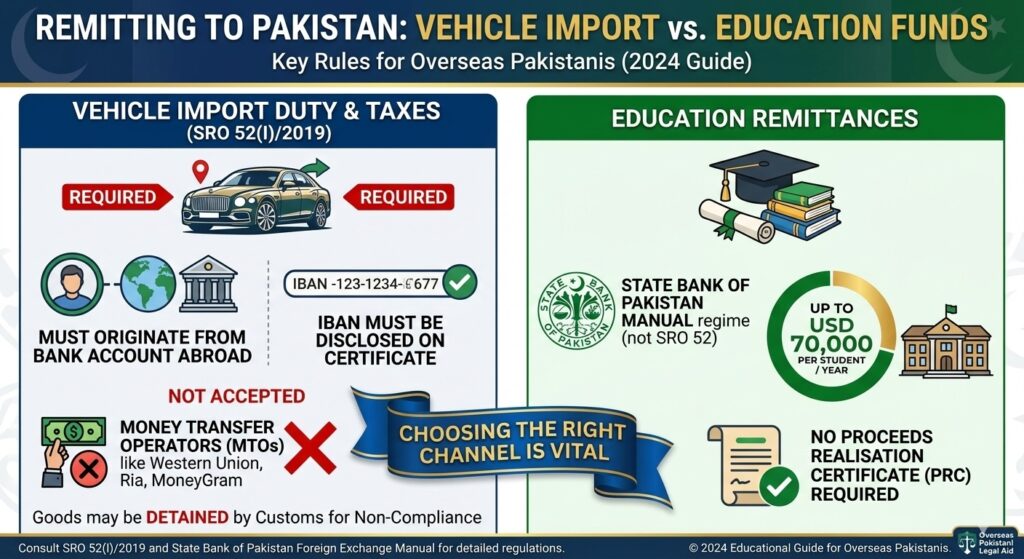
If you are an overseas Pakistani remitting funds to pay customs duty or taxes on an imported vehicle, SRO 52(I)/2019 requires that the money must originate from your own personal bank account abroad. The International Bank Account Number (IBAN) must be disclosed on the remittance certificate. Remittances sent through money transfer operators (MTOs) such as Western Union, Ria, or MoneyGram for duty-related payments are not accepted. For education remittances, a different regime applies: the State Bank of Pakistan’s Foreign Exchange Manual permits remittances of up to USD 70,000 per student per calendar year through authorised dealer banks, with no Proceeds Realisation Certificate required.
What the Law Says
The legal framework governing remittances for import-related payments in Pakistan is set by three overlapping instruments:
1. SRO 52(I)/2019 dated 15 January 2019. Issued by the Ministry of Commerce as an amendment to the Import Policy Order, this Statutory Regulatory Order provides that for vehicles imported under the personal baggage, transfer of residence, and gift schemes, the duty and taxes must be paid out of foreign exchange arranged by Pakistani nationals themselves or by a local recipient, supported by a bank encashment certificate showing conversion of the foreign remittance into local currency. A subsequent clarification issued by the Ministry of Commerce in September 2020 confirmed that the remittance “shall only be acceptable when [it] originate[s] from the bank account of the Overseas Pakistani sending/importing the vehicle from abroad, and the International Bank Account Number (IBAN) is disclosed on the remittance certificate”. Other modes of transfer are expressly not acceptable.
2. Import Policy Order, 2016 (IPO 2016). Paragraph 15 of the IPO 2016 governs the import of vehicles under personal baggage, transfer of residence, and gift schemes. Appendix E to the Order sets out the detailed procedure, including eligibility criteria and age restrictions. Vehicles more than five years old are not permitted under these schemes (with a limited exception for bullet-proof vehicles), and cars older than three years are also excluded. The duty and taxes for cars with engine capacity of 1800cc and above, and for new 4×4 vehicles imported under personal baggage or gift schemes, must be paid out of foreign exchange arranged by Pakistani nationals or a local recipient, supported by a bank encashment certificate.
3. State Bank of Pakistan regulations. The SBP’s Foreign Exchange Manual (Chapter 17) governs outward remittances for purposes such as education and medical treatment. These are separate from the duty-payment regime and follow different documentary requirements.
The practical effect of SRO 52(I)/2019 was considered by the Peshawar High Court in W.P. No. 4351-P/2023 (Faisal Ahmad and others v. Federation of Pakistan). The petitioners had imported used vehicles under Appendix E of the IPO 2016 and submitted Goods Declarations and Proceeds Realisation Certificates (PRCs). Customs detained the vehicles on the ground that the remittances for duties and taxes originated from accounts held with foreign exchange companies rather than bank accounts. The court examined the requirement and the distinction between bank-channel remittances and transfers through exchange companies.
Who This Applies To
The bank-channel requirement in SRO 52(I)/2019 applies specifically to:
-
Overseas Pakistanis importing vehicles into Pakistan under the personal baggage, transfer of residence, or gift schemes;
-
Local recipients in Pakistan receiving funds from an overseas Pakistani for the purpose of paying customs duty and taxes on such vehicles.
It does not apply to:
-
Remittances for family maintenance or general personal use, which may be received through banks or licensed exchange companies;
-
Remittances for education or medical treatment abroad, which are governed by the State Bank’s Foreign Exchange Manual;
-
Commercial imports made by registered importers through normal trade channels.
If you are sending money to Pakistan for a purpose other than paying customs duty on a personally imported vehicle, the SRO 52(I)/2019 bank-account requirement does not apply to you. The applicable rules will depend on the purpose of the remittance.
Practical Procedure for Duty-Related Remittances
For an overseas Pakistani seeking to remit funds for the customs duty on a used vehicle imported under one of the concessionary schemes, the verified procedure is as follows.
Step 1 — Confirm eligibility under the IPO 2016. Before any remittance is made, confirm that the vehicle meets the age and eligibility criteria in Appendix E of the IPO 2016. A vehicle that does not meet these criteria cannot be regularised through payment of duty, regardless of the remittance channel used.
Step 2 — Determine the assessed duty. The customs duty and taxes payable are assessed by Pakistan Customs upon filing of the Goods Declaration. The assessed amount determines how much foreign exchange must be remitted.
Step 3 — Remit from your personal bank account abroad. The funds must originate from your own bank account in the country where you reside. The remittance must be made through a bank, not through an exchange company or money transfer operator. The IBAN of your account must be disclosed on the remittance certificate.
Step 4 — Obtain a Proceeds Realisation Certificate (PRC). Once the funds are received in Pakistan, the receiving bank issues a PRC. Since August 2022, PRCs are issued electronically (e-PRC) and can be verified by Pakistan Customs, the FBR, and the SBP through an online portal. The PRC confirms that the funds were received from abroad and realised in Pakistan in PKR.
Step 5 — Present the PRC to Customs. The PRC, along with the Goods Declaration and other supporting documents, is presented to Pakistan Customs for clearance of the vehicle. Customs will verify the PRC through the bank’s online verification portal.
Step 6 — Retain records. Keep copies of the remittance instruction, the bank statement showing the transfer, the PRC, and the customs clearance documents for your records. The FBR may require these in any subsequent audit or verification.
Documentation Requirements
The following documents are required for duty-related remittances under the IPO 2016 and SRO 52(I)/2019:
| Document | Issuing Authority | Purpose |
|---|---|---|
| Goods Declaration (GD) | Importer / Customs Agent | Declares the imported vehicle to Customs |
| Proceeds Realisation Certificate (PRC) | Receiving bank in Pakistan | Confirms foreign remittance received |
| Bank remittance certificate showing IBAN | Sending bank abroad | Confirms origin of funds from sender’s account |
| Passport copy of overseas Pakistani | Sender | Establishes identity and eligibility |
| Age certificate / Bill of Lading | Shipping line / exporter | Establishes vehicle age for IPO 2016 compliance |
For education remittances, the documentation is different. The State Bank’s Foreign Exchange Manual requires a completed application form, copies of the student’s CNIC or Form ‘B’, the student’s passport, an admission letter from the foreign institution, and a cost sheet showing the breakdown of expenses. The bank remits the funds directly to the educational institution or to the student as appropriate.
Penalties and Consequences
The raw article’s claim that a penalty of “up to PKR 500,000” applies for using an MTO for duty-related payments could not be verified against any specific statutory provision or official notification. What can be verified is the following:
Detention of goods. Customs authorities may detain imported vehicles where the remittance for duty and taxes does not meet the requirements of SRO 52(I)/2019. This was the factual position in W.P. No. 4351-P/2023, where vehicles were detained at Peshawar Dry Port because the remittances originated from foreign exchange companies rather than bank accounts.
Penalties under the Customs Act, 1969. Section 156 of the Customs Act, 1969, provides for penalties for contraventions of the Act and related rules. The specific penalty applicable will depend on the nature of the contravention and the provisions invoked by Customs. No specific penalty amount is prescribed in SRO 52(I)/2019 itself.
Seizure and confiscation. Where false documentation is used to obtain clearance, Customs may initiate proceedings for confiscation of the goods and impose penalties. Recent enforcement actions have involved fake PRCs submitted by clearing agents in collusion with bank employees.
The practical consequence of non-compliance is therefore not a fixed monetary penalty, but the risk of detention, delayed clearance, and potential confiscation proceedings.
Common Mistakes to Avoid
Using a money transfer operator for duty payments. SRO 52(I)/2019 requires the funds to originate from a bank account. MTOs such as Western Union, Ria, and MoneyGram do not satisfy this requirement for duty-related payments, even though they are legitimate channels for other types of remittances.
Failing to ensure the IBAN is disclosed. The Ministry of Commerce clarification of 2020 requires the IBAN of the sender’s bank account to be disclosed on the remittance certificate. If the PRC does not show the IBAN, Customs may refuse to accept it.
Assuming a PRC is sufficient without the correct remittance channel. A PRC confirms that funds were received, but it does not by itself establish that the funds originated from an eligible bank account. Customs will examine the underlying remittance trail.
Not checking vehicle eligibility before remitting. If the vehicle does not meet the age criteria in Appendix E of the IPO 2016, no amount of duty payment will secure its release.
Relying on verbal assurances from agents. All arrangements should be confirmed in writing with the bank. Verbal assurances from clearing agents or informal intermediaries do not provide legal protection.
Practical Compliance Checklist
- Confirm the vehicle meets the age and eligibility criteria in Appendix E of the IPO 2016.
- Ensure the remittance originates from your personal bank account abroad.
- Confirm that your bank discloses the IBAN on the remittance certificate.
- Do not use a money transfer operator for duty-related payments.
- Obtain the electronic PRC from the receiving bank in Pakistan.
- Verify that the PRC can be accessed by Customs through the online verification portal.
- Present the PRC and Goods Declaration to Customs for clearance.
- Retain all remittance and clearance documents for at least five years.
- For education remittances, use an authorised dealer bank and comply with the State Bank’s Foreign Exchange Manual requirements.
Frequently Asked Questions
Q1: Can I use Western Union or MoneyGram to pay customs duty on an imported vehicle?
No. SRO 52(I)/2019, as clarified by the Ministry of Commerce in 2020, requires that remittances for the payment of duties and taxes originate from the bank account of the overseas Pakistani sending or importing the vehicle. MTOs and exchange companies do not satisfy this requirement.
Q2: What is a Proceeds Realisation Certificate and how do I get one?
A PRC is a certificate issued by the receiving bank in Pakistan confirming that foreign currency was received from abroad and converted into Pakistani Rupees through approved banking channels. Since August 2022, PRCs are issued electronically (e-PRC) as soon as funds are credited to the account. You obtain it from your bank in Pakistan.
Q3: Is a PRC issued by the FBR or by the bank?
The PRC is issued by the bank, not by the FBR. The FBR and Pakistan Customs can verify e-PRCs through the bank’s online verification portal. The raw article’s statement that a PRC must be obtained from the FBR is incorrect.
Q4: What documents do I need for an education remittance?
Under Chapter 17 of the State Bank’s Foreign Exchange Manual, you need a completed application form, copies of the student’s CNIC or Form ‘B’, the student’s passport, an admission letter from the foreign institution, and a cost sheet showing the breakdown of expenses. The bank remits the funds directly to the institution or to the student.
Q5: How much can I remit for education per year?
Authorised dealer banks may remit up to USD 70,000 per student per calendar year for tuition, living expenses, and other educational costs.
Q6: What happens if Customs detains my vehicle because the remittance came from an exchange company?
Customs may detain the vehicle pending verification. You will need to demonstrate that the remittance complies with SRO 52(I)/2019. If it does not, the vehicle may remain detained and clearance may be refused. In W.P. No. 4351-P/2023, the Peshawar High Court examined this issue where vehicles were detained at Peshawar Dry Port for this reason.
Q7: Does the bank-channel requirement apply to all remittances to Pakistan?
No. It applies specifically to remittances for the payment of customs duty and taxes on vehicles imported under the personal baggage, transfer of residence, and gift schemes. General family maintenance remittances and education remittances are governed by different rules.
Q8: Can I use a foreign currency account in Pakistan to pay the duty?
SRO 52(I)/2019 requires the remittance to originate from the overseas Pakistani’s bank account abroad. Payment from a local foreign currency account in Pakistan would not satisfy this requirement. The funds must be remitted from abroad through banking channels.
Q9: What is the penalty for not complying with SRO 52(I)/2019?
SRO 52(I)/2019 does not itself prescribe a specific monetary penalty. The consequences include detention of the imported goods and potential proceedings under the Customs Act, 1969. The specific penalty will depend on the nature of the contravention and the provisions invoked by Customs.
Q10: Is there a minimum or maximum amount below which the bank-channel rule does not apply?
No. SRO 52(I)/2019 does not differentiate based on the amount. The bank-account requirement applies to all duty-related remittances regardless of the sum involved.
Final Takeaway
For overseas Pakistanis importing vehicles under the concessionary schemes in the IPO 2016, the remittance rules are strict and specific. The funds must come from your own bank account abroad, the IBAN must be disclosed on the remittance certificate, and the transfer must be made through a bank — not an MTO or exchange company. The PRC is issued by the receiving bank, not by the FBR, and since 2022 it is issued electronically. Education remittances follow a separate regime under the State Bank’s Foreign Exchange Manual and are not subject to the SRO 52(I)/2019 bank-account requirement.
The most common cause of clearance delays is not the amount of duty paid, but the channel through which it was remitted. Checking the channel before sending funds is the single most effective step you can take to avoid detention of your vehicle.
Pak Legal Desk CTA
If you are planning to import a vehicle into Pakistan or need guidance on remittance compliance, Pak Legal Desk can assist. We provide research-based guidance on SRO 52(I)/2019, the Import Policy Order, and State Bank regulations. For personalised advice on your specific circumstances, schedule a consultation with a licensed Pakistani advocate.
References
-
Ministry of Commerce, Government of Pakistan. (2020). Clarification on SRO 52(I)/2019 dated 15.02.2019. Office Memorandum. https://senate.gov.pk/uploads/documents/debates/1623918422_180.pdf
-
Ministry of Commerce, Government of Pakistan. (2016). Import Policy Order, 2016. https://senate.gov.pk/uploads/documents/debates/1572000026_580.pdf
-
Peshawar High Court. (2024). W.P. No. 4351-P/2023: Faisal Ahmad and others v. Federation of Pakistan. https://www.peshawarhighcourt.gov.pk/PHCCMS//judgments/WP-4351-2023-DT-19-4-20250001.pdf
-
State Bank of Pakistan. (2022). Banks to issue proceed realization certificates electronically (Press Release ERD/M&PRD/PR/01/2022-94). https://www.sbp.org.pk/press/2022/Pr-06-Aug-2022.pdf
-
State Bank of Pakistan. (2015). Remittances for Medical Treatment and Studies Abroad (FE Circular No. 08 of 2015). https://www.sbp.org.pk/circulars/fe-circular-no-08-of-20215
-
State Bank of Pakistan. Frequently Asked Questions on Revised Instructions on Sale of Foreign Exchange by Exchange Companies to Individuals. https://www.sbp.org.pk/epd/pdf/FAQs.pdf
Legal Information Disclaimer
This article is provided for educational purposes only and does not constitute legal advice. The information is based on Pakistani law, including the Import Policy Order, 2016, SRO 52(I)/2019, the Customs Act, 1969, and State Bank of Pakistan regulations as checked on 28 September 2026. Laws and regulations may change. Readers should consult a licensed Pakistani advocate for advice specific to their circumstances. Nothing in this article creates an advocate-client relationship. Pak Legal Desk and its contributors accept no liability for any action taken or not taken on the basis of this information.