

Quick Answer
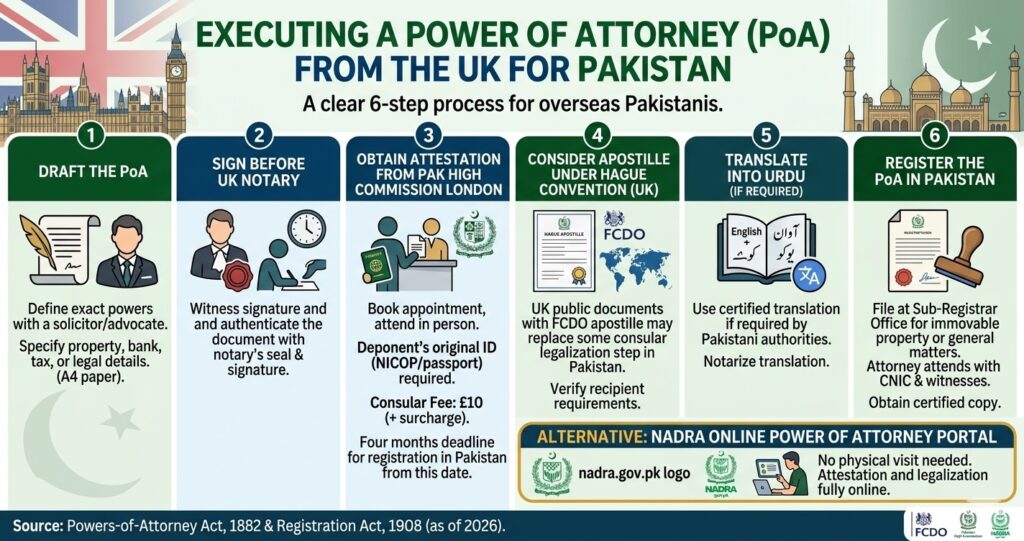
A power of attorney (PoA) executed in the United Kingdom for use in Pakistan must be drafted with precise powers, signed before a UK notary public, attested by the Pakistan High Commission in London, and registered with the relevant Sub-Registrar in Pakistan if it concerns immovable property. Since 9 March 2023, Pakistan accepts apostilles issued under the Hague Apostille Convention, which may replace the consular legalisation step for eligible UK public documents, but the Pakistan High Commission in London continues to attest powers of attorney directly. Overseas Pakistanis may alternatively use the NADRA online power of attorney portal.
What the Law Says
The execution and recognition of powers of attorney in Pakistan are governed principally by the Powers-of-Attorney Act, 1882 (Act No. VII of 1882), which extends to the whole of Pakistan. Section 2 of the Act provides that a donee of a power of attorney may execute instruments in their own name and signature, by the authority of the donor, and such instruments are as effectual in law as if executed by the donor.
Where a power of attorney is executed outside Pakistan and is to be used to present a document for registration under the Registration Act, 1908, Section 33(1)(c) provides that if the principal does not reside in Pakistan, the power of attorney must be executed before and authenticated by a Notary Public, or any Court, Judge, Magistrate, Pakistan Consul or Vice-Consul, or representative of the Federal Government. Such a power of attorney may be proved by production without further proof when it purports on its face to have been executed before and authenticated by the relevant person or court.
The Registration Act, 1908 further provides under Section 33 that powers of attorney recognised for the purposes of Section 32 (persons who may present documents for registration) include those executed before and authenticated by a Notary Public or any Court, Judge, Magistrate, Pakistan Consul or Vice-Consul, or representative of the Federal Government, where the principal does not reside in Pakistan.
Who This Applies To
This guidance applies to:
-
Pakistani nationals and dual nationals residing in the United Kingdom who need to authorise someone in Pakistan to manage property, bank accounts, tax matters, or legal proceedings.
-
British nationals who own property or have financial interests in Pakistan and wish to appoint an attorney.
-
Overseas Pakistanis who prefer to use the NADRA online power of attorney portal rather than attending the High Commission in person.
It does not apply to powers of attorney executed within Pakistan, which follow a different procedural route involving stamp paper, oath commissioners, and Sub-Registrar registration.
Step-by-Step Procedure
Step 1: Draft the Power of Attorney
Engage a qualified solicitor in the UK, or have the document drafted by an advocate in Pakistan, to prepare a power of attorney that clearly states the principal’s full name and identity document details, the attorney’s full name and CNIC/NICOP details, and the exact powers being granted. Avoid generic templates that do not specify the precise authority required for the intended transaction. Where the power relates to immovable property, the instrument must contain an express clause authorising alienation, because the authority to sell cannot be inferred from vague or general expressions.
The document should be printed on standard A4 paper in a clear, computerised format.
Step 2: Sign Before a UK Notary Public
The principal must sign the power of attorney in the presence of a UK notary public. The notary will affix their seal and signature, confirming the authenticity of the signature. Do not sign in advance of the appointment; the notary must witness the signature.
Step 3: Obtain Attestation from the Pakistan High Commission in London
Submit the notarised power of attorney to the Pakistan High Commission in London for attestation. An appointment must be booked in advance through the High Commission’s appointment system. The deponent must be physically present with their original passport or NICOP, the original power of attorney, and a copy for the High Commission’s records.
The current consular fee for attestation of a power of attorney is £10, with an additional £3 bank surcharge per application. For powers of attorney executed by foreign nationals and attested by the FCDO, the fee is £20. An additional fee of £10 per executor applies where there are additional executants.
The registration deadline for a power of attorney attested by the High Commission for Pakistan, London, or its Sub-Missions in Manchester, Birmingham, Bradford, and Glasgow, from the concerned Assistant Commissioner/Additional Collector/Sub-Registrar in Pakistan is four months from the date of attestation.
Step 4: Consider Apostille Under the Hague Convention
Pakistan joined the Hague Apostille Convention on 8 July 2022, and the Convention entered into force for Pakistan on 9 March 2023. Pakistan’s Ministry of Foreign Affairs includes the United Kingdom on its official list of countries accepting apostilles. An eligible UK public document can normally use an FCDO apostille instead of the former embassy and consular legalisation chain. However, an eligible UK document carrying an FCDO apostille should not need additional legalisation by the Pakistan High Commission, as the apostille replaces the longer diplomatic or consular legalisation process between countries where the Convention applies.
Notwithstanding the apostille, the Pakistani recipient—whether a university, employer, regulator, court, bank, or government office—may still set its own rules regarding original documents, certified copies, verification reports, translations, and document validity periods. An apostille does not remove the need to follow the recipient’s application checklist.
Step 5: Translate into Urdu (If Required)
Some Pakistani authorities require the power of attorney to be in Urdu. Use a certified translator and have the translation notarised.
Step 6: Register the Power of Attorney in Pakistan
File the original power of attorney, the attestation, the apostille (if applicable), and the Urdu translation with the Sub-Registrar Office where the property or matter is located. Registration is required where the power of attorney authorises dealings in immovable property. The attorney must attend the Sub-Registrar’s office with CNICs and witnesses.
The Sub-Registrar is required under Section 34 of the Registration Act, 1908, to enquire whether the document was executed by the persons by whom it purports to have been executed, and to satisfy himself as to the identity of the persons appearing before him.
Step 7: Obtain a Certified Copy
After registration, request a certified copy of the power of attorney from the Sub-Registrar. This copy can be presented to banks, government departments, or courts as proof of authority.
Alternative: NADRA Online Power of Attorney
The Government of Pakistan has launched an online attestation and legalisation service for powers of attorney through NADRA in collaboration with the Ministry of Foreign Affairs. Overseas Pakistanis can apply online at https://poa.nadra.gov.pk without physically visiting the consulate or embassy. Manual powers of attorney remain operational, and both systems run in parallel.
Fees
| Item | Fee | Source |
|---|---|---|
| Pakistan High Commission London attestation of power of attorney | £10 | |
| Bank surcharge per application | £3 | |
| Power of attorney (foreign nationals, FCDO attested) | £20 | |
| Additional fee per additional executor | £10 | |
| Punjab e-stamp paper for power of attorney (as of January 2026) | PKR 1,800 | |
| MOFA attestation of legal documents (effective 08 July 2024) | PKR 4,500 per document |
Fees for registration at the Sub-Registrar level vary by province and by the nature of the transaction. Legal practitioners’ fees for drafting and registration coordination are separate from government fees.
Deadline for Registration in Pakistan
The deadline for registration of a power of attorney attested by the High Commission for Pakistan, London, or its Sub-Missions, from the concerned Assistant Commissioner/Additional Collector/Sub-Registrar in Pakistan is four months from the date of attestation.
Consequences of Non-Compliance
Where a power of attorney is not proved in accordance with the requirements of the Registration Act, 1908, and the Powers-of-Attorney Act, 1882, any transaction based on it may be set aside. A power of attorney whose copy alone is produced, and which has not been proved so as to enable the court to examine whether it contained any express clause authorising alienation, cannot form the basis of a valid property transfer.
Common Mistakes to Avoid
-
Using a generic template that does not specify the exact powers required for the intended transaction.
-
Signing the document in advance instead of before the notary or consular officer.
-
Attending the wrong mission: consular jurisdiction is geographic, so the correct mission is the one covering the applicant’s area of residence, not the most convenient one.
-
Skipping notarisation or attestation, assuming a UK notary seal alone is sufficient for Pakistani authorities.
-
Failing to register the power of attorney with the Sub-Registrar where it concerns immovable property.
-
Omitting the express authority to alienate where the power of attorney is intended to authorise a sale of immovable property.
-
Not checking the attested document for name spellings, CNIC numbers, and property descriptions before leaving the consular counter. A name spelled differently from the NICOP or a wrong CNIC digit will result in refusal in Pakistan.
Practical Compliance Checklist
- Draft the power of attorney with precise, specific powers.
- Include an express clause authorising alienation if property is involved.
- Print on A4 paper in computerised format.
- Book an appointment with the Pakistan High Commission in London (or the correct consular jurisdiction).
- Bring original passport/NICOP, original PoA, and a copy.
- Sign before the consular officer; do not sign in advance.
- Pay the consular fee and obtain a receipt.
- Check the attested document before leaving the counter.
- Obtain FCDO apostille if the recipient requires it.
- Translate into Urdu if required by the receiving authority.
- Courier the original to Pakistan by tracked delivery.
- Register with the Sub-Registrar within four months of attestation.
- Obtain certified copies before the original is submitted.
Frequently Asked Questions
Q1: Can I grant a power of attorney to a family member living in Pakistan while I am in the UK?
Yes. The power of attorney must clearly state the family member’s name and the specific powers granted. The document must be notarised in the UK, attested by the Pakistan High Commission in London, and registered in Pakistan where it concerns immovable property.
Q2: Is an apostille required for a power of attorney used in Pakistan?
Pakistan joined the Hague Apostille Convention on 8 July 2022, and the Convention entered into force on 9 March 2023. An eligible UK public document can normally use an FCDO apostille instead of consular legalisation. However, the Pakistan High Commission in London continues to attest powers of attorney directly. Whether an apostille is sufficient depends on the requirements of the specific Pakistani recipient.
Q3: How long does the registration process take in Pakistan?
The registration timeline depends on the Sub-Registrar’s office and the completeness of the documents. The statutory deadline for registration of a power of attorney attested by the Pakistan High Commission in London is four months from the date of attestation.
Q4: Can I use the NADRA online portal instead of attending the High Commission?
Yes. The NADRA online power of attorney portal allows overseas Pakistanis to apply online at https://poa.nadra.gov.pk without physically visiting the consulate or embassy.
Q5: What happens if the power of attorney is challenged in court?
The court will examine whether the power of attorney was properly executed, attested, and registered. A power of attorney that has not been proved in accordance with the Registration Act, 1908, and the Powers-of-Attorney Act, 1882, may be declared void, and any transaction based on it may be set aside.
Q6: Can I revoke the power of attorney after it has been registered?
Yes. The principal can execute a revocation deed, have it notarised and attested, and file it with the same Sub-Registrar Office where the original power of attorney was registered.
Q7: What is the difference between a general and a special power of attorney?
A general power of attorney authorises a broad range of acts, while a special power of attorney is limited to a specific transaction or purpose.
Q8: Does a power of attorney always need to be registered in Pakistan?
Registration is generally required when the power authorises dealings in immovable property. Other general powers may be valid on attested stamp paper alone.
Q9: What is the current stamp paper fee for a power of attorney in Punjab?
As of January 2026, the e-stamp paper fee for a power of attorney in Punjab has been increased to PKR 1,800.
Q10: Can a UK solicitor draft the power of attorney?
A UK solicitor can draft the document, but it is advisable to have the draft reviewed in Pakistan before execution. A document that omits the specific authority the Sub-Registrar requires will be refused at registration, and the consular attestation step will have to be repeated.
Final Takeaway
A power of attorney executed in the UK for use in Pakistan is a structured legal instrument that requires precise drafting, proper notarisation, consular attestation by the Pakistan High Commission in London, and registration with the Sub-Registrar in Pakistan where immovable property is involved. The four-month registration deadline from the date of attestation must be observed. Overseas Pakistanis may alternatively use the NADRA online portal. The Powers-of-Attorney Act, 1882, and the Registration Act, 1908, provide the statutory framework, and compliance with both is essential for the instrument to be recognised and enforceable in Pakistan.
Pak Legal Desk CTA
If you need assistance drafting, attesting, or registering a power of attorney for use in Pakistan, Pak Legal Desk can connect you with a qualified Pakistani advocate who can review your requirements, prepare the instrument, and coordinate the attestation and registration process. Contact us for a consultation.
References
Powers-of-Attorney Act, 1882 (Act No. VII of 1882) (Pak.). Available at: https://pakistancode.gov.pk/pdffiles/administratorb062eb64b9476b2fda4f4609312b273d.pdf
Registration Act, 1908 (XVI of 1908) (Pak.), Section 33. Available at: https://commercial.lhc.gov.pk/pdf/14_THE_REGISTRATION_ACT_1908.pdf
Pakistan High Commission, London. (n.d.). Attestation. Available at: https://new.phclondon.org/consular-services/attestation/
Pakistan High Commission, London. (n.d.). Attestation Fees and Processing Time. Available at: https://www.phclondon.org/attestation-fee
Pakistan High Commission, London. (n.d.). Prerequisite for documents originating from the UK. Available at: https://new.phclondon.org/consular-services/attestation/
National Database and Registration Authority (NADRA). (n.d.). Automated Power of Attorney. Available at: https://poa.nadra.gov.pk
Ginkgo Advisory. (2026). FCDO e-Apostille for Pakistan: Solicitor Certification. Available at: https://ginkgoadvisory.com/fcdo-e-apostille-pakistan/
LexForm. (2026, July 17). General Power of Attorney Execution and Registration in Pakistan. Available at: https://lex-form.com/blog/general-power-of-attorney-execution-registration-pakistan-2026.html
Legal Information Disclaimer
This article is provided for general information and educational purposes only. It does not constitute legal advice and should not be relied upon as a substitute for consultation with a qualified legal practitioner. The legal position stated is based on the Powers-of-Attorney Act, 1882, the Registration Act, 1908, and official guidance from the Pakistan High Commission in London and the Ministry of Foreign Affairs as at the date of publication. Laws, regulations, fees, and official procedures are subject to change. Readers should verify the current position with a licensed Pakistani advocate or the relevant Pakistani authority before taking any action. No attorney-client relationship is created by the publication or reading of this article. Pak Legal Desk accepts no liability for any loss arising from reliance on the information contained herein.