
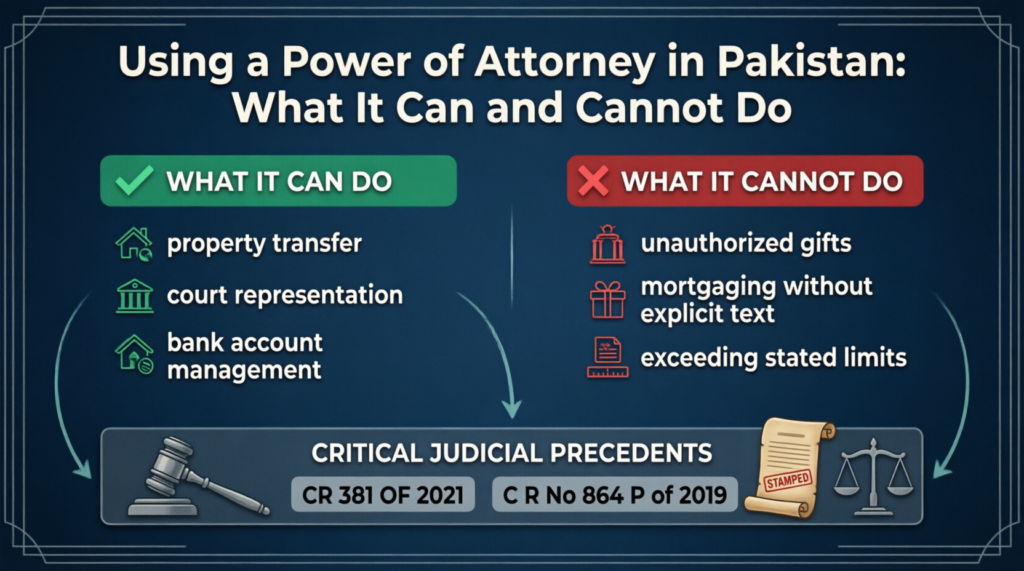

Quick Answer
A Power of Attorney (PoA) in Pakistan is governed by the Powers-of-Attorney Act, 1882 (Act VII of 1882), which extends to the whole of Pakistan. A PoA authorises an appointed attorney to act within the powers expressly conferred by the instrument. Any act beyond those powers is void unless the principal subsequently ratifies it. A PoA cannot be used to make unauthorised gifts, transfer property to the attorney’s own relatives without specific permission, or confer powers that the principal does not possess. Where the PoA relates to immovable property, registration under the Registration Act, 1908 is compulsory, and mere notarisation is insufficient.
What the Law Says
The Governing Statute
The creation and execution of a Power of Attorney in Pakistan are primarily governed by the Powers-of-Attorney Act, 1882 (Act VII of 1882). Section 2 of the Act provides that the donee of a power-of-attorney may execute or do any assurance, instrument or thing in and with his own name and signature, and every such instrument or thing so executed shall be as effectual in law as if it had been executed or done by the donor of the power.
The Act extends to the whole of Pakistan and came into force on 1 May 1882.
The Agent’s Authority Is Limited
The foundational principle of agency law in Pakistan is that an agent may act only within the authority expressly conferred by the principal. The Islamabad High Court in Access Solar (Pvt.) Ltd. v. Federation of Pakistan (RFA No. 124 of 2022) held that a power of attorney confers “only such authority as is conferred expressly or by necessary implication” and that judicial proceedings launched without proper authorisation are “a nullity in the eye of law”.
Registration Requirements for Immovable Property
Section 17 of the Registration Act, 1908 was amended by provincial legislation to include clause (ba), which provides that an instrument granting power to an attorney in respect of immovable property of the value of one hundred rupees and upward must be compulsorily registered.
The Supreme Court of Pakistan in Sirai Din v. Ghulam Nabi (PLD 2003 SC 159) held that where a power of attorney creates or purports to create any right, title or interest in immovable property, it must be compulsorily registered. Mere attestation by a Notary Public is not sufficient to meet the requirement of the law.
Fiduciary Nature of the Attorney’s Role
A General Power of Attorney creates a fiduciary relationship between the principal and the attorney. The attorney is obliged to act loyally and only within the scope of authority granted. The Supreme Court of Pakistan in Ijaz Bashir Qureshi v. Shams-un-Nisa Qureshi (Civil Appeal No. 1498 of 2016) examined whether an attorney under a General Power of Attorney can transfer the principal’s property through gift on the attorney’s own behalf.
The Lahore High Court has held that a holder of a general power of attorney must obtain special permission from the principal when alienating the principal’s property, particularly where the transfer is in favour of the attorney’s own relatives or spouse.
What a Power of Attorney Can Do
A properly drafted and executed PoA in Pakistan can authorise the attorney to:
-
Sell immovable property — where the PoA expressly grants the power of sale and is registered at the relevant Sub-Registrar office.
-
Manage bank accounts — including withdrawing funds, issuing cheques, and operating fixed deposits, where the instrument specifically authorises “management of bank accounts.”
-
Represent the principal in court — provided the PoA expressly confers the power to institute, defend, or conduct legal proceedings.
-
Execute contracts and commercial documents — where the instrument specifically lists such powers.
-
Receive and pay money on behalf of the principal.
-
Complete registration formalities for transactions already authorised by the principal.
What a Power of Attorney Cannot Do
A PoA cannot be used for the following purposes:
-
Making unauthorised gifts: An attorney cannot gift the principal’s property to any person, including the attorney’s own spouse or relatives, without specific and express authorisation in the instrument. The Lahore High Court has held that such a gift is beyond the PoA’s limits and can be set aside.
-
Transferring property to the attorney’s own relatives: A general power of attorney does not authorise the attorney to transfer the principal’s property to the attorney’s own kith and kin. Prior written approval of the principal is required.
-
Acting beyond the instrument: Any act not expressly mentioned in the PoA is void unless the principal later ratifies it.
-
Creating rights that the principal does not possess: An attorney cannot confer a greater right than the principal has.
-
Operating without registration for immovable property: An unregistered PoA relating to immovable property is ineffective against third parties and cannot be used to execute registered transfers.
Registration and Execution Requirements
Execution Before a Notary
A PoA must be executed before a Notary Public in Pakistan. Where the principal is resident outside Pakistan, the PoA may be executed before a Pakistani Notary, a Pakistani Consul or Vice-Consul, or a representative of the Federal Government.
Registration at the Sub-Registrar
Where the PoA relates to immovable property and creates or purports to create any right, title or interest in such property, it must be compulsorily registered at the relevant Sub-Registrar office. The Registration Act, 1908 requires the document to be presented for registration within four months of its execution.
Attestation and Authentication
For PoAs executed abroad, the document must be:
-
Notarised in the jurisdiction where it is executed.
-
Attested by the Pakistani High Commission or Embassy in that jurisdiction.
-
Where required, further authenticated by the Ministry of Foreign Affairs in Pakistan.
Overseas Pakistanis may now use the Automated Power of Attorney system managed by NADRA, which allows online application, biometric verification, and attestation through Pakistani missions abroad.
Practical Application for Common Scenarios
Selling Property in Pakistan While Abroad
A Pakistani expatriate in Dubai wishing to sell a house in Lahore must execute a PoA that specifically mentions “sale” as a permitted act. The PoA must be:
-
Executed before a Pakistani Notary or attested by the Pakistani Consulate in Dubai.
-
Registered at the relevant Sub-Registrar office in Lahore within four months.
-
The original instrument should be provided to the appointed attorney, with a certified copy retained by the principal.
The attorney can then sign the sale deed, obtain the title, and receive the proceeds — but only because the power of sale is expressly granted.
Managing Bank Accounts
A PoA authorising “management of bank accounts” enables the attorney to withdraw funds, issue cheques, and open fixed deposits. However, if the PoA does not expressly permit “investment in securities,” any such investment would be ultra vires and could be challenged.
Corporate Representation
A company incorporated in the UAE must provide a properly executed and attested PoA to a Pakistani manager before the manager can enter into supply contracts on the company’s behalf. The Islamabad High Court’s decision in Access Solar confirms that failure to produce a valid PoA can lead to the contract being struck down.
Common Mistakes to Avoid
| Mistake | Why It Is a Problem |
|---|---|
| Leaving the PoA vague | A generic “general power” without specific clauses leads to disputes. |
| Failing to register a property-related PoA | The instrument is ineffective against third parties. |
| Allowing the attorney to act beyond stated powers | Acts such as gifting assets without explicit consent are void. |
| Not obtaining a notarised copy | Courts may reject unauthenticated evidence. |
| Assuming a PoA signed abroad is automatically valid | It must be attested by a Pakistani Notary or Consulate. |
| Using a PoA after the principal’s death without knowledge | Section 3 of the Act protects payments made in good faith without notice of death or revocation. |
Step-by-Step Process
-
Identify the exact powers required — e.g., sale of immovable property, bank account management, or court representation.
-
Draft the PoA wording, ensuring each power is listed separately and clearly.
-
Execute the document before a Notary Public in Pakistan; the principal must sign in the presence of the Notary.
-
Register the PoA at the relevant Sub-Registrar office if it relates to immovable property. The deadline is four months from execution.
-
Provide the original PoA to the appointed attorney and retain a certified copy.
-
Request written receipts or acknowledgements for each transaction the attorney conducts.
-
Periodically review the PoA and revoke it in writing if the relationship changes or the purpose is fulfilled.
Revocation of a Power of Attorney
Under Sections 202 and 206 of the Contract Act, 1872, the principal is duty bound to give notice to the agent before cancellation of the power of attorney. Any revocation without notice to the attorney would be illegal.
Revocation must be made in writing and, where the PoA was registered, the revocation should also be registered to ensure public record. Notice of revocation should be formally communicated to the attorney and any third parties who relied on the PoA.
Frequently Asked Questions
Can a Power of Attorney be used to mortgage my house?
Only if the PoA expressly includes “mortgage” as a permitted act. Otherwise, the mortgage will be void, as the courts require clear authority for such encumbrances.
Do I need to register a Power of Attorney for bank transactions?
Registration is not mandatory for banking matters, but the bank will ask to see the original notarised PoA before allowing the attorney to operate the account.
What happens if my attorney gifts my property to his spouse?
Without a specific clause authorising gifts, such a transfer exceeds the PoA’s scope. The Lahore High Court has held that the attorney in whose favour there is a power of attorney to transfer property through gift has no right to gift the property to any person on his own behalf.
Is a Power of Attorney valid if signed in the UAE?
It must be notarised by a Pakistani Notary or attested by the Pakistani High Commission. Otherwise, Pakistani courts may reject it.
Can I revoke a Power of Attorney after it has been used?
Yes, provided the PoA is not coupled with an interest. A written revocation, signed and notarised, must be communicated to the attorney and any third parties who relied on the PoA. Under the Contract Act, 1872, notice to the agent is mandatory.
What is the deadline for registering a Power of Attorney in Pakistan?
The Registration Act, 1908 requires presentation for registration within four months from the date of execution.
Can a general power of attorney holder transfer property to his own relatives?
No. The Lahore High Court has held that it is obligatory upon the attorney to seek specific written permission from the principal before transferring the property to close blood relations or a spouse.
What happens if the principal dies before the attorney acts?
Section 3 of the Powers-of-Attorney Act, 1882 protects a person who makes a payment or does an act in good faith under the PoA without knowledge of the principal’s death. However, the PoA itself is terminated by the principal’s death.
Can an overseas Pakistani execute a PoA online?
Yes. The Automated Power of Attorney system managed by NADRA allows overseas Pakistanis to apply online, complete biometric verification, and obtain attestation through Pakistani missions abroad.
Is a Power of Attorney the same as a will?
No. A PoA operates during the principal’s lifetime and is generally revocable. A will takes effect only upon death and is governed by separate succession laws.
What is the difference between a General PoA and a Special PoA?
A General PoA grants broad powers, typically for managing all affairs. A Special PoA grants limited powers for a specific transaction or purpose. In either case, the attorney cannot exceed the powers expressly conferred.
Can a PoA be used to gift property to a charity?
Only if the PoA expressly authorises gifts, including to charitable organisations. Without such a clause, the gift is beyond the attorney’s authority.
Final Takeaway
A Power of Attorney in Pakistan is a powerful instrument, but its scope is strictly limited to the powers expressly conferred. It cannot be used to make unauthorised gifts, transfer property to the attorney’s own relatives without specific permission, or bypass registration requirements for immovable property. The Supreme Court and High Courts have consistently held that an attorney acts as a fiduciary and must remain within the bounds of the instrument. Whether you are an overseas Pakistani selling property, a company appointing an agent, or an individual managing bank accounts, the PoA must be drafted with precision, executed before a Notary, and registered where required.
Pak Legal Desk CTA
If you need a Power of Attorney drafted, registered, or challenged, Pak Legal Desk can connect you with a qualified Pakistani advocate who can tailor the instrument to your specific needs. Whether you are dealing with property in Lahore, bank accounts in Karachi, or corporate representation in Islamabad, our legal team can assist with the entire process — from drafting and notarisation to registration and enforcement.
Contact Pak Legal Desk for a consultation.
References
-
The Powers-of-Attorney Act, 1882 (Act VII of 1882). Pakistan Code. https://pakistancode.gov.pk
-
The Registration Act, 1908 (XVI of 1908). Pakistan Code. https://pakistancode.gov.pk
-
The Contract Act, 1872. Pakistan Code. https://pakistancode.gov.pk
-
Sirai Din v. Ghulam Nabi, PLD 2003 SC 159 (Supreme Court of Pakistan).
-
Ijaz Bashir Qureshi v. Shams-un-Nisa Qureshi, Civil Appeal No. 1498 of 2016 (Supreme Court of Pakistan).
-
Access Solar (Pvt.) Ltd. v. Federation of Pakistan, RFA No. 124 of 2022 (Islamabad High Court).
-
Syed Monis Raza v. Mst. Asia Bano, Civil Revision No. 314-D of 2015 (Lahore High Court).
-
High Commission for Pakistan, Wellington. Attestation of Power of Attorney — Registration Deadline. https://pakhcwellington.wixsite.com
-
Embassy of Pakistan, Kabul. Automated Power of Attorney — Application Submission Guidelines. https://pakembassykabul.gov.pk
-
Ministry of Foreign Affairs, Pakistan. Power of Attorney Attestation Guidelines. https://mofa.gov.pk
Legal Information Disclaimer
This article is provided for educational and information purposes only and does not constitute legal advice. The information is based on Pakistani law as at the date of publication. Laws, regulations, and judicial interpretations may change. Readers should consult a qualified Pakistani advocate for advice specific to their circumstances. Nothing in this article creates an attorney-client relationship. Pak Legal Desk is not a law firm and does not provide legal representation. Any reliance on the information herein is at the reader’s own risk. This article is intended to comply with the professional and ethical standards applicable to legal information dissemination in Pakistan, including the Pakistan Bar Council Act and the rules framed thereunder.