

Quick Answer
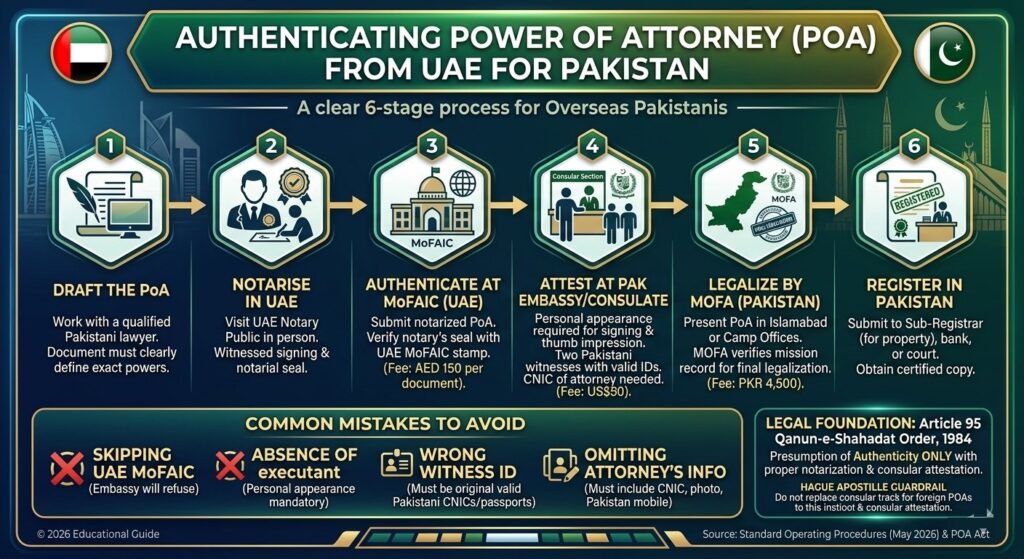
A Power of Attorney (POA) executed by a Pakistani national in the UAE is enforceable in Pakistan only after completing a four-stage authentication chain: notarisation before a UAE Notary Public, authentication by the UAE Ministry of Foreign Affairs and International Cooperation (MoFAIC), attestation by the Pakistan Embassy in Abu Dhabi or the Consulate General in Dubai, and final legalisation by the Ministry of Foreign Affairs (MOFA) in Islamabad. Under Article 95 of the Qanun-e-Shahadat Order, 1984, a POA executed before and authenticated by a Notary Public or a Pakistan Consul attracts a presumption of due execution and authentication. Without the full chain, Pakistani courts, banks, and land registries may decline to act on the document.
What the Law Says
The Power of Attorney Act, 1872
The Power of Attorney Act, 1872 governs the creation and execution of powers of attorney in Pakistan. A POA is a formal instrument by which one person (the principal or executant) authorises another (the attorney or donee) to act on their behalf in specified legal, financial, or property matters. The Act does not prescribe a single mandatory form, but the document must clearly identify the principal, the attorney, and the scope of authority conferred.
Qanun-e-Shahadat Order, 1984 — Presumption of Authenticity
Article 95 of the Qanun-e-Shahadat Order, 1984 provides that when a document purporting to be a power of attorney has been executed before and authenticated by a Notary Public, a Court, a Judge, a Magistrate, a Pakistan Consul or Vice-Consul, or a representative of the Federal Government, the Court shall presume that the document was so executed and authenticated. This presumption is the legal foundation for requiring notarisation and consular attestation. Critically, the presumption attaches only where the POA has been executed in the manner contemplated by Article 95. A POA that lacks proper notarial or consular authentication does not benefit from this statutory presumption.
For foreign-issued public documents generally, Article 89(5) of the Qanun-e-Shahadat Order provides that a public document from a foreign country may be proved by the original or a certified copy, with a certificate under the seal of a Notary Public or a Pakistan Consul or diplomatic agent confirming that the copy is duly certified by the officer having legal custody of the original.
Constitutional Context — Article 199
Article 199 of the Constitution of the Islamic Republic of Pakistan, 1973 empowers High Courts to issue writs, including certiorari under Article 199(1)(b)(ii), to examine the legality of actions taken by authorities exercising functions within their territorial jurisdiction. While this provision does not directly regulate POA attestation, it underscores that documents submitted before Pakistani judicial and administrative authorities must satisfy procedural requirements of authentication and verification.
Who This Applies To
This process applies to Pakistani nationals resident in the United Arab Emirates — whether in Dubai, Abu Dhabi, Sharjah, or any other Emirate — who need to execute a POA for use in Pakistan. Common scenarios include:
-
Sale, purchase, or transfer of immovable property in Pakistan
-
Bank transactions and account operations
-
Representation before Pakistani courts or tribunals
-
Family matters, including inheritance and succession
-
Corporate and commercial transactions requiring a Pakistani-based representative
Step-by-Step Process
Step 1: Draft the POA
Engage a qualified Pakistani lawyer to draft the POA. The document must identify the executant (principal) and the attorney (donee) with full particulars, specify the property or assets to be dealt with, and delineate the powers conferred. The executant will make a document mentioning all details of the executant and attorney and the specific property or assets to be sold, purchased, or transferred.
Step 2: Notarise in the UAE
Visit a UAE Notary Public authorised by the relevant Emirate’s courts. The notary will verify the signatory’s identity, witness the signature, and affix the notarial seal. Personal appearance is required.
Step 3: Authenticate with UAE MoFAIC
Submit the notarised POA to the UAE Ministry of Foreign Affairs and International Cooperation (MoFAIC). The MoFAIC will place its official stamp confirming that the notary’s seal is genuine. For personal documents, the MoFAIC attestation fee is AED 150 per document. Processing is typically completed within a few working days.
Step 4: Attest at the Pakistan Embassy or Consulate
Present the MoFAIC-authenticated POA to the Consular Section of the Pakistan Embassy in Abu Dhabi or the Consulate General in Dubai, depending on the applicant’s Emirate of residence. The following are required:
-
Personal appearance of the executant at the Consulate for signature and thumb impression
-
Two Pakistani witnesses with original and copy of their valid CNICs and passports
-
Original and copy of the executant’s CNIC and passport
-
CNIC copy of the attorney with a Pakistan mobile number
-
One photograph of the attorney
-
Two photographs of the executant and one photograph of each witness
A register is maintained at the Consulate for the signature and thumb impression of the executant and the two witnesses. The consular fee for attestation of a Power of Attorney is US$50.
Step 5: Legalisation by MOFA Islamabad
Upon arrival in Pakistan, the POA must be presented to the Ministry of Foreign Affairs (MOFA), Islamabad, or one of its Camp Offices in provincial capitals for final legalisation. Under the Standard Operating Procedures for Attestation of Documents (May 2026), a POA originating from abroad for use in Pakistan must first be attested by Pakistan’s Embassy or Consulate in the concerned country; after obtaining confirmation of genuineness from that mission, MOFA will attest it. Personal appearance of the principal is mandatory for POA attestation at MOFA. The apostille fee for legal documents is PKR 4,500 per document.
Step 6: Register or Submit to the Relevant Authority
Depending on the purpose of the POA, submit or register the fully attested document with the relevant Pakistani authority — for example, the Registrar of Deeds for property transactions, the State Bank of Pakistan for banking matters, or the relevant court for litigation.
Fees
| Item | Fee | Source |
|---|---|---|
| UAE Notary Public | Varies by Emirate; confirm with the notary | — |
| UAE MoFAIC attestation (personal document) | AED 150 | |
| Pakistan Embassy/Consulate attestation | US$50 | |
| MOFA Islamabad final legalisation (legal document) | PKR 4,500 |
Fees are subject to revision. The UAE MoFAIC fee and MOFA Islamabad fee should be confirmed immediately before submission.
Common Mistakes to Avoid
Skipping UAE MoFAIC authentication. The Pakistan Embassy will not attest a POA that has not first been authenticated by the UAE Ministry of Foreign Affairs. This is a sequential requirement.
Failing to appear in person. Personal appearance of the executant before the Consular Section is mandatory for POA attestation. The executant must sign and provide a thumb impression in the presence of two Pakistani witnesses.
Insufficient witness documentation. Both witnesses must be Pakistani nationals with valid original CNICs and passports, and copies must be provided. Witnesses without proper documentation will cause the application to be refused.
Omitting the attorney’s CNIC and photograph. The Consulate requires a CNIC copy of the attorney with a Pakistan mobile number, as well as one photograph of the attorney.
Assuming apostille replaces consular attestation. Pakistan acceded to the Hague Apostille Convention, effective 9 March 2023. However, the Apostille Act, 2023 designates MOFA as the competent authority for apostille certification for documents issued in Pakistan. The Act does not remove the requirement for consular attestation of foreign-issued POAs for use in Pakistan. The POA must still be attested by the Pakistan Embassy or Consulate in the country of execution.
Practical Compliance Checklist
- □ POA drafted by a qualified Pakistani lawyer
- □ Executant’s identity documents (passport, CNIC/NICOP) ready
- □ Two Pakistani witnesses identified and their documents ready
- □ POA notarised before a UAE Notary Public
- □ UAE MoFAIC authentication obtained
- □ Pakistan Embassy/Consulate attestation completed (personal appearance, witnesses present)
- □ Consular fee paid (US$50)
- □ MOFA Islamabad legalisation obtained (personal appearance of principal mandatory)
- □ Document registered or submitted to the relevant Pakistani authority
Frequently Asked Questions
Q1: Can a POA be executed in the UAE without appearing in person at the Pakistan Embassy?
No. Personal appearance of the executant before the Consular Section is mandatory for POA attestation. The executant must sign and provide a thumb impression in the presence of two Pakistani witnesses.
Q2: What is the fee for POA attestation at the Pakistan Embassy in Abu Dhabi?
The consular fee for attestation of a Power of Attorney is US$50.
Q3: Is UAE MoFAIC attestation required before Pakistan Embassy attestation?
Yes. The Pakistan Embassy requires the document to have been authenticated by the UAE Ministry of Foreign Affairs and International Cooperation (MoFAIC) before it will attest the POA.
Q4: Does Article 95 of the Qanun-e-Shahadat Order automatically validate a POA?
No. Article 95 creates a presumption of due execution and authentication only where the POA has in fact been executed before and authenticated by a Notary Public, Court, Judge, Magistrate, Pakistan Consul, or representative of the Federal Government. Without such authentication, the presumption does not arise.
Q5: What is the fee for MOFA Islamabad legalisation of a POA?
For legal documents, the MOFA Islamabad apostille fee is PKR 4,500 per document.
Q6: Can I execute a POA through the NADRA online portal instead of attending the Embassy?
The NADRA online POA portal (poa.nadra.gov.pk) allows Pakistani expatriates to execute a POA through a video interview with the relevant Consulate or Embassy. The NADRA system provides an alternative to in-person attendance at the Consulate, subject to the requirements of that system.
Q7: Does Pakistan’s accession to the Hague Apostille Convention eliminate the need for Embassy attestation of a UAE-issued POA?
No. The Apostille Act, 2023 designates MOFA as the competent authority for apostille certification for documents issued in Pakistan. For a POA executed in the UAE for use in Pakistan, the document must be attested by the Pakistan Embassy or Consulate in the UAE. MOFA Islamabad will then legalise it upon confirmation of genuineness from the Embassy.
Q8: What happens if the POA is not properly attested?
A POA that lacks the required authentication may not benefit from the presumption under Article 95 of the Qanun-e-Shahadat Order, and Pakistani courts, banks, and land registries may decline to act on it. The document may be treated as unproven.
Final Takeaway
POA attestation from the UAE for use in Pakistan is a sequential process: notarisation, UAE MoFAIC authentication, Pakistan Embassy/Consulate attestation with personal appearance and witnesses, and final MOFA Islamabad legalisation. Each stage is mandatory. The statutory presumption of authenticity under Article 95 of the Qanun-e-Shahadat Order, 1984 rewards strict compliance; it does not excuse procedural shortcuts.
Pak Legal Desk CTA
If you need assistance drafting a POA for execution in the UAE, coordinating the attestation chain, or verifying that an existing POA meets Pakistani legal requirements, contact Pak Legal Desk to consult a licensed Pakistani advocate experienced in cross-border document authentication.
References
Constitution of the Islamic Republic of Pakistan, 1973, Article 199.
Qanun-e-Shahadat Order, 1984 (X of 1984), Articles 89 and 95.
Power of Attorney Act, 1872.
Ministry of Foreign Affairs, Government of Pakistan. (2026). Standard Operating Procedures for Attestation of Documents (May 2026). https://mofa.gov.pk/storage/files/1/6a8535a9aff29.pdf
Ministry of Foreign Affairs, Government of Pakistan. Power of Attorney — Consular Requirements. https://www.mofa.gov.pk/chengdu-power-of-attorney
Ministry of Foreign Affairs, Government of Pakistan. Attestations and Power of Attorney — Consular Fee (Revised w.e.f. 20 September 2024). https://mofa.gov.pk
National Information Technology Board. (2026). PAK Center Service Catalogue (Updated 30 March 2026). https://www.nitb.gov.pk/PAKC/Service%20Catalog%20PAKC.pdf
Apostille Act, 2023.
United Arab Emirates Ministry of Foreign Affairs and International Cooperation. Attestation Service Fees. https://www.mofa.gov.ae
Legal Information Disclaimer
This article is provided for educational and informational purposes only and does not constitute legal advice or a substitute for consultation with a qualified legal professional. The legal position stated is based on the sources identified and checked as at 28 September 2026. Laws, regulations, fees, and administrative procedures are subject to change. Nothing in this article creates an attorney-client relationship. Readers should consult a licensed advocate enrolled under the Pakistan Bar Council Act, 1973 or the relevant provincial Bar Council before acting on any matter discussed herein. Pak Legal Desk does not guarantee any particular outcome and accepts no liability for reliance on this general information.