

Quick Answer
Contract templates for Pakistani businesses can be a practical starting point for routine transactions such as standard service agreements, mutual NDAs, and basic employment contracts. Under the Contract Act, 1872, a contract does not need to be drafted by a lawyer to be legally valid, provided it meets the essential requirements of offer, acceptance, lawful consideration, free consent, capacity, and lawful object. However, templates cannot be treated as a substitute for legal advice. Customised drafting or professional review becomes essential for high-value transactions, complex intellectual property arrangements, cross-border engagements, regulated sectors, and any situation where the parties have unequal bargaining power or where liability exposure is significant.
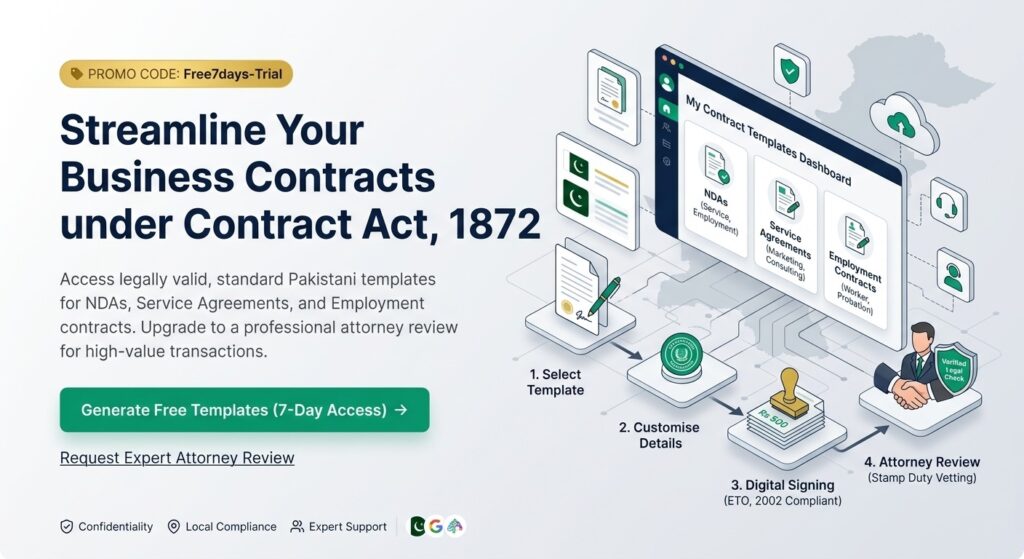
Generate free Contract templates – Get free 7 Days Acees Use Promo Code : Free7days-Trial
What the Law Says
The Contract Act, 1872
The Contract Act, 1872 is the foundational statute governing commercial agreements in Pakistan. Section 10 provides that “all agreements are contracts if they are made by the free consent of parties competent to contract, for a lawful consideration and with a lawful object, and are not hereby expressly declared to be void”. This means that, in principle, even an oral agreement can be legally binding. In commercial practice, however, a written contract is indispensable because it provides clarity, evidence, and enforceability.
Two provisions of the Contract Act are particularly relevant to business contracts:
-
Section 27 renders void every agreement by which any person is restrained from exercising a lawful profession, trade, or business of any kind. This has significant implications for non-compete clauses in employment and consultancy agreements.
-
Section 56 provides for the doctrine of frustration, under which a contract becomes void where performance is rendered impossible by an unpreventable event.
Companies Act, 2017
For companies incorporated under the Companies Act, 2017, Section 201 governs the method of contracting. A company may enter into a contract or other enforceable obligation through a person acting under its express or implied authority. For unlisted companies, the requirement to execute written contracts under seal has been relaxed, leaving the matter to be decided in accordance with the articles of association.
Electronic Transactions Ordinance, 2002
The Electronic Transactions Ordinance, 2002 recognises electronic documents, records, and signatures. It provides legal recognition to electronic transactions and signatures and includes provisions preventing fraud in the application of electronic signatures and violation of privacy of information. This Ordinance facilitates digital contracting, though certain documents (such as wills, trusts, and powers of attorney) are excluded from its scope.
Stamp Duty
Stamp duty is a provincial subject in Pakistan. Rates vary across provinces and have recently been revised. As of January 2026, the stamp paper used for any private or business contract is Rs 500 (previously Rs 100). For contracts up to Rs 5 lakh, a stamp of Rs 3,000 is mandatory; for contracts between Rs 5 lakh and Rs 10 lakh, Rs 6,000; and for contracts exceeding Rs 15 million, an additional Rs 20,000 is required. Failure to pay proper stamp duty does not render a contract void, but it may affect admissibility in evidence and attract penalties.
Employment Legislation
Employment relationships are governed by overlapping federal and provincial statutes. The West Pakistan Industrial and Commercial Employment (Standing Orders) Ordinance, 1968 requires that every workman be provided with an order in writing showing the terms and conditions of service at the time of appointment, transfer, or promotion. Similar provisions exist in the Khyber Pakhtunkhwa Industrial and Commercial Employment (Standing Order) Act 2013 and the Sindh Terms of Employment (Standing Orders) Act 2015.
Under the Standing Orders Ordinance, the probation period is capped at three months. A “permanent workman” is one who has been engaged on work of a permanent nature likely to last more than nine months and has satisfactorily completed a three-month probationary period.
Partnership Act, 1932
A partnership is the relationship between persons who have agreed to share the profits of a business carried on by all or any of them acting for all. Registration of a partnership firm is voluntary, but Section 69 provides that an unregistered firm cannot enforce its rights arising from a contract in court. A written and registered partnership deed is therefore strongly advisable.
Arbitration Act, 1940
The Arbitration Act, 1940 provides the legal framework for arbitration in Pakistan. An arbitration agreement must be in writing and must reflect the parties’ intention to submit present or future differences to arbitration. Courts in Pakistan have upheld multi-tier dispute resolution clauses requiring negotiation, mediation, or adjudication before arbitration.
Who Does This Apply To?
This guide is relevant to:
-
SMEs and startups entering into commercial agreements
-
Freelancers, consultants, and independent contractors
-
Employers and HR managers drafting employment contracts
-
Suppliers and vendors negotiating supply terms
-
Agencies and service businesses engaging clients
-
Pakistani companies contracting with domestic and international parties
Contract Template Categories
1. Non-Disclosure Agreement (NDA)
Purpose: Protects confidential information shared between parties during negotiations, employment, or commercial collaboration.
When to use: Before sharing business plans, financial data, technical specifications, client lists, or proprietary processes with a potential partner, employee, contractor, or vendor.
Key clauses: Definition of confidential information; permitted use; exclusions (public domain, prior possession, independently developed); term of confidentiality; return or destruction of materials; remedies for breach; governing law and jurisdiction.
Template vs custom: A standard mutual NDA template is often sufficient for routine disclosures. Custom drafting is advisable when the confidential information includes trade secrets with significant commercial value or when cross-border disclosure is involved.
2. Service Agreement
Purpose: Governs the provision of services by one party to another on an ongoing or project basis.
When to use: Engaging a service provider for marketing, design, consulting, maintenance, or professional services.
Key clauses: Scope of services (detailed schedule); service levels and performance metrics; payment terms (amount, timing, method); taxes (who bears withholding tax, sales tax); term and termination; confidentiality; intellectual property ownership; representations and warranties; limitation of liability; indemnity; force majeure; dispute resolution; governing law.
Tax consideration: Withholding tax under Section 153 of the Income Tax Ordinance, 2001 applies to payments for services. The contract should specify whether the service fee is inclusive or exclusive of tax and which party is responsible for deduction and deposit.
Template vs custom: A standard service agreement template works for routine, low-value, short-duration engagements. Custom drafting becomes important for high-value contracts, complex service levels, or where regulatory compliance is involved.
3. Consultancy Agreement
Purpose: Engages an independent consultant to provide expert advice or specialised services.
When to use: Hiring a management consultant, legal advisor, tax consultant, or technical expert on a retainer or project basis.
Key clauses: Scope of consultancy; deliverables and timelines; fees and expenses; independent contractor status; confidentiality; intellectual property (work product ownership); non-solicitation; termination; limitation of liability.
Misclassification risk: Pakistani courts distinguish between a “contract of service” (employment) and a “contract for service” (independent contractor). The Supreme Court of Pakistan has held that outsourcing agreements used to evade labour rights may be considered a “sham or pretence,” and the true employment relationship will be recognised.
Template vs custom: A template is suitable for straightforward consultancy engagements. Custom review is recommended where the consultant will have access to sensitive data, where the engagement is long-term, or where the consultant is based outside Pakistan.
4. Employment Agreement
Purpose: Establishes the terms and conditions of employment between an employer and an employee.
When to use: Hiring any employee, whether permanent, probationary, or fixed-term.
Mandatory contents: Under the applicable Standing Orders, the employment agreement must include the employer’s name and address, the employee’s full name, date of birth, gender, residence, CNIC or passport number, job title and description, working hours, wages, benefits, probation period, and termination procedures.
Key clauses: Appointment and duties; remuneration and benefits (including EOBI, social security, gratuity); working hours and leave; probation; termination (notice period, grounds); confidentiality; intellectual property assignment; non-compete (carefully drafted — restraints of trade may be void under Section 27 of the Contract Act); dispute resolution; governing law.
Provincial variations: Labour legislation varies across provinces. Punjab, Sindh, Khyber Pakhtunkhwa, and Balochistan each have their own statutes governing industrial relations, minimum wages, and working conditions.
Template vs custom: A well-drafted template covering the mandatory particulars is appropriate for standard hires. Custom drafting is essential for senior executives, expatriate employees, or where the employer operates in a regulated sector.
5. Independent Contractor Agreement
Purpose: Engages a self-employed individual or entity to provide services without creating an employment relationship.
When to use: Hiring freelancers, agencies, or independent professionals for specific projects or ongoing work.
Key clauses: Scope of work; deliverables; independent contractor status (explicit declaration that no employment relationship is created); fees and payment terms; taxes (contractor responsible for own income tax and social security); confidentiality; intellectual property assignment; indemnity; termination; dispute resolution.
IP assignment: Under Section 13 of the Copyright Ordinance, 1962, the “Author” is the first owner of copyright. Without a formal assignment, a business only has an implied licence to use the work. Section 14 of the Ordinance provides that an owner of copyright may assign the copyright either wholly or partially. Every independent contractor agreement should include an explicit clause assigning all intellectual property in the deliverables to the client upon full payment.
Template vs custom: Templates are widely used for freelancer engagements. Custom review is advisable for high-value projects, where IP is the core asset, or where the contractor operates across multiple jurisdictions.
6. Vendor/Supplier Agreement
Purpose: Governs the purchase and supply of goods or materials.
When to use: Procuring raw materials, inventory, equipment, or consumables from a supplier.
Key clauses: Specifications and quality standards; pricing and price adjustment mechanisms; delivery terms (Incoterms if international); acceptance and rejection procedures; warranties (quality, fitness for purpose, title); payment terms; risk and title transfer; indemnity; limitation of liability; termination; force majeure.
Template vs custom: A standard supply agreement template works for routine purchases. Custom drafting is important for critical supply chains, perishable goods, or regulated products.
7. Partnership Agreement
Purpose: Documents the terms of a partnership under the Partnership Act, 1932.
When to use: When two or more persons agree to carry on a business and share profits.
Key clauses: Firm name; nature of business; capital contributions; profit-sharing ratio; partner roles and authority; decision-making (majority vs unanimous); admission and retirement of partners; expulsion; dissolution; valuation of share on exit; non-compete; dispute resolution.
Registration: While registration is voluntary, an unregistered firm cannot enforce its contractual rights in court under Section 69 of the Partnership Act, 1932. The Supreme Court of Pakistan has confirmed that the bar under Section 69 applies to suits for enforcement of rights arising from a contract by an unregistered firm. Registration with the Registrar of Firms is therefore strongly recommended.
Template vs custom: A standard partnership deed template covering the essential terms is a reasonable starting point. Custom drafting is strongly recommended for multi-partner firms or where the business holds significant assets or IP.
8. Memorandum of Understanding (MOU)
Purpose: Records preliminary understanding between parties before a binding contract is executed.
When to use: During negotiations for joint ventures, partnerships, collaborations, or large transactions.
Legal status: An MOU is generally not legally binding, as it expresses intent rather than enforceable obligations. However, Pakistani courts may enforce an MOU as a contract if it contains the essential elements of a contract under the Contract Act, 1872. If any provisions are intended to be binding (e.g., confidentiality, exclusivity), this should be expressly stated.
Template vs custom: A template MOU is suitable for simple, early-stage discussions. Custom drafting is essential where substantial commitments are contemplated or where confidential information will be shared.
9. Software/IT Services Agreement
Purpose: Governs the development, licensing, implementation, or maintenance of software and IT systems.
When to use: Commissioning custom software development, licensing enterprise software, engaging IT support, or implementing ERP/CRM systems.
Key clauses: Scope of work and technical specifications; development methodology and milestones; acceptance testing criteria; source code and object code ownership; licence terms (perpetual, subscription, named user); escrow arrangements; maintenance and support; service levels; data protection and security; IP indemnity; limitation of liability; termination and transition assistance.
IP ownership: Under Pakistani copyright law, the author of software is the first owner of copyright unless there is a written agreement to the contrary. Clear contractual provisions are essential to vest ownership in the commissioning party if that is the intention.
Template vs custom: Templates can be used for simple IT support or standard software licensing. Custom drafting is critical for bespoke software development, enterprise implementations, and any arrangement involving source code access or data processing.
10. Marketing/Agency Agreement
Purpose: Engages a marketing agency or professional to provide advertising, branding, digital marketing, or promotional services.
When to use: Retaining an agency for brand campaigns, social media management, SEO, or lead generation.
Key clauses: Scope of services (channels, deliverables, frequency); creative approval process; fees (retainer, commission, performance-based); budget and expenses; IP ownership in creative assets; use of client brand and marks; confidentiality; non-solicitation of client’s employees; performance metrics; termination; post-termination obligations.
Template vs custom: A template is suitable for standard agency engagements. Custom drafting is advisable for long-term retainers or performance-based compensation structures.
11. Lease/Office Agreement
Purpose: Governs the lease of commercial premises for business use.
When to use: Renting office space, retail premises, warehouse, or industrial facility.
Key clauses: Premises description; term and renewal options; rent and escalation; security deposit; permitted use; maintenance and repairs; utilities; alterations and improvements; subletting and assignment; insurance; default and remedies; surrender at expiry; stamp duty and registration.
Stamp duty and registration: Under Section 17 of the Registration Act, 1908, leases of immovable property from year to year, or for any term exceeding one year, or reserving a yearly rent, are compulsorily registrable. The stamp duty rates vary by province and by lease term and rent.
Template vs custom: Templates can be adapted for standard commercial leases. Custom review is important for unusual premises, long-term leases, or leases with fit-out obligations.
12. Client Engagement Agreement
Purpose: Establishes the terms on which a professional or service business engages clients.
When to use: For lawyers, accountants, consultants, architects, doctors, and other professionals who engage clients on standard terms.
Key clauses: Scope of engagement; client responsibilities; fees and billing (hourly, fixed, retainer); disbursements and expenses; conflicts of interest; confidentiality; professional liability; file retention; termination; dispute resolution; governing law.
Template vs custom: A standard engagement letter or client agreement template is appropriate for routine professional engagements. Custom drafting is advisable for complex matters or high-value engagements.
Clause Guide — What Each Clause Does and Why It Matters
This section explains the function of the most common clauses in Pakistani business contracts. Not every contract requires every clause. The inclusion of specific clauses should be determined by the nature of the transaction, the parties involved, and the risks at stake.
Parties
The parties clause identifies the legal persons entering into the contract. For companies, this should include the full registered name, incorporation number, and registered address. For individuals, it should include the full legal name, CNIC number, and address.
Definitions
Definitions clarify the meaning of terms used repeatedly throughout the contract. Key terms to define include “Confidential Information,” “Deliverables,” “Intellectual Property,” “Services,” “Term,” and “Force Majeure.”
Scope and Deliverables
The scope clause describes what the performing party is required to do. It should be precise and, where possible, include schedules or statements of work. Deliverables should be described in measurable terms with agreed acceptance criteria.
Payment
The payment clause specifies the amount, currency, timing, and method of payment. In Pakistan, withholding tax obligations under the Income Tax Ordinance, 2001 should be addressed. The clause should state whether amounts are inclusive or exclusive of applicable taxes.
Taxes
The taxes clause allocates responsibility for income tax, sales tax, withholding tax, and any other applicable levies.
Confidentiality
The confidentiality clause protects information that a party discloses to the other in confidence. It should define what constitutes confidential information, the permitted purposes of use, the exclusions, the duration of the obligation, and the remedies for breach.
Intellectual Property
The IP clause determines who owns the intellectual property created under or in connection with the contract. Under Pakistani law, the default rule is that the author retains copyright unless there is a written assignment under Section 14 of the Copyright Ordinance, 1962. An express assignment clause is therefore essential if the commissioning party is to own the work product.
Representations and Warranties
Representations are statements of fact made by a party to induce the other to enter into the contract. Warranties are contractual promises that certain facts are true. Common warranties include authority to enter into the contract, no conflict with other obligations, and ownership of or right to use IP.
Limitation of Liability
The limitation of liability clause caps the amount a party can be required to pay for breach of contract. It typically excludes indirect, consequential, and special damages. Such clauses are generally enforceable in Pakistan, provided they are clearly drafted.
Indemnity
The indemnity clause requires one party to compensate the other for specified losses, liabilities, or claims. Indemnities are commonly given for IP infringement, breach of confidentiality, and third-party claims.
Termination
The termination clause specifies the circumstances in which the contract can be brought to an end, including termination for cause and termination for convenience. The consequences of termination should be addressed.
Force Majeure
Where a contract contains an express force majeure clause, courts will give effect to it. Where there is no express clause, the sole recourse is Section 56 of the Contract Act, 1872, which provides for the doctrine of frustration but imposes a strict impossibility threshold. A well-drafted force majeure clause should define qualifying events, specify notice requirements, and provide for suspension or termination.
Dispute Resolution
The dispute resolution clause specifies how disputes will be resolved — through negotiation, mediation, arbitration, or litigation. The Arbitration Act, 1940 provides the legal framework. A well-drafted arbitration clause should specify the seat of arbitration, the number of arbitrators, the appointing authority, the language, and the governing rules.
Governing Law and Jurisdiction
The governing law clause specifies which legal system will govern the interpretation and enforcement of the contract. The jurisdiction clause specifies which courts or tribunal will have authority to hear disputes.
Notices
The notices clause specifies how formal communications under the contract must be delivered and when they are deemed received. This clause is often overlooked but is critical for the valid exercise of termination, default, and other rights.
Template vs Custom Contract — A Decision Framework
When a Template May Be Sufficient
A well-drafted contract template can be appropriate when:
-
The transaction is routine: Standard service engagements, simple NDAs, basic employment contracts, and routine supply arrangements.
-
The facts are straightforward: The parties, deliverables, and payment terms are clear and unlikely to change.
-
The risks are limited: Low contract value, short duration, no significant IP, no regulatory issues.
-
The user understands the clauses: The person adapting the template has read and understood every clause.
When Custom Legal Drafting or Review Becomes More Important
Custom legal drafting or review becomes advisable when:
-
The transaction is high value: The financial exposure justifies the cost of professional drafting.
-
The parties have unequal bargaining power: A one-sided template may not adequately protect the weaker party.
-
IP is important: Ownership, licensing, and assignment of intellectual property require careful drafting under Pakistani copyright and trademark law.
-
Cross-border issues exist: Foreign governing law, jurisdiction, currency, tax, and enforcement issues require specialist advice.
-
Regulatory issues exist: Contracts in regulated sectors must comply with sector-specific requirements.
-
Liability is significant: Where a breach could result in substantial losses, the limitation of liability and indemnity provisions require careful negotiation.
A template is a starting point, not a substitute for legal advice. Even when using a template, a lawyer’s review can identify provisions that do not fit the specific transaction and flag jurisdictional issues.
Common Mistakes
-
Using a foreign template without adaptation: Foreign templates may reference foreign statutes and omit Pakistan-specific requirements such as stamp duty, withholding tax, and provincial labour law.
-
Failing to address IP ownership: Without an express assignment clause, the author of a work retains copyright under the Copyright Ordinance, 1962.
-
Ignoring withholding tax obligations: Payments for services are subject to withholding tax under Section 153 of the Income Tax Ordinance, 2001.
-
Using post-termination non-compete clauses: Such clauses may be void under Section 27 of the Contract Act, 1872.
-
Failing to register a lease exceeding one year: Under the Registration Act, 1908, such leases are compulsorily registrable.
-
Relying on an unregistered partnership deed: An unregistered firm cannot enforce its contractual rights in court under Section 69 of the Partnership Act, 1932.
Practical Compliance Checklist
Use this checklist before executing any contract:
- All parties correctly identified with full legal names and CNIC/incorporation numbers
- Scope of work/services clearly defined with deliverables and timelines
- Payment terms specify amount, currency, timing, and method
- Tax obligations (withholding tax, sales tax) allocated
- Confidentiality provisions included where sensitive information will be shared
- Intellectual property ownership and assignment addressed
- Representations and warranties appropriate to the transaction
- Limitation of liability clause included and clearly drafted
- Indemnity provisions negotiated and understood
- Termination provisions specify grounds, notice, and consequences
- Force majeure clause included with defined qualifying events
- Dispute resolution mechanism specified
- Governing law and jurisdiction specified
- Notices clause specifies delivery methods and deemed receipt
- Stamp duty paid at correct rate
- Registration completed where required (leases exceeding one year, partnership firms)
- Signatures of authorised representatives obtained
Frequently Asked Questions
Q: Are contract templates legally binding in Pakistan?
A: Yes, if the template meets the essential requirements of a valid contract under Section 10 of the Contract Act, 1872. The law does not distinguish between a contract drafted by a lawyer and one adapted from a template. However, a poorly drafted template may fail to protect your interests even if it is technically valid.
Q: Do I need a stamp paper for a business contract?
A: Yes, most business contracts in Pakistan require stamp paper. The stamp duty rate depends on the nature and value of the contract and the province in which it is executed. As of January 2026, a general business contract stamp costs Rs 500, while higher-value contracts attract higher rates.
Q: Can I use a foreign contract template in Pakistan?
A: You can, but it must be adapted to Pakistani law. Foreign templates may reference foreign statutes, use legal concepts that do not exist in Pakistan, and omit Pakistan-specific requirements such as stamp duty, withholding tax, and provincial labour law.
Q: What is the difference between a contract and an agreement?
A: In Pakistani law, every contract is an agreement, but not every agreement is a contract. An agreement becomes a contract when it is enforceable by law.
Q: How long should a confidentiality obligation last?
A: The duration depends on the nature of the information. Trade secrets may require indefinite protection, while other confidential information may be protected for a fixed period (typically two to five years).
Q: Can I terminate a contract for convenience?
A: Only if the contract expressly provides for termination for convenience. Without such a clause, termination is only permitted for cause or as provided by law.
Q: What is the limitation period for breach of contract in Pakistan?
A: Under Article 113 of the Limitation Act, 1908, the limitation period for a suit for breach of contract is three years from the date the breach occurred or from when the plaintiff has notice that performance is refused.
Q: What is the difference between an MOU and a contract?
A: A Memorandum of Understanding (MOU) typically records preliminary understanding and may not be legally binding, whereas a contract is intended to create enforceable legal obligations. However, the distinction is not determined by the document’s title but by its content.
Q: Should a lawyer review a contract template?
A: A lawyer’s review is strongly recommended for any contract that involves significant value, risk, or complexity. Even for routine contracts, a one-time review of your standard template by a Pakistani commercial lawyer can identify issues and prevent problems down the line.
Q: Can AI draft business contracts?
A: AI tools can generate draft contracts, but they are not a substitute for legal advice. AI-generated contracts may contain errors, omit jurisdiction-specific requirements, or fail to reflect the commercial nuances of the transaction.
Final Takeaway
Contract templates can serve as a useful starting point for Pakistani businesses, particularly for routine, low-risk transactions. However, they are not a substitute for legal advice. The Contract Act, 1872 establishes the essential requirements for a valid contract, but the enforceability and adequacy of a contract depend on its specific terms. Businesses should use templates with caution, adapt them to Pakistani law and provincial requirements, and seek professional legal review for high-value, complex, or cross-border transactions.
Pak Legal Desk CTA
Download Our Business Contract Template Pack
Our template pack includes:
-
Mutual NDA — general information, editable, jurisdiction-specific (Pakistan)
-
Service Agreement — general information, editable, jurisdiction-specific (Pakistan)
-
Employment Agreement — general information, editable, jurisdiction-specific (Pakistan)
-
Independent Contractor Agreement — general information, editable, jurisdiction-specific (Pakistan), includes IP assignment clause
-
Partnership Deed — general information, editable, jurisdiction-specific (Pakistan)
-
MOU Template — general information, editable, jurisdiction-neutral with Pakistan-specific governing law and dispute resolution options
Important: These templates are provided for general information purposes only and do not constitute legal advice. They are not a substitute for professional legal drafting or review. Stamp duty requirements, withholding tax obligations, and provincial labour law variations may require adaptation. We strongly recommend having any contract reviewed by a qualified Pakistani lawyer before execution.
Use prompo Code to get Trail 7 Days free generate contract templete
You can use during registration Proomp Code : Free7days-Trial
References
Primary Law
-
Contract Act, 1872 (Pak.).
-
Companies Act, 2017 (Pak.).
-
Electronic Transactions Ordinance, 2002 (Pak.).
-
Partnership Act, 1932 (Pak.).
-
Arbitration Act, 1940 (Pak.).
-
Copyright Ordinance, 1962 (Pak.).
-
Registration Act, 1908 (Pak.).
-
Limitation Act, 1908 (Pak.).
-
Income Tax Ordinance, 2001 (Pak.).
-
West Pakistan Industrial and Commercial Employment (Standing Orders) Ordinance, 1968 (Pak.).
Official Regulators / Government
-
Securities and Exchange Commission of Pakistan (SECP).
-
Federal Board of Revenue (FBR).
-
Small and Medium Enterprises Development Authority (SMEDA).
Official Judicial Sources
-
Supreme Court of Pakistan, Ch. Nazir Ahmed Ali Ahmed and another (Civil Appeal No. 363-L of 2015).
Secondary Sources
-
RIAA Barker Gillette. (2026, April 9). Force Majeure and the Gulf Conflict: What Pakistani Businesses Need to Know.
-
WageIndicator. (2026, April 3). Employment Contract — Pakistan.
Legal Information Disclaimer
This article is provided for general information purposes only and does not constitute legal advice. Laws and regulations change. For specific legal advice relating to your business or transaction, consult a qualified Pakistani lawyer.