

Quick Answer
Free legal AI tools in Pakistan give users access to AI-powered legal research, document analysis and general legal information without payment. Tools such as NAZ Assist, HAQ, QanoonAI and Lexiber AI offer free tiers or entirely free access, with varying limits and features. However, “free” does not mean “legal advice.” AI cannot represent you in court, does not owe you a duty of confidentiality and cannot reliably assess limitation periods. For litigation, criminal matters, urgent injunctions, property transactions, corporate transactions, employment disputes and family disputes, human legal advice remains essential.
What Is Legal AI?
Legal AI refers to software that uses large language models (LLMs), retrieval-augmented generation (RAG) and natural language processing to help users find, understand or work with legal information. In Pakistan, these tools are trained on or retrieve from Pakistani statutes, case law and constitutional texts.
The technology works by combining a legal corpus — such as Pakistani Acts and judgments — with a language model. The model does not “know” the law from memory. It retrieves relevant passages from a verified database and uses them to generate an answer. This retrieval step is critical: without it, a language model may produce plausible-sounding but incorrect legal information.
The Supreme Court of Pakistan, in Ishfaq Ahmed v. Mushtaq Ahmed (2025 SCP 112), has noted that despite remarkable advancements made by current-generation LLMs in mimicking human-like intelligence, these systems exhibit hallucinations and may provide irrelevant context. This judicial recognition of AI’s limitations is an important starting point for understanding what legal AI can and cannot do.
Pakistani developers and institutions have built several legal AI systems. HAQ (حق) is an open-source bilingual AI legal assistant grounded in over 100 Pakistani Acts, with every answer citing specific sections and verified links to pakistancode.gov.pk. Legalyze, developed at the National University of Sciences and Technology (NUST), Islamabad, is an open-source, structure-aware RAG platform designed to support legal analysis. QanoonAI is an AI legal intelligence platform focused on Pakistani law, combining a database of Pakistani judgments with tools for neutral case briefs, petition drafting, citation verification, court-fee calculation and Urdu-language legal guidance.
What Does “Free” Mean?
The word “free” in “free legal AI” covers several distinct things. Conflating them leads to confusion.
Free access means you can open the tool and use some features without paying. This may be a limited version, a free tier with query caps, or a completely free public-service tool.
Free consultation means you can speak to a human lawyer at no cost. This is not the same as free AI. The Sindh Legal Advisory Call Centre (SLACC) operates a 24/7 helpline where High Court-registered lawyers provide free legal advice.
Free legal information means access to statutes, judgments and general explanations. This is not legal advice.
Free AI research means using an AI tool to search case law or statutes. The AI does not practise law. It retrieves and summarises.
Free lawyer services means pro bono representation or free legal aid. The Legal Aid Society (LAS) provides free litigation support and out-of-court mediation assistance to vulnerable populations. This is distinct from AI tools.
NAZ Assist is genuinely free. The Legal Aid Society states there are no monthly fees, and users do not have to create a login account. HAQ is open-source and free. QanoonAI offers free access for citizens and paid professional plans. Lexiber AI positions itself as offering free, AI-powered access to constitutional, statutory and case-law research in English and Urdu. Pak Legal Database offers a free trial with full access, after which specific content is behind a paid firewall.
Calling a limited free trial “completely free” would be inaccurate.
How AI Legal Search Works
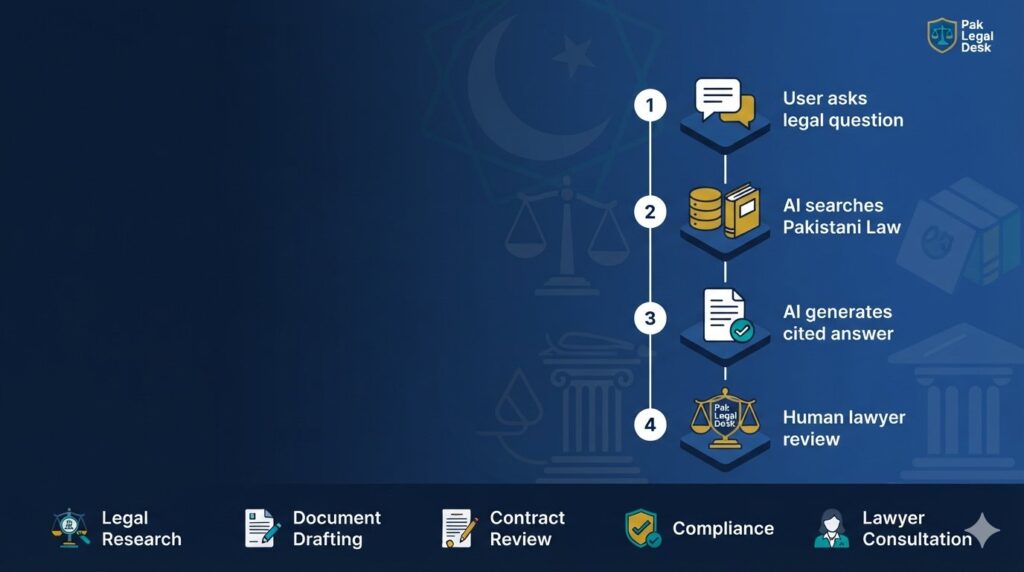
A legal AI tool typically operates in four stages.
Retrieval. The user’s query is converted into a search vector. The system searches a database of legal documents — statutes, judgments, regulations — for passages that are semantically similar to the query. Legalyze uses a dual-stream retrieval pipeline combining lexical and semantic search. HAQ uses Cohere embeddings and Pinecone vector search across 100+ Acts before every answer.
Grounding. The retrieved passages are fed to the language model along with the user’s question. The model is instructed to answer only from the retrieved text. HAQ’s anti-hallucination design requires every response to include section numbers and verified links to pakistancode.gov.pk.
Generation. The model produces an answer, summary, draft or explanation.
Citation. Good legal AI tools provide citations back to the source. QanoonAI offers citation verification as a core feature.
This architecture matters because legal AI is not a search engine that returns a list of links. It synthesises an answer. If retrieval fails — because the query is poorly phrased, the database is incomplete or the relevant law is not indexed — the model may fill the gap with plausible but incorrect content.
What Free Legal AI Can Help With
Free legal AI tools in Pakistan can assist with several practical tasks.
Legal Research
AI tools can search Pakistani case law and statutes faster than manual browsing. Pak Legal Database offers searchable judgments, legislation and AI-assisted precedent retrieval. QanoonAI combines a database of Pakistani judgments with tools for neutral case briefs and citation verification. HAQ indexes 100+ Pakistani Acts and 4,000+ legal chunks.
Document Understanding
HAQ supports document analysis for FIRs, court notices and contracts, with OCR in English and Urdu. It provides structured output covering overview, critical clauses, key dates, legal implications, red flags and next steps. This capability is useful for understanding what a document says. It is not legal advice on what to do about it.
Contract Assistance
HAQ flags suspicious, one-sided or legally risky clauses automatically and can generate formal legal letters with proper headers, section citations and layout. These outputs are drafts requiring human review.
Legal Issue Identification
AI can help a user identify what area of law their problem falls under. This identification is useful for knowing which authority or forum is relevant. It is not a legal opinion on the merits.
Questions and Explanations
NAZ Assist provides free legal guidance in English, Urdu, Sindhi and Pashto. It is available 24/7, 365 days a year. For a person who cannot afford a consultation, an explanation of what a legal term means or what a procedure involves can be genuinely useful.
What Free AI Cannot Reliably Do
Give legal advice. Legal advice involves applying the law to a specific set of facts and recommending a course of action. AI can explain what the law says. It cannot safely tell you what to do in your particular circumstances. The Pakistan Bar Council has not yet issued conclusive ethics rules regulating AI in legal practice. Commentary has called for the Bar Councils to urgently address the responsible inclusion of AI and technological advancement, noting that legal practice is a regulated profession and only individuals who have lawfully obtained a practising licence should be permitted to perform activities reserved for advocates.
Represent you in court. AI cannot appear before a court, examine witnesses, cross-examine opposing parties or make oral submissions.
Guarantee accuracy. All AI systems that generate text can produce incorrect information. The Supreme Court of Pakistan has discussed the limitations of AI, including transparency issues, technological faults and data privacy concerns.
Protect confidentiality. Free AI tools may not have the data protection safeguards that a law firm is expected to maintain. Pakistan lacks a comprehensive data protection law. The Personal Data Protection Bill remains in draft form, and its provisions do not yet offer a complete or enforceable compliance framework. The Digital Rights Foundation has found that while Pakistan’s National AI Policy 2025 prioritises innovation and growth, it lacks enforceable safeguards to protect rights.
Handle limitation issues. Limitation periods are strict. AI may not reliably identify the applicable limitation period for a specific cause of action.
Manage urgent injunctions. Injunctions require immediate action and precise legal drafting. AI cannot assess whether the conditions for an injunction are met.
Hallucinations
A hallucination is when an AI model generates content that is not supported by its source material or by reality. In legal AI, hallucinations take several forms: citing a case that does not exist, citing a section number that does not say what the AI claims, or inventing a procedural requirement.
The Supreme Court of Pakistan in Ishfaq Ahmed v. Mushtaq Ahmed (2025 SCP 112) has highlighted that LLMs may “hallucinate” content as if it existed in quoted literature. This is not a bug that can be eliminated entirely. Retrieval-augmented generation reduces hallucinations by grounding answers in retrieved documents, but it does not eliminate them.
Anti-hallucination measures exist. HAQ requires every response to include section numbers and verified pakistancode.gov.pk links. But no system is perfect, and users should verify every citation before relying on it.
False Citations
False citations are a specific and serious form of hallucination. An AI tool may generate a case citation that looks correct — correct format, plausible party names, plausible year — but the case does not exist or does not stand for the proposition cited.
The Supreme Court of Pakistan has specifically cautioned about this. In a 2025 matter, the Supreme Court expressed concern that a provincial Service Tribunal may have relied on “hallucinating” AI to produce fake legal citations, and reiterated a caution previously expressed regarding the use of AI in judicial decision-making.
If you use AI to find case law, you must verify every citation against an authoritative source.
Confidentiality
Confidentiality is one of the most important differences between AI and a lawyer.
A lawyer owes a professional duty of confidentiality to the client. AI tools do not owe the same duty. When you type a question into a free AI tool, you are using software. The operator’s terms of service govern what happens to your data.
Pakistan’s data protection framework is incomplete. The draft Personal Data Protection Bill 2023 has not been enacted. The Digital Rights Foundation has reported that 65 percent of participants in its study feared loss of privacy, 63 percent expressed concern about disinformation, and half worried about AI-enabled monitoring.
The National Judicial (Policy Making) Committee (NJPMC) has issued National Guidelines for the Use of Artificial Intelligence in Judicial Institutions (April 2026). These guidelines place strong emphasis on protection of data and privacy, with strict standards outlined for safeguarding information regarding litigants and other stakeholders. However, these guidelines apply to judicial institutions. They do not automatically bind commercial AI tools.
Human Lawyer Review
Human lawyer review is necessary whenever AI output will be relied upon for a real legal decision. This includes litigation, criminal matters, urgent injunctions, limitation issues, property transactions, corporate transactions, employment disputes and family disputes.
The Sindh Legal Advisory Call Centre provides free legal advice from High Court-registered lawyers daily from 9:00 am to 1:00 am. The Centre received more than 66,000 calls between July 2025 and June 2026, of which around 27,000 were related to civil disputes, while thousands sought legal advice on criminal matters and administrative issues. During the same period, the call centre received 2,710 calls concerning dowry disputes, child custody, divorce, khula and other family law matters.
If cost is a barrier, this is a better starting point than relying solely on AI.
Free AI vs Lawyer
| Free Legal AI | Lawyer | |
|---|---|---|
| Cost | Free or low-cost | Fee-based, unless legal aid |
| Availability | 24/7, instant | Business hours, by appointment |
| Legal advice | No | Yes |
| Court representation | No | Yes |
| Confidentiality | Operator-dependent | Professional duty |
| Accountability | Limited | Professional regulation |
| Limitation analysis | Unreliable | Reliable with instructions |
| Document drafting | Draft only | Draft and execution |
| Liability | Usually disclaimed | Professional liability |
A lawyer is not simply a more expensive version of an AI tool. A lawyer owes duties to the client, to the court and to the profession.
Free AI vs Paid Legal AI
Paid legal AI tools typically offer larger databases, better retrieval, more queries, citation verification, document comparison and priority support. Free tools typically limit the number of queries per day, restrict access to premium features or provide a time-limited trial.
Pak Legal Database offers a free trial with full access, after which specific content is behind a paid firewall. QanoonAI offers free access for citizens and paid professional plans.
The practical question is whether the free tier gives you enough to answer your question. For a simple query, a free tool may suffice. For complex research requiring cross-referencing multiple authorities, a paid tool or a lawyer is more appropriate.
How Pak Legal Desk Can Help
Pak Legal Desk provides professional legal services, including consultations, document drafting, legal research and related services. The firm’s approach is to combine AI-assisted research with human legal review. AI can speed up the identification of relevant authorities and the preparation of first drafts. A qualified lawyer then reviews the output for accuracy, completeness and applicability to the client’s specific circumstances.
This is not the same as using a free AI tool on your own. The difference is the human review step. When a lawyer reviews AI-assisted work, the lawyer takes professional responsibility for the final product. When you use a free AI tool on your own, you bear that responsibility yourself.
Frequently Asked Questions
Is there free legal AI in Pakistan?
Yes. Several tools offer free access to Pakistani legal research. NAZ Assist provides free legal guidance in four languages and is available 24/7 with no login required. HAQ is an open-source bilingual legal assistant grounded in over 100 Pakistani Acts. QanoonAI offers free access for citizens and paid professional plans. Lexiber AI offers free, AI-powered access to constitutional, statutory and case-law research in English and Urdu. Pak Legal Database offers a free trial.
Can AI give free legal advice?
AI can give free legal information, explanations and research assistance. It cannot give legal advice in the regulated sense. Legal advice involves applying the law to specific facts and recommending a course of action. The Pakistan Bar Council has not yet issued conclusive ethics rules regulating AI in legal practice.
Is free legal AI reliable?
Reliability varies. Retrieval-augmented tools that ground answers in verified Pakistani sources are more reliable than general-purpose chatbots. But all AI systems can hallucinate. The Supreme Court of Pakistan in Ishfaq Ahmed v. Mushtaq Ahmed (2025 SCP 112) has discussed the limitations of AI, including hallucinations and the need for careful verification. Always verify citations and legal propositions against authoritative sources.
Can AI search Pakistani law?
Yes. Legalyze was developed at NUST Islamabad and is designed to support legal analysis over Pakistani statutes and case law. QanoonAI combines a database of Pakistani judgments with legal tools. HAQ is grounded in over 100 Pakistani Acts. These tools can search Pakistani law, but the completeness and currency of their databases vary.
Can AI read a legal document?
Yes. HAQ supports document analysis for FIRs, court notices and contracts, with OCR in English and Urdu. It can identify critical clauses, key dates and red flags. This is document understanding, not legal advice on the document.
Is free legal AI safe?
Safety depends on the tool and the information you provide. Pakistan lacks a comprehensive data protection law; the Personal Data Protection Bill remains in draft form. The Digital Rights Foundation has reported that the National AI Policy 2025 lacks enforceable safeguards to protect rights. Do not upload sensitive documents to a free AI tool unless you have verified its data handling practices.
Can AI replace a lawyer?
No. AI cannot represent you in court, cannot give legal advice, cannot assess limitation periods reliably and does not owe you a duty of confidentiality. AI can assist with research, document review and first drafts. A lawyer provides professional judgment, accountability and representation.
What should I do if AI gives me a case citation?
Verify it. Search for the case on an authoritative database or on the relevant court’s website. Read the case. Confirm that it says what the AI claims it says. Do not cite any case in a legal document unless you have read it.
Final Takeaway
Free legal AI in Pakistan is real, and it is useful for what it is: a research and information tool. It can help you find statutes, understand documents, identify legal issues and draft first versions of letters or applications. It cannot give legal advice, cannot represent you, cannot guarantee accuracy and does not owe you confidentiality.
If your matter involves litigation, criminal charges, an urgent injunction, a limitation deadline, a property transaction, a corporate transaction, an employment dispute or a family dispute, obtain human legal advice. The Sindh Legal Advisory Call Centre provides free legal advice from High Court-registered lawyers. AI can help you prepare. It cannot take responsibility.
Pak Legal Desk CTA
If you need assistance applying these principles to your specific circumstances, Pak Legal Desk can help with legal research, document preparation and professional legal guidance. We combine AI-assisted research with human legal review, so you get the speed of modern tools and the accountability of a qualified lawyer.
References
Primary and Official Sources
-
Supreme Court of Pakistan, Ishfaq Ahmed v. Mushtaq Ahmed, 2025 SCP 112.
-
National Judicial (Policy Making) Committee (NJPMC), National Guidelines for the Use of Artificial Intelligence in Judicial Institutions (April 2026). Available at: https://ljcp.gov.pk/
-
Ministry of Information Technology and Telecommunication, National Artificial Intelligence Policy 2025. Available at: https://moitt.gov.pk/
-
Personal Data Protection Bill 2023 (draft, not enacted).
Legal AI Platforms and Tools
-
Legal Aid Society, NAZ Assist. Available at: https://las.org.pk/nazassist/
-
HAQ (حق), open-source bilingual AI legal assistant. Available at: https://github.com/Shahrukh-aidev/Adovacate-AI
-
QanoonAI, Stanford CodeX TechIndex. Available at: https://techindex.law.stanford.edu/companies/qanoonai
-
Legalyze, NUST Islamabad. Legalyze: An Open-Source Structure-Aware Agentic RAG Platform for High-Precision Legal Intelligence (2026). Available at: https://onlinelibrary.wiley.com/
-
Lexiber AI, website launch record (January 2026). Available at: https://lexiber.com/
-
Pak Legal Database. Available at: https://www.paklegaldatabase.com/
Secondary and Contextual Sources
-
Digital Rights Foundation, Emerging Technologies in Pakistan: Towards a People-Centred Policy Framework (January 2026). Available at: https://digitalrightsfoundation.pk/
-
Daily Times, “Sindh launches Pakistan’s first AI-powered free legal aid chatbot” (18 July 2026).
-
The Express Tribune, “SC orders reinstatement of 36 teachers, citing tribunal’s use of ‘hallucinating’ AI” (8 December 2025).
-
LinkedIn commentary on Pakistan Bar Council and AI regulation (January 2026).
Information checked as at 28 September 2026.
Legal Information Disclaimer
This article provides general legal information about free legal AI tools in Pakistan. It does not constitute legal advice. AI tools and their terms of service change frequently. You should verify the current features, limits and data practices of any AI tool before relying on it. For advice on your specific circumstances, consult a qualified Pakistani lawyer.