
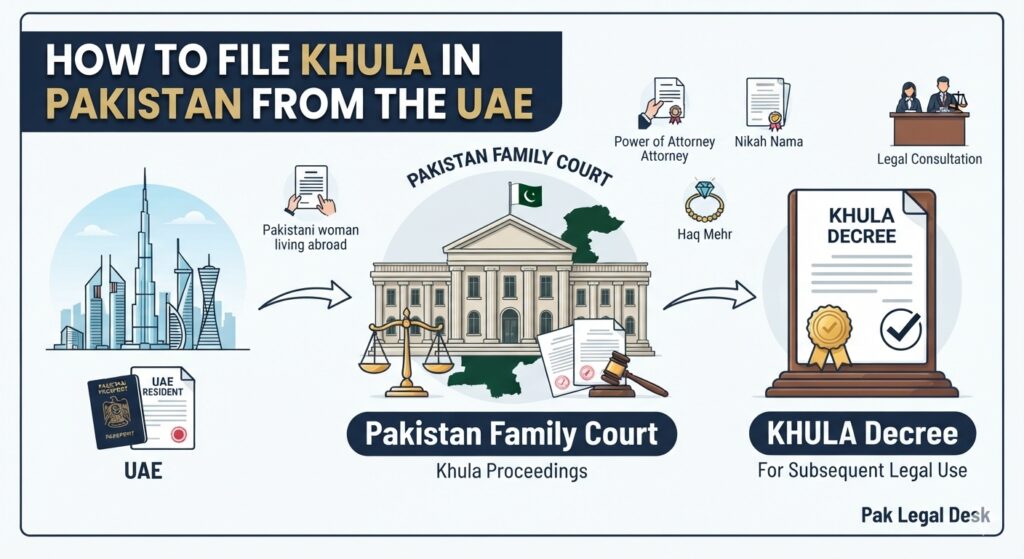

Quick Answer
A Pakistani Muslim woman living in the UAE may, in appropriate circumstances, seek dissolution of her marriage through khula before a Family Court in Pakistan without treating the place where the marriage was registered as the only possible basis of jurisdiction.
The correct Family Court depends on the applicable territorial-jurisdiction rules and the facts of the particular marriage. Under Rule 6 of the West Pakistan Family Courts Rules, 1965, a suit may fall within the jurisdiction of a court where the cause of action wholly or partly arose, where the parties reside or last resided together, and, in a suit for dissolution of marriage or dower, where the wife ordinarily resides. The Supreme Court has specifically considered a case in which the wife was living abroad and instituted a khula suit in Pakistan through a duly constituted attorney.
The governing procedural framework is principally found in the West Pakistan Family Courts Act, 1964, particularly its provisions concerning institution of family suits, pre-trial reconciliation and dissolution of marriage. Khula is expressly included within the Family Court’s jurisdiction.
Living in the UAE therefore does not, by itself, prevent a Pakistani Family Court from entertaining a khula case. However, the correct territorial jurisdiction should be established before filing rather than assuming that the court where the Nikah was registered automatically has jurisdiction.
What Is Khula in Pakistan?
Khula is a form of dissolution of marriage initiated by the wife.
The Family Courts Act, 1964 expressly places “Dissolution of marriage [including Khula]” within Part I of its Schedule. Family Courts consequently have exclusive jurisdiction over the matters listed in that Schedule, subject to the statutory framework governing family litigation.
Khula should also be distinguished from dissolution of marriage sought on statutory grounds under the Dissolution of Muslim Marriages Act, 1939. The legal consequences, evidentiary requirements and treatment of dower can differ depending upon the basis on which dissolution is sought.
The Supreme Court has emphasised this distinction: khula does not require the wife to establish a specific statutory ground in the same manner as a dissolution claim based upon the grounds recognised by the Dissolution of Muslim Marriages Act.
Can a Woman Living in the UAE File Khula in Pakistan?
Yes, potentially.
The important question is not simply whether the applicant currently lives in the UAE. The Family Court must have territorial jurisdiction under the applicable law and rules.
Rule 6 of the West Pakistan Family Courts Rules, 1965 provides the principal territorial-jurisdiction framework. It refers to:
- where the cause of action wholly or partly arose;
- where the parties reside or last resided together; and
- in suits for dissolution of marriage or dower, the place where the wife ordinarily resides.
The Supreme Court considered this rule in Sohail Ahmed v. Mst. Samreena Rasheed Memon and another, reported as 2024 SCMR 634. The wife in that case was living in the United States and instituted the family proceedings in Karachi through a duly constituted attorney. The Supreme Court upheld the Pakistani Family Court’s jurisdiction on the facts before it and explained the significance of the expression “ordinarily resides”.
That decision is particularly relevant to expatriate Pakistanis, but it should not be converted into a rule that every UAE resident can automatically file in any Pakistani Family Court. Jurisdiction remains fact-specific.
Which Family Court in Pakistan Should You Approach?
The answer should be determined before preparing the plaint.
The original article incorrectly suggested that the Family Court where the marriage was registered is necessarily the competent court. That is too broad.
The Family Courts Act establishes Family Courts and gives them exclusive jurisdiction over matters listed in its Schedule. Section 7 governs institution of suits, while Rule 6 of the Family Courts Rules addresses territorial jurisdiction.
For a woman living in the UAE, the relevant facts may include:
- where the spouses lived together;
- where the matrimonial relationship was maintained;
- where the relevant cause of action arose;
- where the wife ordinarily resides for the purpose of the applicable rule;
- the wife’s continuing connection with Pakistan; and
- other facts relevant to territorial jurisdiction.
Because jurisdiction can determine whether the plaint is properly instituted, it should be assessed on the individual facts rather than selected merely because the Nikah Nama was registered in a particular district.
Can Khula Proceedings Be Started Through a Representative?
An overseas applicant may, depending on the circumstances and the court’s requirements, act through a duly constituted attorney.
This is not merely theoretical. In Sohail Ahmed v. Mst. Samreena Rasheed Memon, the wife was residing in the United States when the Pakistani family suit was instituted and she proceeded through a duly constituted attorney. The Supreme Court considered that fact while determining the jurisdictional question.
However, the statement that Pakistani law requires every khula suit to be filed by a licensed advocate is not supported by the statutory text reviewed for this article.
Section 18 of the Family Courts Act specifically addresses representation through agents in the case of a pardah-nashin lady, while the Act also refers in several provisions to parties, agents and advocates. The precise authority required for an overseas litigant should therefore be settled with the relevant Family Court and counsel before filing.
Where a power of attorney is executed in the UAE for use in Pakistan, the documentary and attestation requirements should also be followed.
The Embassy of Pakistan in Abu Dhabi publishes requirements for attestation of a UAE-executed Power of Attorney, including the executant’s personal presence and specified identification documents.
What Is the Legal Procedure for Khula?
The procedure generally follows the Family Courts Act.
1. Determine the competent Family Court
The first step is to establish territorial jurisdiction.
Do not assume that the court where the marriage was registered is automatically competent. The applicable jurisdictional facts should be documented before filing.
2. Prepare the plaint
A family suit is instituted through a plaint in the manner prescribed by the Family Courts Act and applicable rules.
Section 7 requires the plaint to contain the material facts relating to the dispute and provides for accompanying witness and documentary information. A plaint for dissolution of marriage may also contain claims relating to matters such as dower, maintenance, dowry, personal property, custody and visitation, where legally applicable.
3. File the case before the competent Family Court
The plaint and required accompanying material are presented before the appropriate Family Court.
The court then initiates the process for notifying the defendant.
4. Service upon the husband
Section 8 provides for issuance of summons and service of the plaint and accompanying documents.
The Act provides that the Family Court is to fix a date for the defendant’s appearance and issue the necessary summons and notices.
5. Pre-trial reconciliation
Reconciliation is an important statutory part of the process.
Under Section 10, the Family Court examines the pleadings and material before it and attempts to effect compromise or reconciliation where possible.
Where reconciliation fails in a suit for dissolution of marriage, the statutory proviso to Section 10(4) requires the Family Court to pass the decree for dissolution of marriage forthwith and to restore to the husband the Haq Mehr received by the wife in consideration of the marriage, subject to the legal application of the provision to the particular case.
The Supreme Court has also recognised the distinction between khula and dissolution on statutory grounds under the Dissolution of Muslim Marriages Act.
6. Khula decree
Where the legal requirements are satisfied and reconciliation has failed, the Family Court may pass the decree for dissolution of marriage by khula in accordance with Section 10.
A useful authority is Khurram Naseer v. Judge Family Court (West) and others, 2016 MLD 1183, in which the Islamabad High Court considered a Family Court decree dissolving a marriage on the basis of khula following unsuccessful reconciliation proceedings.
Is It Necessary to Prove Cruelty for Khula?
Not necessarily.
Khula and dissolution under the statutory grounds contained in the Dissolution of Muslim Marriages Act, 1939 are legally distinct routes.
The Supreme Court has explained that a woman seeking khula does not have to establish a specific statutory ground in the same manner as a woman seeking dissolution under the Dissolution of Muslim Marriages Act.
That distinction is important when drafting the plaint. The legal basis for the relief sought should be stated accurately rather than simply reproducing allegations of cruelty from another type of dissolution case.
What Happens to Dower or Haq Mehr?
Dower requires particular care.
The statutory framework governing khula contains a provision concerning restoration of the Haq Mehr received by the wife. Section 10(4) of the Family Courts Act addresses restoration of the Haq Mehr received by the wife in consideration of marriage when the Family Court dissolves the marriage after reconciliation has failed.
However, it would be inaccurate to reduce every dower dispute to a simple statement that the wife must always return every amount or benefit received during the marriage.
The Supreme Court has recognised a distinction between khula and dissolution under the Dissolution of Muslim Marriages Act, including their different consequences concerning dower.
The precise treatment of dower should therefore be determined from the Nikah Nama, payment records, pleadings, applicable law and the nature of the relief actually sought.
What Documents May Be Required?
The exact documentary requirements depend on the case and the Family Court.
Commonly relevant documents may include:
- Nikah Nama or marriage record;
- CNIC/NICOP or other identification documents;
- passport;
- documents establishing the applicant’s relevant residence or identity;
- information concerning the husband’s address for service;
- evidence relating to dower, where relevant;
- power of attorney, where proceedings are being conducted through an authorised representative; and
- other documents relevant to additional claims joined with the dissolution suit.
The final document list should be confirmed with the advocate handling the particular case and the relevant Family Court.
The Family Courts Act itself requires documentary material relied upon by the plaintiff to be dealt with at the institution stage in accordance with Section 7.
How Long Does Khula Take?
The law provides an important statutory benchmark.
Section 12A of the Family Courts Act states that a Family Court shall dispose of a case, including a suit for dissolution of marriage, within six months from the date of institution. Where a case is not disposed of within six months, either party may apply to the High Court for an appropriate direction.
This statutory period should not be presented as a guarantee that every khula case will conclude within six months.
Actual proceedings may be affected by matters such as:
- service of summons;
- the defendant’s response;
- jurisdictional objections;
- reconciliation proceedings;
- additional claims;
- court scheduling;
- procedural applications; and
- circumstances particular to the case.
The earlier claim that khula “typically spans 3 to 6 months” has therefore been removed because a reliable authoritative source does not establish that as a general statistical average.
Does the Husband Have to Agree to Khula?
The husband’s consent is not equivalent to the wife’s statutory entitlement to seek khula.
The Family Court is required to attempt reconciliation. If reconciliation fails, Section 10 provides the statutory mechanism for dissolution. The Supreme Court has explained that khula is a distinct form of dissolution and that the wife’s express request for khula is material.
Accordingly, the husband’s refusal to consent does not by itself mean that a khula suit cannot proceed.
The court must nevertheless follow the applicable statutory procedure.
Can the Husband Contest the Case?
Yes.
The husband is entitled to participate in the proceedings and respond to the plaint in accordance with the Family Courts Act.
The Act provides for service of the plaint and summons and requires the defendant to appear and file a written statement in accordance with the prescribed procedure.
If a defendant fails to appear despite due service, the Family Court may proceed ex parte in accordance with Section 9, subject to the safeguards contained in that provision.
Can a Khula Decree Be Appealed or Challenged?
This requires more precision than the original article provided.
Section 14 of the Family Courts Act establishes appellate jurisdiction but expressly provides that no appeal lies from a Family Court decree for dissolution of marriage, except in the statutory exception concerning dissolution on the specified ground under the Dissolution of Muslim Marriages Act.
It is therefore inaccurate to describe every khula decree as ordinarily appealable to a High Court.
Constitutional jurisdiction under Article 199 is also not simply an ordinary appeal against a Family Court judgment. The Islamabad High Court in Khurram Naseer discussed the limited constitutional jurisdiction applicable to challenges involving Family Court khula decrees and emphasised that constitutional jurisdiction is not to be treated as an ordinary appellate jurisdiction.
Accordingly, the statement in the original article that either party can simply file an Article 199 petition “within the prescribed period” has been removed. The maintainability of any constitutional petition depends upon the applicable legal requirements and the facts of the particular case.
What Happens After the Pakistani Khula Decree?
Obtaining the Pakistani decree is not necessarily the end of the administrative process.
If the decree is required for use in another country or for updating an official record, the relevant authority may require additional documentation, attestation, translation or legalisation.
The Embassy of Pakistan in Abu Dhabi publishes documentation and attestation requirements and, for certain Pakistani identity-document modifications, refers to a divorce certificate or a local final court order/absolute decree together with the applicable attestation and English-translation requirements.
This should not be confused with a blanket rule that the Pakistani Embassy automatically enforces a khula decree against UAE immigration authorities.
For a UAE-specific immigration, residency, family-status or civil-record issue, the requirements of the relevant UAE authority should be checked separately before relying on the Pakistani decree.
Common Mistakes to Avoid
1. Filing in a court merely because the Nikah was registered there
Marriage registration is not the only jurisdictional consideration.
2. Assuming UAE residence prevents proceedings in Pakistan
The Supreme Court has recognised Pakistani Family Court jurisdiction in a case involving a wife residing abroad and proceeding through an attorney.
3. Treating a Pakistani advocate as automatically mandatory in every circumstance
The statutory framework should be examined together with the proposed representation arrangement, particularly where an overseas litigant uses a duly constituted attorney.
4. Treating khula and dissolution for statutory grounds as identical
They are legally distinct routes with different consequences, including potentially different consequences concerning dower.
5. Assuming a fixed three-to-six-month result
The statute contains a six-month disposal provision, but actual case duration can depend on procedural circumstances.
6. Assuming every decree can be appealed in the ordinary way
Section 14 contains specific restrictions concerning appeals from dissolution-of-marriage decrees.
7. Assuming a Pakistani decree automatically changes UAE records
The Pakistani decree may need further documentary processing, and the requirements of the relevant UAE authority should be independently checked.
Practical Checklist for a UAE-Based Khula Applicant
Before instructing counsel, prepare:
- CNIC/NICOP and passport details.
- Nikah Nama or available marriage record.
- Husband’s current and previous known addresses.
- Details of where the spouses lived together.
- Information relevant to Pakistani territorial jurisdiction.
- Dower/Haq Mehr information.
- Details of any maintenance, custody, dowry or property claims.
- Proposed Power of Attorney, if proceedings will be conducted through an authorised representative.
- UAE identification/residency documents where relevant to the representation or documentary process.
- Copies of relevant correspondence or other documents relied upon.
- A clear instruction identifying whether the intended relief is khula or dissolution on another legal ground.
Frequently Asked Questions
Can I file khula in Pakistan while living in the UAE?
Yes, Pakistani Family Courts can have jurisdiction even where the wife is living abroad, but the correct Pakistani court must be established from the applicable territorial-jurisdiction rules and the facts of the case. The Supreme Court considered an overseas-resident wife proceeding through an attorney in Sohail Ahmed v. Mst. Samreena Rasheed Memon.
Does the case have to be filed where my Nikah was registered?
Not necessarily. The original article overstated this point. Territorial jurisdiction is governed by the applicable Family Courts legislation and rules, including Rule 6 of the Family Courts Rules.
Can my Pakistani lawyer handle the proceedings while I remain in the UAE?
Proceedings may, depending on the circumstances and court requirements, be conducted through an authorised representative. The Supreme Court has considered a case where an overseas-resident wife instituted proceedings through a duly constituted attorney.
Does my husband have to agree to khula?
His agreement is not the same thing as a statutory requirement for khula. The Family Court must undertake the required reconciliation process and then apply Section 10 where reconciliation fails.
Do I have to prove cruelty to obtain khula?
Khula is legally distinct from dissolution sought under the statutory grounds of the Dissolution of Muslim Marriages Act. The Supreme Court has explained that khula does not operate in precisely the same way as a ground-based dissolution claim.
How long does khula take in Pakistan?
Section 12A provides a six-month statutory disposal period for Family Court cases, including suits for dissolution of marriage. This should not be treated as a guarantee of an actual six-month completion in every case.
Do I have to return the Haq Mehr?
Section 10(4) contains a provision concerning restoration of Haq Mehr in a dissolution proceeding based on khula. The exact financial consequences should be assessed from the Nikah Nama, the dower actually received and the legal basis of the dissolution.
Can a khula decree be challenged?
The answer depends on the nature of the decree and the legal route being considered. Section 14 restricts ordinary appeals from dissolution-of-marriage decrees, while constitutional jurisdiction is distinct from an ordinary appeal.
Can I use the Pakistani khula decree in the UAE?
The decree may be relevant for subsequent administrative or legal purposes, but the requirements of the particular UAE authority should be checked. Pakistani diplomatic authorities publish attestation and documentation requirements for certain uses of divorce-related documents.
Final Takeaway
A Pakistani woman living in the UAE may be able to obtain khula through a Pakistani Family Court without returning to Pakistan for every stage of the proceedings.
The critical issues are jurisdiction, correct drafting of the dissolution claim, valid representation or power of attorney where required, statutory reconciliation procedure, dower consequences and subsequent document-use requirements.
The Supreme Court’s decision in Sohail Ahmed v. Mst. Samreena Rasheed Memon, 2024 SCMR 634, is particularly relevant because it considered Pakistani Family Court jurisdiction where the wife was living abroad and had instituted proceedings through an attorney.
Because jurisdiction and representation can turn on individual facts, an expatriate applicant should have the proposed Pakistani Family Court, jurisdictional basis and documentation reviewed before filing.
Pak Legal Desk
If you are living in the UAE and considering khula in Pakistan, Pak Legal Desk can connect you with appropriate Pakistani legal assistance for reviewing the jurisdictional position, preparing the family-court documentation and assessing the representation and document-attestation requirements applicable to your circumstances.
The appropriate legal route depends on the facts of the marriage and the relief being sought. A professional review before filing can help identify jurisdictional and procedural issues at the outset.
References
- West Pakistan Family Courts Act, 1964, Pakistan Code. Official legislation. Pakistan Code — West Pakistan Family Courts Act, 1964
- Sohail Ahmed v. Mst. Samreena Rasheed Memon and another, Civil Petitions Nos. 488-K and 489-K of 2023, decided 20 December 2023, reported as 2024 SCMR 634.
- Khurram Naseer v. Judge Family Court (West) and others, W.P. No. 662 of 2016, decided 3 March 2016, reported as 2016 MLD 1183, Islamabad High Court.
- Embassy of Pakistan, Abu Dhabi — Attestation and Power of Attorney requirements. Embassy of Pakistan, Abu Dhabi — Attestation
- Embassy of Pakistan, Abu Dhabi — SNICOP Modification requirements. Embassy of Pakistan, Abu Dhabi — SNICOP Modification
- Supreme Court of Pakistan, C.P. No. 4657 of 2022 and connected matters, concerning the distinction between khula and dissolution under the Dissolution of Muslim Marriages Act and the statutory consequences concerning dower.
Legal Information Disclaimer
This article provides general legal information concerning Pakistani family law and is not a substitute for advice on an individual case. Jurisdiction, representation, dower, service, procedural requirements and the use of a Pakistani decree in the UAE may depend on facts and applicable rules that cannot be determined from a general article. Laws, court procedures and administrative requirements may also change. Professional legal advice should be obtained before filing proceedings or relying upon a decree for an immigration, residency or other UAE legal purpose.