

Quick Answer
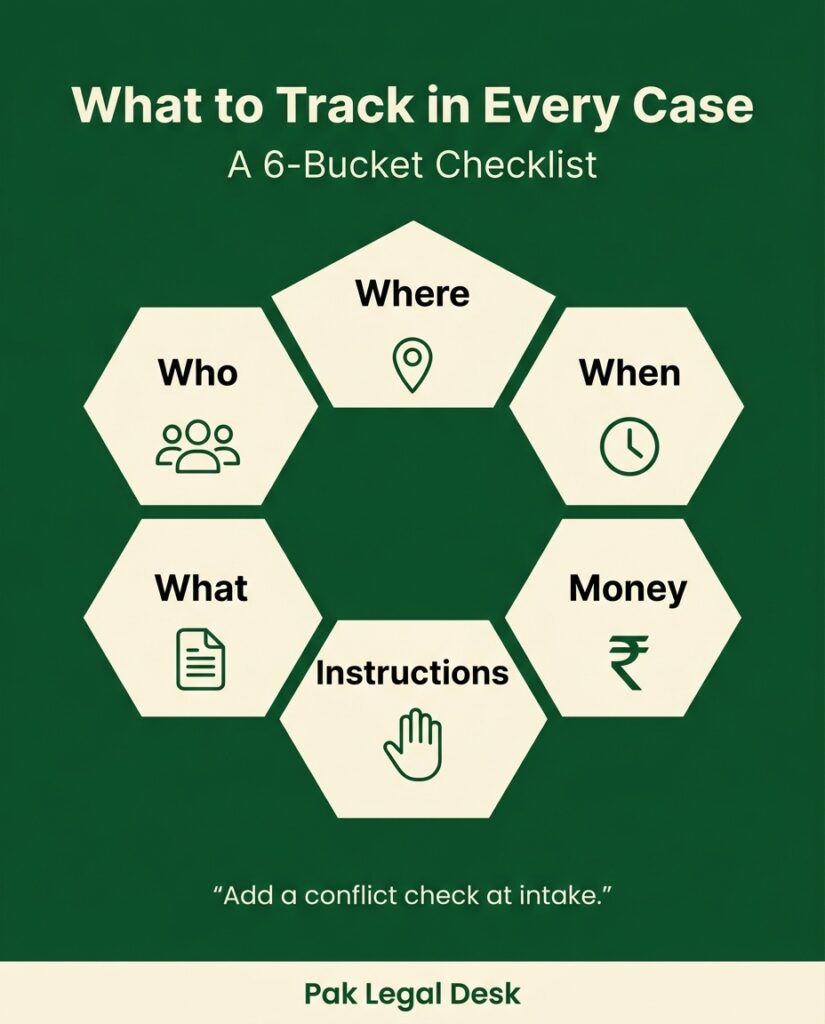
Track six groups of information in every case: who (parties, counsel, client), where (court, bench, case number), when (hearing history, next date, deadlines), what (pleadings, orders and evidence), instructions (authority, advice given, client decisions) and money (fees, expenses, invoices). Add a conflict check at intake and a dated diary note after each step. Good software gives each group a structured place; a checklist works even without software.
Who This Guide Is For
Advocates setting up a file system, juniors learning chamber practice, and chambers choosing what a case record should contain.
What the Law Says
Under the Legal Practitioners and Bar Councils Act, 1973, advocates are enrolled with Provincial Bar Councils (Sections 22 and 23). Fee arrangements and client communications are subject to the professional-conduct canons; review Chapter XII of the Pakistan Legal Practitioners and Bar Councils Rules, 1976.
Limitation is governed by the Limitation Act, 1908 and special statutes; software cannot determine it.
The Case Record Checklist
1. Identity and parties. Client name and contact; opposing parties; opposing counsel; other parties or interveners; relationship between the parties.
2. Forum. Court and bench; case number and year; case type; stage (for example pleadings, evidence, arguments); previous or related proceedings.
3. Dates. Filing date; every hearing with outcome; next date and its purpose; separate deadlines (written statement, rejoinder, appeal, compliance); source of each date (order sheet or cause list).
4. Documents. Pleadings (with versions); annexures; orders and certified copies; evidence; correspondence; vakalatnama and authority documents.
5. Instructions and advice. Client’s objectives; instructions received; advice given and when; decisions the client made; settlement discussions.
6. Money. Fee arrangement as agreed in writing; expenses; invoices; payments; court-related charges (which are separate from professional fees).
7. Risks and checks. Conflict-of-interest check; limitation considerations to verify; confidentiality level; who in the chamber has access.
Pakistan-Specific Legal Position
- The court’s order sheet is the authoritative source for dates.
- Fee arrangements and client communications are subject to the professional-conduct canons; review Chapter XII of the 1976 Rules.
- Limitation is governed by the Limitation Act, 1908 and special statutes; software cannot determine it.
- Keep court fees, government charges and professional fees as separate records.
Law and administrative procedures can change; verify the current position before acting.
Step-by-Step: Using the Checklist
- Create the record at intake and fill groups 1 and 2.
- Run the conflict check.
- Agree the fee arrangement in writing and record it.
- After every hearing, update group 3.
- File each new document under group 4 with a clear name.
- Add a dated diary note for each instruction or advice.
- Review open matters weekly.
Common Mistakes
Recording only the case number; no purpose for the next date; no record of advice given; mixing court fees and professional fees; storing everything in one folder; no access control.
When Professional Advice Is Appropriate
Ask a senior colleague or your Bar Council if unsure what records you should keep for your practice.
Pak Legal Desk Solution
Per its product page (checked 8 October 2026), Pak Legal Desk’s case-management system provides fields for case number, court, judge, jurisdiction, status, priority and filing date; party management; a case diary; a document vault with version history and client-visible or private flags; time and expense tracking; invoice generation; and a conflict-of-interest check. See Pak Legal Desk’s case-management system.
Frequently Asked Questions
What should a lawyer record in every case? Parties, forum, dates, documents, instructions and fees, plus a conflict check.
Should I record advice given to clients? Keeping dated notes of instructions and advice is good practice; follow your professional obligations.
Are court fees the same as lawyer fees? No. They are separate; record them separately.
How often should I update a case record? After every hearing and every significant step.
Can software replace the checklist? Software holds the fields; you still decide what to record.
Final Takeaway
A good case record covers six groups: who, where, when, what, instructions and money. Add a conflict check at intake and a dated diary note after each step. Software helps, but the discipline is yours.
References
- Legal Practitioners and Bar Councils Act, 1973 — Sections 22, 23
- Pakistan Legal Practitioners and Bar Councils Rules, 1976, Chapter XII
- Limitation Act, 1908 (Pakistan Code)
Legal Information Disclaimer
This article provides general legal information for educational purposes and does not constitute legal advice. For advice concerning a specific matter, consult a qualified advocate.