

By Pak Legal Desk | Published: September 27, 2026 | 22 min read
Introduction
Artificial intelligence has entered the Pakistani legal research landscape—but not in the way many headlines suggest. Courts are not being replaced. Judges are not being automated away. Instead, a more subtle and more consequential transformation is underway: the tools lawyers, judges, and law students use to find, read, and analyse Pakistani law are changing.

In April 2026, the National Judicial (Policy Making) Committee formally issued National Guidelines for Use of Artificial Intelligence in Judicial Institutions, establishing a framework in which AI is positioned as an “assistive tool” that “enhances judicial performance while firmly preserving human judgment, constitutional safeguards, and judicial independence” . The Sindh High Court has developed an in-house AI-powered legal research system called the LRC-Assistant, designed to help judges and research officers retrieve past orders and decisions . Private platforms such as Conclavity, QanoonAI, Pakistan Law Bot, and Pak Legal Database have emerged, each offering AI-assisted legal research tools focused on Pakistani law .
But alongside this innovation comes a serious risk. In December 2025, the Supreme Court of Pakistan expressed “dismay” after discovering that a provincial service tribunal had relied on fabricated legal citations—cases that did not exist—apparently generated by an AI system . The court described the AI as “hallucinating.” This is not a uniquely Pakistani problem; courts in the United States, the United Kingdom, and Australia have all grappled with AI-generated fake citations. But it is a problem that Pakistani lawyers must now confront directly.
This guide answers a practical question: what is AI legal research, how can it be used for Pakistani law in 2026, what are its advantages and limitations, and how should lawyers verify AI-generated legal research before relying on it?
What Is AI Legal Research?
AI legal research refers to the use of artificial intelligence technologies—particularly large language models, retrieval-augmented generation systems, and semantic search engines—to assist in finding, analysing, and summarising legal materials. These materials include statutes, regulations, judgments, and legal commentary.
At its core, AI legal research does not replace legal reasoning. It accelerates the discovery phase of research: identifying potentially relevant authorities, extracting key legal principles, and surfacing connections between cases that might otherwise take hours or days to find manually. The lawyer still reads the case, verifies the holding, and decides whether and how it applies to the client’s matter.
In Pakistan, AI legal research tools typically combine a database of Pakistani judgments and legislation with a conversational interface. A user types a legal question in natural language—for example, “What are the grounds for pre-arrest bail under the CrPC?”—and the system returns a summary answer with references to potentially relevant statutory provisions and case law.
Why Pakistani Legal Research Is Different
Pakistani legal research presents distinct challenges that make AI assistance both more valuable and more dangerous.
Volume and dispersal. Pakistani judgments are spread across the Supreme Court, five High Courts, and numerous subordinate courts and tribunals. No single official database contains every reported judgment. The Supreme Court maintains its own judgment search portal, the Lahore High Court operates a research centre with fortnightly case law updates, and the Sindh High Court provides access to over 25,000 judgments and orders . Provincial law departments maintain separate legislation portals, and the federal Pakistan Code covers laws from 1839 onward .
Inconsistent reporting. Not all judgments are published. Many trial court decisions and even some High Court judgments remain unreported or available only in physical archives. When AI systems claim to search “all Pakistani judgments,” that claim is almost always overstated.
Linguistic complexity. Pakistani legal materials exist in English, Urdu, and occasionally regional languages. Legal terminology often has no direct translation. The Constitution of Pakistan itself is bilingual, and research may require working across both languages.
Rapid legal change. Pakistani law evolves through statutory amendments, ordinance promulgations, and shifting judicial interpretation. An AI system trained on data from 2023 may not know about a 2025 amendment or a 2026 Supreme Court ruling.
Constitutional framework. Pakistan’s legal system operates under a written constitution with specific provisions for fundamental rights, writ jurisdiction, and judicial review. An AI system that does not understand Article 199 of the Constitution (writ jurisdiction) or Article 8 (laws inconsistent with fundamental rights) cannot provide meaningful constitutional research assistance.
Traditional vs AI-Assisted Research
| Aspect | Traditional Research | AI-Assisted Research |
|---|---|---|
| Starting point | Digest, index, or known citation | Natural-language question |
| Speed of initial discovery | Hours to days | Seconds to minutes |
| Breadth of initial scan | Limited by researcher’s familiarity | Can scan large indexed corpora |
| Risk of missing authorities | Low if using systematic digests | Depends on database coverage |
| Risk of false authorities | Very low | Higher if not verified |
| Verification burden | Built into the process | Falls entirely on the researcher |
| Cost | Time-intensive | Subscription or per-query cost |
| Language handling | Researcher must translate | Can process multiple languages (with accuracy limits) |
The critical difference is not speed—it is the location of the verification burden. Traditional research embeds verification into every step: you find a case in a digest, you pull the report, you read it. AI-assisted research front-loads discovery and back-loads verification. This is efficient only if the researcher understands that the verification step is non-negotiable.
How AI Legal Search Works
Understanding the technology helps explain both its power and its limitations.
Modern AI legal research systems typically combine several components:
-
A document corpus. A collection of judgments, statutes, and possibly secondary materials. The size and quality of this corpus determine what the system can find. Some Pakistani platforms claim to index 600,000+ judgments; others operate on much smaller collections.
-
A retrieval system. When you ask a question, the system searches its corpus for relevant documents. Early systems used keyword matching; modern systems use “embeddings”—mathematical representations of text that capture semantic meaning. A well-designed embedding system can find cases that discuss your issue even if they use different terminology.
-
A generation layer. After retrieving relevant documents, a large language model (such as GPT-4 or a similar system) reads them and generates a response. This is where hallucination risk is highest: the model may generate plausible-sounding text that is not grounded in the retrieved documents.
-
Retrieval-Augmented Generation (RAG). The most reliable current architecture combines retrieval with generation. The system first retrieves relevant documents, then instructs the language model to answer only based on those documents. A recent academic study on Pakistani criminal law examined RAG architectures specifically for this purpose . Systems that use RAG with a strict “citation contract”—requiring the model to cite only retrieved documents—are more reliable than systems that rely on the model’s internal training data alone .
-
Citation verification layers. Some advanced systems attempt to verify that cited cases actually exist. Pak Legal Database, for example, describes citation verification as part of its system . But verification against an incomplete database is not the same as verification against the actual judgment.
What AI Can Help a Lawyer Do
Within its proper limits, AI can assist with:
Finding relevant cases. A well-designed AI search system can surface judgments that discuss a legal issue, even when the user does not know the case name or citation. This is particularly useful in areas where the relevant case law is scattered across multiple courts and time periods.
Finding legislation. AI systems can search statutory databases and identify provisions relevant to a legal question. The Pakistan Code, provincial law portals, and platforms like Pak Legal Database and Conclavity maintain searchable legislation collections .
Extracting legal principles. A language model can read a judgment and summarise the ratio decidendi—the legal principle on which the decision rests. This is useful for quickly triaging a large set of potentially relevant cases.
Comparing judgments. AI can identify similarities and differences between judgments, helping a researcher understand how the law has evolved or where courts have diverged.
Finding authorities by issue. Instead of searching by case name, a researcher can describe a legal issue and ask the AI to find authorities that address it.
Natural-language queries. A lawyer can ask a question in plain English (or Urdu) rather than constructing a complex Boolean search. This lowers the barrier to effective legal research.
Document analysis. Some platforms allow users to upload documents—contracts, pleadings, court orders—and ask the AI to analyse them. This can assist with contract review, issue spotting, and document summarisation.
Pakistani Legal Research Examples
CPC Research
The Code of Civil Procedure 1908 governs civil litigation in Pakistan. AI systems can assist with finding provisions on specific procedural issues—for example, the requirements for filing a written statement, the grounds for amendment of pleadings, or the circumstances in which a court may grant a temporary injunction.
A 2024 Express Tribune report noted that a Pakistani judge used ChatGPT to help formulate a judgment based on the CPC, explaining that the tool was used “to test the use of AI in making decisions and to reduce the burden on courts” . The judge’s approach—using AI as a research aid rather than a decision-maker—is consistent with the National Guidelines’ human-centric approach.
Example query: “Under the CPC 1908, what are the requirements for an application for temporary injunction under Order XXXIX Rules 1 and 2, and what case law from Pakistani High Courts discusses the three-pronged test?”
CrPC Research
The Code of Criminal Procedure 1898 (as amended) governs criminal procedure. AI can assist with research on bail applications, FIR registration, remand procedures, and trial process. A recent study examined RAG architectures specifically for Pakistan’s criminal legal system, finding that AI can help process “vast legal databases to extract relevant precedents, statutory provisions, and scholarly commentary” .
However, the same study and the Supreme Court’s December 2025 judgment in the Shakir Ullah case demonstrate the danger: the KP Service Tribunal relied on “hallucinated” judgments of the Supreme Court that did not exist . In criminal matters, where liberty is at stake, the verification burden is even higher.
Qanun-e-Shahadat Order 1984 Research
The Qanun-e-Shahadat Order 1984 is Pakistan’s law of evidence. AI research in this area is complicated by the fact that the QSO does not explicitly address AI-generated evidence. Academic research has examined whether Article 164—which provides for the admissibility of evidence produced by modern devices—can accommodate AI-generated or AI-analysed evidence . The QSO has been amended over the years, and a well-designed AI system should incorporate the current consolidated text.
Key risk: An AI system trained on an older version of the QSO may not know about recent amendments. Always verify the current text against the official Pakistan Code.
Labour Law Research
Pakistani labour law is governed by a complex mix of federal and provincial statutes, including the Industrial Relations Act 2012, the Factories Act 1934, and provincial Shops and Establishments Ordinances . AI can assist with finding provisions on employment status, termination, benefits, and dispute resolution.
However, Pakistan’s labour laws are widely recognised as outdated in their treatment of AI and algorithmic management. A 2026 paper argued that “Pakistan’s outdated legal architecture regarding AI and data cannot adequately address such algorithmic decision making” . AI research tools may be better at finding existing law than at identifying where the law has gaps.
Constitutional/Writ Research
Constitutional research under the Constitution of Pakistan 1973 involves Articles on fundamental rights (Articles 8-28), writ jurisdiction (Article 199), and the powers of the Supreme Court (Articles 184-188). AI can assist with finding cases that discuss specific constitutional provisions. The Constitution of Pakistan is available in both English and Urdu, and some AI systems (such as the ULBERT model developed by Pakistani researchers) are specifically designed for bilingual information retrieval from the Constitution .
Contract/Commercial Disputes
AI can assist with research on contract formation, breach, remedies, and specific performance under the Contract Act 1872. Conclavity, launched in September 2026, explicitly offers contract review as part of its platform . For commercial disputes, AI can also help identify relevant case law on arbitration (under the Arbitration Act 1940) and enforcement of foreign awards.
Property Disputes
Property law in Pakistan is governed by a mix of statutes (such as the Transfer of Property Act 1882) and provincial land revenue laws. AI can assist with research on title, possession, partition, and specific performance. However, property disputes often turn on documentary evidence and local custom, areas where AI assistance is limited.
Family/Criminal Research
Family law in Pakistan is governed by personal laws (Muslim Family Laws Ordinance 1961, Christian family laws, Hindu marriage laws) and the Family Courts Act 1964. AI can assist with research on divorce, maintenance, custody, and dower. Criminal law research involves the Pakistan Penal Code 1860 and the CrPC 1898. In both areas, the verification burden is high because the law is both statutory and judge-made, and because the stakes for clients are personal.
AI Hallucinations and False Citations
An AI hallucination occurs when a language model generates content that is factually incorrect but presented with confidence. In legal research, the most dangerous hallucination is a false citation: a case name, citation number, or court reference that does not correspond to any real judgment.
The Supreme Court of Pakistan addressed this directly in the Shakir Ullah case, where the KP Service Tribunal relied on AI-generated “judgments” that could not be located by either citation or case title . The court noted that “searches conducted both by citation and case title confirmed that the cases referenced by the Tribunal were fabricated” .
Research on legal hallucinations has found that large language models are particularly prone to generating plausible but non-existent citations, especially for less well-known jurisdictions . A 2026 study proposed a “Dual-Phase Verification Framework” that combines RAG with post-generation citation validation, achieving 90% citation accuracy on a test set of Pakistani Penal Code queries, compared to 75% for a plain GPT-4 baseline . This is a meaningful improvement, but 90% accuracy still means one in ten citations may be wrong—an unacceptable error rate for legal practice without independent verification.
How to Verify an AI Legal Answer
The verification process is not optional. It is the lawyer’s professional obligation. Here is a practical approach:
Step 1: Identify the claim. What legal proposition is the AI asserting? Write it down in plain language.
Step 2: Locate the primary source. For a case citation, find the actual judgment. For a statutory provision, find the current official text. Do not rely on the AI’s summary of the source.
Step 3: Read the relevant portion. A case may contain language that sounds like the AI’s claim but was made in dissent, in obiter, or in a different factual context. Read the paragraph the AI cites—and the surrounding paragraphs.
Step 4: Check subsequent treatment. Has the case been overruled, distinguished, or doubted? Has the statute been amended? An AI system trained on older data may not know about subsequent developments.
Step 5: Assess jurisdiction. A judgment from the Lahore High Court is persuasive but not binding on the Sindh High Court. The AI may not distinguish between binding and persuasive authority.
Step 6: Apply the law to the facts. This is the lawyer’s work, not the AI’s. The AI can tell you what a case says; it cannot tell you whether that case applies to your client’s situation.
10-Step AI Legal Research Verification Checklist
Use this checklist for every AI-assisted legal research task:
| # | Verification Step | What to Check |
|---|---|---|
| 1 | Case name | Does the case exist? Is the name spelled correctly? |
| 2 | Citation | Is the citation accurate (volume, year, page)? Does it match the case name? |
| 3 | Court | Which court decided the case? Is it a court whose judgments bind or persuade your forum? |
| 4 | Date | When was the judgment delivered? Is it still good law? |
| 5 | Relevant paragraph | Does the paragraph cited actually contain the proposition the AI claims? |
| 6 | Legal proposition | Is the proposition stated correctly? Was it the ratio or obiter? |
| 7 | Statutory provision | Does the statute say what the AI claims? Is the provision still in force? |
| 8 | Subsequent treatment | Has the case been overruled, distinguished, or followed? |
| 9 | Jurisdiction | Does the case bind your forum? Is there contrary authority in your jurisdiction? |
| 10 | Applicability | Does the legal principle apply to your client’s facts? |
If any answer is uncertain, do not rely on the AI’s output. Find the primary source and read it yourself.
When AI Should Not Be Relied Upon
AI should not be used as the sole basis for:
-
Filing a document in court. Every citation in a pleading, application, or written argument must be verified against the primary source.
-
Advising a client on legal rights. Legal advice requires professional judgment that AI cannot provide.
-
Interpreting ambiguous statutory language. AI can find the words; it cannot resolve interpretive disputes.
-
Predicting case outcomes. AI cannot account for the specific facts, the judge, the evidence, or the dynamics of a hearing.
-
Areas with rapid legal change. If you know a statute has been recently amended or a case recently decided, verify whether the AI system’s data is current.
-
Matters involving personal liberty or fundamental rights. The consequences of error are too severe to rely on unverified AI output.
Practical Workflow for Lawyers
The following workflow integrates AI assistance into responsible legal research:
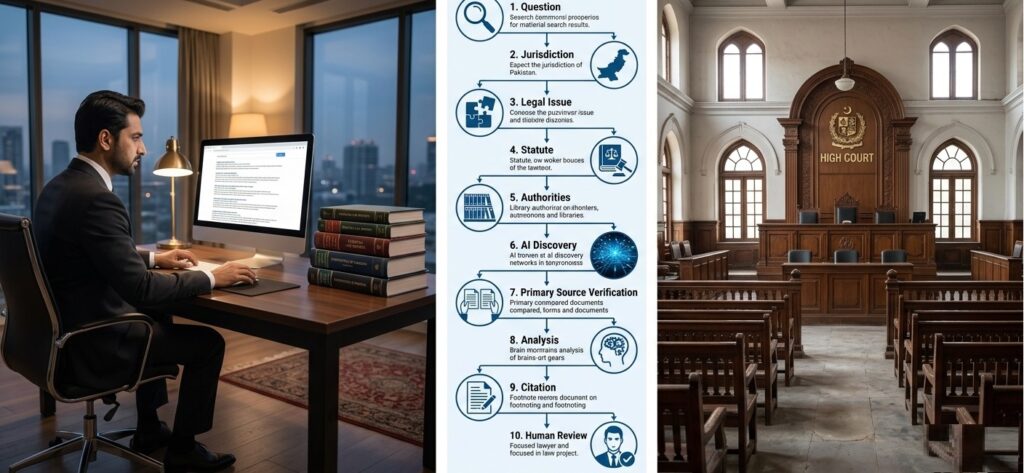
Step 1: Question. Define the legal question precisely.
Step 2: Jurisdiction. Identify the relevant court and applicable law.
Step 3: Legal issue. Break the question into specific legal issues.
Step 4: Statute. Identify the governing statutory provisions. Check the current official text.
Step 5: Authorities. Use AI-assisted discovery to find potentially relevant cases.
Step 6: Primary-source verification. For every AI-suggested authority, locate and read the actual judgment or statute.
Step 7: Legal analysis. Apply the verified authorities to the client’s facts.
Step 8: Citation. Cite the verified authority correctly, using the standard Pakistani citation format.
Step 9: Human review. A senior lawyer or colleague reviews the research and analysis.
Step 10: Document. Preserve the research trail: what was searched, what was found, what was verified, and what was relied upon.
The critical step is Step 6. AI discovery is a starting point, not an endpoint. The lawyer must read the primary source.
How Pak Legal Desk’s AI Legal Research Works
The following description is based on an inspection of Pak Legal Desk’s publicly available materials. It describes what the system is designed to do and what it does not claim to do.
Pak Legal Desk’s AI legal research operates as an AI-assisted discovery layer on top of a searchable database of Pakistani legal materials. It is designed to help users find potentially relevant judgments and statutory provisions by asking questions in natural language.
What the system does:
-
AI-assisted discovery. The system uses a retrieval-augmented generation architecture to search its indexed corpus of Pakistani judgments and legislation in response to natural-language queries.
-
Database/search-based retrieval. Results are grounded in the documents that exist in the system’s corpus. The system does not generate case law from the language model’s internal training data alone.
-
Source-linked results. Where possible, the system links to the underlying judgment or statutory provision, allowing the user to verify the source directly.
-
Statutory references. The system can identify statutory provisions relevant to a query and provide references to the Pakistan Code and provincial legislation.
What the system does not claim to do:
-
Guarantee 100% accuracy. No AI system can guarantee that every citation is correct or that every relevant authority has been found.
-
Replace human verification. The system is a research aid, not a substitute for reading the primary source.
-
Cover every Pakistani judgment. The system’s corpus is limited to the documents it has indexed. Some judgments—particularly older or unreported decisions—may not be included.
-
Provide legal advice. The system provides research assistance, not legal advice. Users must exercise their own professional judgment.
What is outside the system’s scope:
-
Interpreting ambiguous statutory language.
-
Predicting case outcomes.
-
Providing advice on client-specific facts.
-
Replacing the lawyer’s professional judgment.
Frequently Asked Questions
Is AI legal research reliable in Pakistan?
AI legal research can be a useful starting point for finding authorities, but it is not reliable as a final authority. The Supreme Court of Pakistan has cautioned that AI-generated references must be independently verified . Reliability depends on the quality of the database, the architecture of the system, and—most importantly—the rigour of the human verification process.
Can AI find Pakistani judgments?
Yes, but with important limitations. AI systems can search indexed databases of Pakistani judgments. However, no AI system has access to every Pakistani judgment. Unreported decisions, older judgments, and some tribunal decisions may not be in any database. A claim that an AI system indexes “all” Pakistani judgments should be treated with scepticism.
Can lawyers use AI for legal research?
Yes. The National Guidelines for Use of AI in Judicial Institutions explicitly contemplate AI-enabled support in “legal research” alongside case management and document processing . The key constraint is that AI must assist, not replace, judicial decision-making and professional judgment.
Can AI replace legal research?
No. AI can accelerate the discovery phase of research, but it cannot replace the lawyer’s analysis, judgment, and verification. Legal research involves not just finding authorities but understanding their context, assessing their weight, and applying them to specific facts. These are human tasks.
How should AI-generated citations be verified?
Every AI-generated citation should be verified by:
-
Locating the actual judgment or statute.
-
Reading the relevant portion to confirm the proposition.
-
Checking subsequent treatment (overruling, distinguishing, amendment).
-
Confirming the jurisdiction and applicability.
Can AI understand Pakistani law?
AI systems can process Pakistani legal texts and identify patterns, but “understanding” is a contested term. AI can find and summarise Pakistani law; it cannot reason about Pakistani law in the way a trained lawyer can. It does not understand constitutional principles, precedent hierarchies, or the practical realities of Pakistani courts.
What are the risks of AI legal research?
The principal risks are:
-
Hallucinated citations (false case names, citations, or quotations).
-
Outdated law (the system’s data may not include recent amendments or judgments).
-
Missing authorities (the system’s corpus may be incomplete).
-
Jurisdictional confusion (the system may not distinguish binding from persuasive authority).
-
Overreliance (treating AI output as verified when it is not).
Is AI legal research free?
Some Pakistani AI legal research tools offer free tiers or free access for citizens. QanoonAI, for example, offers “free access for citizens and paid professional plans” . Pak Legal Database and other commercial platforms operate on subscription models. “Free” access typically comes with limitations on the number of queries, the depth of research, or access to full-text judgments.