
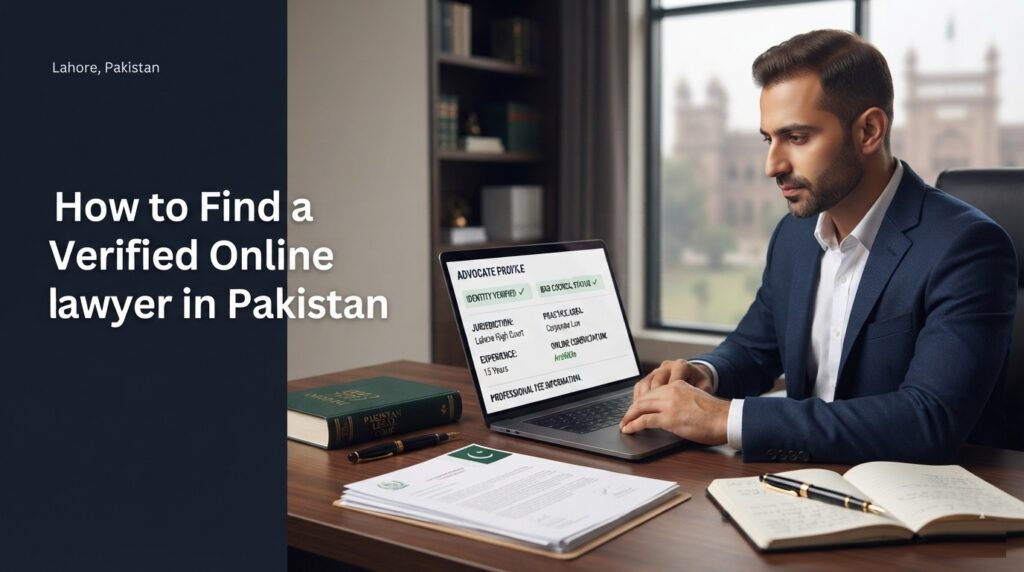

Finding a lawyer online is easy. Finding the right lawyer, with verifiable professional credentials and relevant experience for your particular legal problem, requires more care.

A name, photograph, LinkedIn profile, Google review or professional-looking website does not by itself establish that someone is an advocate entitled to practise. In Pakistan, advocates are regulated through the Bar Council framework established under the Legal Practitioners and Bar Councils Act, 1973, and Bar Councils maintain rolls and enrolment information.
For a prospective client, the safest approach is to separate two questions:
First: Is this person genuinely enrolled as an advocate and is the relevant status verifiable?
Second: Is this particular advocate suitable for my legal problem, jurisdiction, court requirements, urgency and budget?
Those questions are related, but they are not the same.
Quick answer: How can I find a verified lawyer online in Pakistan?
Start with the relevant Bar Council or official professional record to verify the advocate’s identity and enrolment information. Then check whether the advocate’s court level, jurisdiction and area of practice correspond to your matter.
After that, have an initial consultation and ask about the proposed legal approach, documents required, likely stages of the matter, availability, fees and whether any court appearance or local counsel will be necessary.
An online profile can help you discover a lawyer. It should not replace professional verification and your own assessment of suitability.
Why does lawyer verification matter in Pakistan?
The Legal Practitioners and Bar Councils Act, 1973 provides the statutory framework governing legal practitioners and Bar Councils in Pakistan. The Act defines an advocate by reference to entry on a roll under the Act.
That matters because there is an important difference between:
- someone who provides general legal information;
- a law graduate;
- a person working in a law firm or legal department;
- an advocate enrolled with a Bar Council; and
- an advocate with the particular enrolment or practice status relevant to the court or proceeding concerned.
A prospective client should therefore avoid relying solely on a person’s job title or online presentation.
Verification is particularly important when the matter involves substantial money, property, criminal proceedings, employment disputes, family issues, corporate transactions or urgent court proceedings.
What does “verified lawyer” actually mean?
The phrase “verified lawyer” should be treated carefully.
It can refer to different things.
1. Professional verification
This means checking the person’s professional enrolment or status against an appropriate Bar Council record.
2. Identity verification
This means confirming that the person whose professional credentials are being presented is actually the person with those credentials.
3. Jurisdiction verification
This concerns whether the advocate’s enrolment and practice rights correspond to the court, tribunal or geographical jurisdiction relevant to the matter.
4. Practice-area verification
This is different again. An advocate may be properly enrolled but may not be the most suitable person for a specialised corporate, tax, labour, family, property or criminal matter.
5. Platform verification
An online legal marketplace may carry out its own checks before accepting or displaying a lawyer.
That platform-level verification should not be confused with statutory Bar Council enrolment.
A useful rule is:
Bar Council verification answers “Is this person professionally enrolled?” Suitability assessment answers “Is this the appropriate lawyer for my matter?”
You need both.
Where can you find a lawyer online in Pakistan?
There is no single route that every client must use.
You may discover lawyers through:
- official professional directories or verification systems;
- established law firms;
- professional networks;
- referrals from people you trust;
- legal-service platforms;
- professional websites;
- online legal marketplaces;
- LinkedIn and other professional profiles.
Each route has advantages and limitations.
A personal referral may tell you that someone handled a matter successfully for a friend, but it may not tell you whether that lawyer is appropriate for your legal problem.
A website may provide detailed information, but the existence of a website does not itself establish professional enrolment.
A legal marketplace may make discovery and initial contact easier, but you should still understand what the platform means when it describes a lawyer as “verified”.
How can I verify an advocate in Pakistan?
A practical verification process is:
Identity → Bar status → Jurisdiction → Practice area → Relevant experience → Communication → Fees → Engagement
Step 1: Confirm the person’s identity
Ask for the advocate’s full professional name and, where appropriate, their Bar Council registration or enrolment details.
Be careful with profiles using only:
- initials;
- informal names;
- unexplained titles;
- photographs without professional details.
The purpose is not to demand unnecessary personal information. It is to ensure that the professional record you are checking actually relates to the person you are considering instructing.
Step 2: Check the relevant Bar Council record
For advocates enrolled in Sindh, the Sindh Bar Council provides an online advocate-verification system. Its database displays information such as registration number, name, enrolment type and status.
The official database is particularly useful because its records can distinguish between entries showing a Valid status and entries showing Removed status.
This is why simply finding someone’s name in an old document or online directory is not enough.
Step 3: Check the relevant court level
Do not assume that the phrase “High Court lawyer” or “Supreme Court lawyer” is interchangeable with ordinary advocate enrolment.
The statutory framework distinguishes classes and practice rights. Section 22 of the Legal Practitioners and Bar Councils Act sets out different rights for advocates of the Supreme Court, High Court and other advocates.
If your case requires representation before a particular court, confirm the relevant professional status and any applicable court-specific requirements.
Step 4: Check the practice area
A lawyer may be properly enrolled and still not be the right fit for your matter.
For example:
| Your legal problem | Practice area to consider | What to confirm |
|---|---|---|
| Divorce, custody or family dispute | Family law | Relevant family-court experience and location |
| Property dispute | Civil/property litigation | Property documentation and relevant court experience |
| Criminal allegation | Criminal law | Criminal litigation experience and urgency |
| Employee/employer dispute | Labour/employment law | Relevant labour forum and employment-law experience |
| Company agreement | Corporate/commercial law | Contract and corporate advisory experience |
| Tax dispute | Tax law | Relevant tax forum and current tax expertise |
| Commercial dispute | Commercial/civil litigation | Contract, evidence and litigation experience |
| Arbitration | Arbitration/commercial law | Relevant arbitration experience and applicable rules |
The purpose of this table is not to create rigid professional categories. Lawyers often work across multiple areas. The point is to make sure that your lawyer understands the kind of problem you actually have.
Why does jurisdiction matter when choosing a lawyer?
Jurisdiction can affect both the appropriate forum and the lawyer’s practical role.
For example, a dispute may involve:
- a particular province;
- a particular district;
- a High Court;
- a subordinate court;
- a specialised tribunal;
- an employment forum;
- an arbitral proceeding; or
- another judicial or quasi-judicial authority.
The Legal Practitioners and Bar Councils Act contains specific provisions concerning advocates’ rights to practise and the relevant enrolment structure.
Therefore, if someone says, “I can handle everything everywhere,” that statement should prompt a more precise question:
“What is your relevant enrolment and what role will you personally perform in my matter?”
Where a matter crosses jurisdictions, ask the lawyer whether local counsel or another specialist will be required.
What should I ask a lawyer during the first consultation?
A first consultation does not have to be complicated.
Ask questions such as:
- Have you handled matters similar to mine?
- Which court, tribunal or authority would normally deal with this matter?
- What documents do you need from me?
- What are the immediate legal issues I should understand?
- What are the likely stages of the matter?
- Will you personally handle the matter or will another lawyer appear?
- Will another advocate or local counsel be required?
- What are your professional fees?
- What expenses are separate from your fee?
- How will I receive updates?
- What information should I not disclose through ordinary messaging channels?
- What should I do immediately if there is a deadline or court date?
You do not need to expect a guaranteed outcome.
A responsible lawyer should be able to explain the legal issues and possible procedural routes without promising that the court will decide the case in your favour.
What documents should I prepare before an online consultation?
You can make the first consultation considerably more productive by preparing a short factual chronology.
Include:
Who: the people, companies or organisations involved.
What: what happened.
When: important dates.
Where: relevant location, court, workplace, property or transaction.
Documents: agreements, notices, correspondence, orders, applications, receipts or other relevant records.
What you want: for example, recovery of money, defence of a claim, advice on a contract, representation in proceedings, settlement or another legal remedy.
Do not send every document you possess simply because a lawyer has asked to “see everything”.
Start with documents relevant to the issue and ask how sensitive material should be transmitted.
How does online legal consultation work?
An online consultation can be useful when the first stage primarily involves:
- understanding the facts;
- reviewing documents;
- identifying legal issues;
- discussing possible options;
- obtaining preliminary advice;
- discussing a contract;
- planning litigation;
- preparing a legal notice or response; or
- determining whether an in-person meeting is necessary.
A lawyer may conduct the consultation by video call, telephone, secure messaging or another communication method.
But online consultation does not mean every legal matter can be completed remotely.
A court may require a physical appearance, filing, identification, verification, signing, attestation or another procedure. The exact requirements depend on the matter and the relevant forum.
The sensible approach is to use online consultation to determine what can be done remotely and what cannot.
How much does an online lawyer consultation cost in Pakistan?
There is no single universal consultation fee that applies to every Pakistani lawyer or every type of matter.
Fees may depend on factors including:
- the nature of the legal problem;
- complexity;
- urgency;
- documents requiring review;
- seniority and experience;
- whether litigation is involved;
- the number of hearings or procedural stages;
- whether another lawyer must be instructed;
- location and travel;
- specialist expertise; and
- the scope of work.
Before instructing a lawyer, ask whether the quoted amount covers:
consultation only, document review, drafting, filing, appearances, correspondence, or a wider engagement.
Also ask whether court fees, filing expenses, process fees, travel and other disbursements are separate.
The cheapest quotation is not necessarily appropriate. The most expensive quotation is not necessarily appropriate either.
The more useful comparison is:
What exactly am I receiving for the fee, and is the proposed service appropriate for my legal problem?
What are red flags when searching for a lawyer online?
An online profile deserves additional scrutiny when:
- professional credentials cannot be independently checked;
- the person refuses to provide basic professional identification;
- claims of enrolment cannot be reconciled with official records;
- the person promises a guaranteed court result;
- the person claims to have influence over a judge or government official;
- fees are demanded without explaining the scope of work;
- the person pressures you to transfer money immediately;
- important legal documents are requested through an insecure or inappropriate channel without explanation;
- the person cannot explain who will actually appear in court;
- the advertised practice areas appear implausibly broad without meaningful explanation; or
- the person discourages reasonable questions about professional credentials.
A red flag is a reason to verify further, not automatically proof of misconduct.
Avoid making accusations about an individual unless you have reliable evidence and an appropriate basis for doing so.
How should I protect confidential information?
Legal matters often involve highly sensitive information.
Before sending documents online:
- confirm whom you are sending them to;
- avoid posting confidential documents publicly;
- remove irrelevant personal information where practical;
- ask how documents should be transmitted;
- keep copies of important communications;
- be cautious with financial information;
- do not share passwords or authentication codes;
- and verify the recipient before sending sensitive material.
For a company, additional care may be required for trade secrets, customer information, employee records and commercially sensitive contracts.
For litigation, preserve the original documents rather than relying only on screenshots or compressed copies.
Online lawyer or traditional referral: which should you use?
Both approaches can work.
| Consideration | Online discovery | Traditional referral |
|---|---|---|
| Finding several lawyers | Convenient | Usually depends on network |
| Comparing profiles | Easier | May require multiple introductions |
| Initial consultation | Often convenient remotely | Frequently in person |
| Local reputation | May require independent checking | Referral may provide context |
| Professional verification | Must still be checked | Must still be checked |
| Specialised expertise | Easier to search broadly | May depend on personal network |
| Urgent local appearance | Confirm availability/location | Local referral may be convenient |
| Documents | Can be shared electronically where appropriate | Can be reviewed physically |
Neither method eliminates the need for professional verification.
The important question is not whether the lawyer was found online or through a friend.
It is whether you have enough reliable information to make an informed decision about instructing that lawyer.
How can Pak Legal Desk help?
Pak Legal Desk provides an online legal-services environment where users can discover legal professionals and access technology-assisted legal services.
Its public platform currently presents lawyer profiles as verified legal professionals and also provides AI-assisted legal document and legal-service functionality.
If you use an online legal platform, however, you should still understand exactly what its verification label means.
A useful platform should make the distinction clear between:
- professional credentials;
- platform identity checks;
- practice information;
- availability;
- consultation arrangements; and
- any additional verification performed by the platform.
For users who want to begin with an online consultation, Pak Legal Desk can provide a route for discovering available legal professionals and starting the consultation process.
Book a Free Consultation if you want to discuss your legal issue and determine what type of legal assistance you may need.
Practical lawyer verification checklist
Before engaging an online lawyer, work through this checklist:
| Check | What to verify | Why it matters |
|---|---|---|
| Identity | Full professional name | Avoid confusion between individuals |
| Professional status | Relevant Bar Council record | Establishes professional enrolment |
| Status | Current/valid status where the official record provides it | Historical enrolment alone may not be enough |
| Court level | Relevant enrolment/practice status | Court requirements can differ |
| Jurisdiction | Province, district, court or forum | Determines practical suitability |
| Practice area | Relevant legal field | General legal ability does not equal subject expertise |
| Experience | Similar types of matters | Helps assess relevance |
| Consultation | What the first consultation covers | Avoid misunderstandings |
| Fees | Professional fee and separate expenses | Prevents unexpected costs |
| Communication | How updates will be provided | Important during ongoing matters |
| Documents | What must be supplied | Avoid unnecessary disclosure |
| Representation | Who will actually appear | Particularly important in litigation |
| Local counsel | Whether another advocate is needed | Relevant to cross-jurisdiction matters |
| Engagement | Written scope where appropriate | Clarifies responsibilities |
Frequently Asked Questions
How can I verify whether a lawyer is genuine in Pakistan?
Start with the relevant Bar Council’s professional records and compare the advocate’s identifying information with the record. For Sindh, the Sindh Bar Council operates an online advocate-verification system.
How do I check an advocate’s registration in Sindh?
Use the official Sindh Bar Council advocate-verification system. The database provides information including registration number, name, enrolment type and status.
Does finding a lawyer’s name online prove that they are a practising advocate?
No. An online profile, directory entry or social-media account is not itself proof of current professional status. Professional information should be checked against an appropriate authoritative record.
What does High Court enrolment mean?
The Legal Practitioners and Bar Councils Act provides for separate rolls of advocates of the High Court maintained by the relevant Bar Council.
Can every Pakistani lawyer appear before every court?
You should not assume that. The Act provides different practice rights according to the advocate’s professional status, and particular courts or forums may have additional requirements.
Can I hire a lawyer completely online?
The initial consultation and substantial parts of legal work can often be handled remotely, depending on the matter. Whether physical attendance, filing or personal appearance is required depends on the legal proceeding and relevant forum.
Should I choose the lawyer with the lowest fee?
Not automatically. Compare the scope of work, relevant experience, jurisdiction, availability and what expenses are included rather than comparing price alone.
Should I choose the most expensive lawyer?
Not automatically either. A higher fee does not by itself establish that a lawyer is appropriate for your particular matter.
What should I tell a lawyer during the first consultation?
Give a concise factual chronology, important dates, the parties involved, what has already happened, what you want to achieve and the documents most relevant to the issue.
Can I send confidential documents through WhatsApp?
That depends on the lawyer’s preferred communication and security arrangements. Confirm the appropriate method before sending highly sensitive material and avoid sharing passwords or authentication codes.
What if the lawyer claims to guarantee that I will win?
Treat a guaranteed outcome as a reason for caution. Litigation outcomes depend on the facts, evidence, applicable law and decisions of courts or other competent authorities.
Can an online lawyer handle a property dispute in another city?
Possibly, but you should ask about the relevant court, territorial jurisdiction, filing requirements and whether local counsel or physical attendance will be necessary.
Does a legal marketplace’s “verified” label replace Bar Council verification?
No. Platform verification and statutory professional enrolment are different concepts. Ask the platform what its verification process actually checks.
How do I choose between two lawyers?
Compare them using objective factors: professional status, relevant jurisdiction, practice area, experience with similar matters, communication, availability, scope of work and fees.
What is the safest first step if I am unsure?
Verify the advocate’s professional credentials first, then arrange a consultation focused on your actual legal problem. Do not make the decision solely from a profile photograph, advertisement or review.
Final takeaway
Finding a lawyer online in Pakistan should be treated as a verification and suitability exercise, not simply a search exercise.
Start with professional credentials. Check the relevant Bar Council record. Confirm the advocate’s status and relevant court or jurisdiction. Then consider whether the person’s practice area, experience, availability, communication and proposed fees make sense for your particular problem.
An online platform can make discovery and consultation more convenient, but the responsibility for making an informed decision remains with the client.
If you already know that you need legal assistance, you can begin by arranging an initial consultation and explaining the facts of your matter.