

Quick Answer
If you are an overseas Pakistani heir and believe a will has been forged or obtained by fraud, you can challenge it in a Pakistani civil court. The primary routes are:
-
Revocation of probate: If probate has already been granted, you may apply under Section 263 of the Succession Act, 1925, to have the grant revoked or annulled for “just cause” — which expressly includes cases where the grant was obtained fraudulently by making a false suggestion or by concealing something material from the court.
-
Caveat or objection in probate proceedings: If a probate petition is pending, you may enter a caveat or file an objection, which converts the proceedings into contentious proceedings.
-
Independent suit for declaration: Where no probate is pending, you may file a declaratory suit challenging the will’s validity. A residuary limitation period of six years from the date the right to sue accrues generally applies under Article 120 of the Limitation Act, 1908.
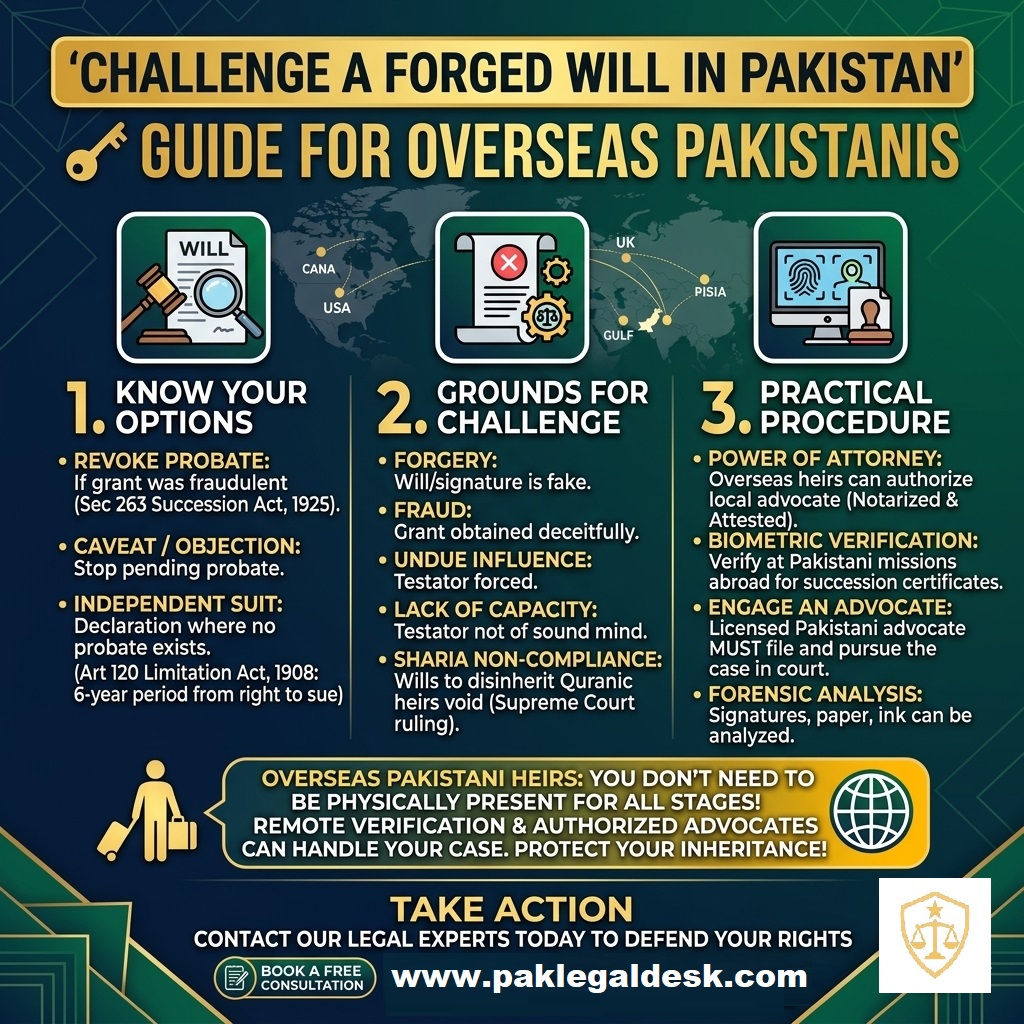
You are not required to be physically present in Pakistan for all stages. Overseas heirs can execute a power of attorney, verify biometrics at designated Pakistani missions abroad for succession certificate matters, and, in appropriate cases, seek remote participation. However, a licensed Pakistani advocate must file and pursue the case before the court; electronic copies alone are insufficient, and dismissal for non-prosecution is a real risk.
The limitation period is not a uniform six months to one year from death as is sometimes stated. The applicable period depends on the nature of the proceeding and when the right to sue accrues.
What the Law Says
The governing statute
Testamentary and intestate succession in Pakistan is governed primarily by the Succession Act, 1925. The Act consolidates the law applicable to intestate and testamentary succession in Pakistan.
Key provisions
| Provision | Subject | Relevance |
|---|---|---|
| Section 2(c) | Definition of “executor” | A person to whom the execution of the last will is confided by the testator’s appointment |
| Section 59 | Persons capable of making wills | Every person of sound mind, not being a minor, may dispose of property by will |
| Section 61 | Will obtained by fraud, coercion or importunity | A will obtained by fraud, coercion, or importunity that takes away the testator’s free agency is void |
| Section 213 | Right as executor or legatee when established | No right as executor or legatee can be established in any court unless a competent court in Pakistan has granted probate or letters of administration with the will annexed |
| Section 263 | Revocation or annulment for just cause | The grant of probate or letters of administration may be revoked or annulled for just cause |
| Section 276 | Petition for probate | Application for probate shall be made by petition |
| Section 278 | Petition for letters of administration | Application for letters of administration shall be made by petition |
| Section 299 | Appeals | Appeals from orders of the District Judge in probate matters |
Grounds for challenging a will
A will may be challenged on grounds that include:
-
Forgery — the will or the testator’s signature was fabricated.
-
Fraud — the will was obtained by fraudulent means.
-
Undue influence or coercion — the testator’s free agency was overcome.
-
Lack of testamentary capacity — the testator was not of sound mind at the time of execution.
-
Non-compliance with statutory formalities — the will was not executed in accordance with the Act.
Section 263 — Revocation for just cause
Section 263 of the Succession Act, 1925 provides that the grant of probate or letters of administration may be revoked or annulled for “just cause”. The explanation to the section deems “just cause” to exist where, inter alia:
-
the proceedings to obtain the grant were defective in substance;
-
the grant was obtained fraudulently by making a false suggestion, or by concealing from the court something material to the case.
Where a probate has already been granted, an application under Section 263 is the appropriate route to challenge it on the ground of fraud.
Section 213 — Necessity of probate
Under Section 213 of the Succession Act, 1925, no right as executor or legatee can be established in any court of justice unless a court of competent jurisdiction in Pakistan has granted probate of the will under which the right is claimed, or has granted letters of administration with the will or with an authenticated copy of the will annexed. This means that until probate is granted, the will cannot be acted upon as a basis for establishing rights to the estate.
Supreme Court guidance on wills contrary to Sharia
In a recent judgment, the Supreme Court of Pakistan held that wills drawn up to deprive Quranic heirs (particularly daughters) of their inheritance shares are contrary to the principles of Sharia and are, as a result, null and void. The Court stated that wills which ex-ante deprive Quranic inheritors of their shares are “unconscionable instruments” not in consonance with Sharia. This principle is relevant where a will is alleged to have been used to disinherit legal heirs improperly.
Who Does This Apply To?
This guidance is relevant to:
-
Overseas Pakistani heirs — individuals residing in the United Kingdom, Canada, the United States, the Gulf states, or elsewhere, who are legal heirs of a deceased person whose estate is in Pakistan.
-
Legal heirs in Pakistan — who suspect a will presented for probate is fraudulent.
-
Beneficiaries under a suspected fraudulent will — who wish to defend or challenge its validity.
-
Executors and administrators — who may face objections or revocation applications.
The Act applies throughout Pakistan. Provincial legislation, such as the Sindh Letters of Administration and Succession Certificates Act, 2021, governs certain succession certificate and letters of administration matters in Sindh, but probate under Section 276 of the Succession Act, 1925 remains a distinct court process.
Practical Procedure
Stage 1 — Engage a Pakistani advocate
You must engage an advocate enrolled with the relevant provincial bar council. The advocate will:
-
assess the grounds for challenge;
-
determine the appropriate court (generally the civil court with jurisdiction over the deceased’s last known residence or where the estate is situated);
-
draft and file the necessary petition or application.
Stage 2 — Collect and authenticate documents
Gather:
-
the contested will (original where available);
-
the death certificate;
-
a family tree or inheritance schedule;
-
any forensic analysis of signatures, paper, or ink (if available);
-
affidavits from witnesses who can speak to the testator’s handwriting, mental state, or the circumstances of execution.
Documents executed abroad may require notarisation and attestation by the relevant Pakistani mission.
Stage 3 — File the appropriate application
If probate has already been granted: File an application under Section 263 of the Succession Act, 1925 for revocation or annulment of the grant.
If probate is pending: Enter a caveat or file an objection to the probate petition, which converts the proceedings into contentious proceedings. In contentious proceedings, the petitioner for probate becomes the plaintiff and the objector becomes the defendant.
If no probate is pending: File a suit for declaration challenging the will’s validity, governed by Article 120 of the Limitation Act, 1908.
Stage 4 — Power of attorney and representation
Overseas heirs typically execute a special power of attorney in favour of a local advocate or a trusted family member in Pakistan. The power of attorney should be:
-
prepared and notarised in the country of residence;
-
attested by the Pakistani embassy or high commission;
-
drafted to authorise the specific legal proceedings.
In succession certificate matters, NADRA’s Succession Facilitation Units allow legal heirs abroad to verify biometrics at designated Pakistani missions in cities including London, Manchester, Birmingham, Bradford, Jeddah, Riyadh, Medina, Dubai, Abu Dhabi, and Doha. After biometric verification and a 14-day public notice period with no objections, a succession certificate or letter of administration may be issued without court proceedings. However, where fraud is alleged or an objection is raised, the matter proceeds through the civil courts.
Stage 5 — Court proceedings
The court will:
-
issue notice to the executor or the party who submitted the will;
-
examine the evidence presented;
-
order a forensic examination if necessary;
-
hear witnesses;
-
determine whether the will is valid.
If the court finds the will fraudulent, it may declare the will null and void and direct distribution according to intestate succession rules.
Stage 6 — Appeal
An appeal against an order of the District Judge in probate matters lies under Section 299 of the Succession Act, 1925. The appellate court may affirm, reverse, or modify the order.
Documents / Requirements
The following documents are generally required:
-
Original or certified copy of the contested will — electronic copies alone are generally insufficient for court purposes.
-
Death certificate of the deceased.
-
Family tree / inheritance schedule — identifying all legal heirs and their relationship to the deceased.
-
Forensic report (if available) — analysis of signatures, paper, or ink.
-
Affidavits from witnesses — persons who can attest to the testator’s handwriting, mental state, or the circumstances surrounding the execution of the will.
-
Power of attorney — notarised and attested by the Pakistani mission.
-
National Identity Card for Overseas Pakistanis (NICOP) or CNIC — for identification purposes.
-
Succession Certificate or Letters of Administration — where already issued.
Deadlines
There is no single uniform limitation period for challenging a will in Pakistan. The applicable period depends on the nature of the proceeding:
| Proceeding | Applicable limitation | Source |
|---|---|---|
| Suit for declaration (no probate pending) | Six years from the date the right to sue accrues | Article 120, Limitation Act, 1908 |
| Application for revocation of probate under Section 263 | No specific statutory limitation; prompt action is advisable | Section 263, Succession Act, 1925 |
| Appeal against probate order under Section 299 | Period prescribed by law for appeals from original decrees | Section 299, Succession Act, 1925 |
Important: The commonly repeated claim that the limitation period is “six months to one year from death” is not supported by the Succession Act, 1925 or the Limitation Act, 1908. Under Article 120 of the Limitation Act, 1908, a suit for declaration for which no specific period is provided has a limitation period of six years from the time when the right to sue accrues. In inheritance disputes involving fraud, the right to sue may accrue from the date the fraud became known to the party. However, a suit filed more than four years after the prescribed period may be dismissed as time-barred.
Fees
The prompt requires that no fees be stated unless verified from an authoritative source. Court fees for probate and declaratory suits vary by province and by the value of the estate. No specific fee figures are included in this article because they were not verified against current official schedules at the time of writing. Readers should obtain current fee information from the relevant court or a qualified advocate.
Penalties / Consequences
The consequences of a finding that a will is fraudulent include:
-
the will is declared null and void;
-
probate or letters of administration granted on the basis of the fraudulent will may be revoked or annulled under Section 263 of the Succession Act, 1925;
-
the estate is distributed according to the rules of intestate succession;
-
persons who procured probate fraudulently may face separate civil or criminal consequences, depending on the facts.
The Supreme Court has held that wills which deprive Quranic heirs of their shares are null and void as contrary to Sharia.
Exceptions
-
Muslim estates: For Muslim testators, Islamic inheritance rules apply by default. A will can only direct up to one-third of the estate away from legal heirs; the remaining two-thirds follow fixed Quranic shares.
-
Non-Muslim estates: The Succession Act, 1925 applies, and the testator may dispose of property by will subject to the Act’s provisions.
-
Sindh: The Sindh Letters of Administration and Succession Certificates Act, 2021 provides an alternative route for letters of administration and succession certificates in Sindh, but does not displace the probate jurisdiction under Section 276 of the Succession Act, 1925.
-
NADRA Succession Facilitation Units: For uncontested succession certificate matters, NADRA’s facilitation units provide a court-free process with a 14-day public notice period.
Common Mistakes
-
Assuming a uniform six-month to one-year limitation period. The correct limitation depends on the nature of the proceeding. A declaratory suit is generally governed by the six-year residuary period under Article 120 of the Limitation Act, 1908.
-
Relying solely on electronic copies of the will. The court generally requires the original or a certified copy.
-
Failing to appoint a local advocate. A petition filed without proper local representation is at risk of dismissal for non-prosecution.
-
Delaying forensic analysis. Obtaining expert analysis of the signature, paper, and ink before filing strengthens the allegation of forgery.
-
Not serving notice on the executor. The court requires proper service of notice on the executor or the party who presented the will.
-
Assuming physical presence is mandatory. While physical presence is not always required, the court may require the overseas heir to appear for oath-taking or cross-examination.
-
Ignoring the distinction between probate and letters of administration. Probate is dealt with under Section 276 of the Succession Act, 1925; letters of administration and succession certificates may be dealt with under Section 278 or, in Sindh, under provincial legislation.
Practical Compliance Checklist
- Engage a Pakistani advocate enrolled with the relevant provincial bar council.
- Obtain the original or certified copy of the contested will.
- Obtain the death certificate and family tree.
- Commission a forensic analysis of the signature, paper, and ink (if forgery is alleged).
- Prepare affidavits from witnesses.
- Execute a special power of attorney, notarised and attested by the Pakistani mission.
- Determine whether probate has already been granted.
- If probate granted, file an application under Section 263 of the Succession Act, 1925 for revocation.
- If probate pending, enter a caveat or file an objection.
- If no probate pending, file a suit for declaration within the limitation period.
- Serve notice on the executor or the party who presented the will.
- Attend hearings or seek remote participation as permitted by the court.
- If the will is declared invalid, obtain the final order and, if necessary, file an appeal under Section 299.
Frequently Asked Questions
1. Can I file a petition myself without a Pakistani lawyer?
While you may prepare documents, Pakistani law requires that a licensed advocate represent you in court. Without local representation, the petition is at risk of dismissal for non-prosecution.
2. What is the time limit to challenge a will after death?
There is no single uniform limitation period. A suit for declaration is generally governed by the six-year residuary period under Article 120 of the Limitation Act, 1908, running from the date the right to sue accrues. In fraud cases, the right to sue may accrue from the date the fraud became known. Prompt action is advisable.
3. Do I need to be present in Pakistan for the hearing?
Physical presence is not always mandatory. The court may permit remote participation in appropriate cases. However, the court may require you to appear for oath-taking or cross-examination.
4. How can I prove that a will is forged?
Expert forensic analysis of the signature, paper, and ink, along with testimonies from individuals who knew the deceased’s handwriting, are the primary evidentiary tools.
5. What happens if the court declares the will invalid?
The estate will be distributed according to the intestate succession provisions of the Succession Act, 1925, which allocate shares to legal heirs based on their relationship to the deceased.
6. What is the difference between probate and letters of administration?
Probate is granted when there is a will and an executor named in it. Letters of administration are granted when there is no executor, or where the will does not name an executor. Probate is dealt with under Section 276 of the Succession Act, 1925; letters of administration under Section 278.
7. Can a will be challenged after probate has been granted?
Yes. Under Section 263 of the Succession Act, 1925, the grant of probate may be revoked or annulled for just cause, including where the grant was obtained fraudulently by making a false suggestion or by concealing something material from the court.
8. Does a will that disinherits daughters have any legal effect?
The Supreme Court of Pakistan has held that wills drawn up to deprive Quranic heirs (including daughters) of their inheritance shares are contrary to Sharia and are null and void.
9. What is the role of NADRA in succession matters?
NADRA operates Succession Facilitation Units that can issue succession certificates and letters of administration for uncontested matters, without court proceedings. Overseas heirs can verify biometrics at designated Pakistani missions abroad. Where an objection or dispute arises, the matter proceeds through the civil courts.
10. Can I challenge a will from abroad without travelling to Pakistan?
You can initiate and pursue a challenge from abroad through a Pakistani advocate acting on your behalf under a power of attorney. However, you may need to verify biometrics at a Pakistani mission and may be required to appear for specific hearings.
11. What if the will is contrary to Sharia?
Wills that contravene Islamic inheritance principles — for example, by attempting to disinherit Quranic heirs — may be declared null and void by the courts.
12. Is there a way to obtain a succession certificate without going to court?
Yes, for uncontested matters, NADRA’s Succession Facilitation Units provide a court-free process with a 14-day public notice period. If an objection is received, the matter must proceed through the civil courts.
Final Takeaway
Challenging a fraudulent will in Pakistan from abroad is possible but requires a structured approach. The key points are:
-
The governing statute is the Succession Act, 1925.
-
Section 263 provides the route to revoke probate obtained by fraud.
-
The limitation period is not a uniform six months to one year; a declaratory suit is generally governed by the six-year residuary period under Article 120 of the Limitation Act, 1908.
-
Overseas heirs can act through a Pakistani advocate under a power of attorney and may verify biometrics at designated Pakistani missions.
-
NADRA’s Succession Facilitation Units offer a court-free process for uncontested succession certificates, but fraud or objections push the matter to the civil courts.
-
The Supreme Court has held that wills depriving Quranic heirs of their shares are null and void.
Verified and accurate legal information is preferable to comprehensive but uncertain guidance. Where a specific fact — such as a current fee or a provincial variation — could not be verified from an authoritative source, it has been omitted.
Pak Legal Desk CTA
If you suspect that a will relating to a Pakistani estate has been forged or obtained by fraud, Pak Legal Desk can assist. We can:
-
review the will and the surrounding circumstances;
-
identify the appropriate legal route (revocation of probate, caveat, or declaratory suit);
-
coordinate with enrolled advocates in the relevant province;
-
assist with documentation, power of attorney, and remote participation arrangements;
-
provide a clear assessment of the limitation position based on the specific facts.
Contact Pak Legal Desk to arrange a consultation with a qualified Pakistani advocate.
References
Primary Legislation
-
Succession Act, 1925 (Pak.). Ministry of Law and Justice, Pakistan Code. https://pakistancode.gov.pk/english/UY2FqaJw2-apaUY2Fqa-ap6Z-con-14070-sg-jjjjjjjjjjjjj
-
Limitation Act, 1908 (Pak.).
-
Sindh Letters of Administration and Succession Certificates Act, 2021 (Sindh Act No. VII of 2021).
Official Regulator / Government
-
Ministry of Foreign Affairs, Government of Pakistan. (2021). Circular: Simplification of Procedure for Issuance of the Letters of Administration/Succession Certificates. https://mofa.gov.pk/wp-content/uploads/2021/03/Plocy-for-Issuance-of-Succession-Certificate.pdf
-
National Database and Registration Authority (NADRA). Succession Certificate Facilitation. https://succession.nadra.gov.pk
Official Judicial Sources
-
Supreme Court of Pakistan. Civil Appeal No. 10 Q of 2021. https://www.supremecourt.gov.pk/downloads_judgements/c.a._10_q_2021.pdf
-
High Court of Sindh at Karachi. Miscellaneous Appeal No. 43 of 2016 (Nazar Akbar, J., 11 March 2020). https://caselaw.shc.gov.pk/caselaw/view-file/MTQ1MDYyY2Ztcy1kYzgz
-
High Court of Sindh at Karachi. Misc. Appeal No. 40 of 2025 (Muhammad Jaffer Raza, J., 29 May 2025). https://caselaw.shc.gov.pk/caselaw/view-file/MjcwMDIwY2Ztcy1kYzgz
-
Lahore High Court Research Centre. Consolidated Case Law Bulletin (2021–2024). https://researchcenter.lhc.gov.pk/pdf/CaseLawBulletin/Consolidated_Bulletin_from_01_01_21_to_31_12_24.pdf
Secondary Authority
-
Saeed Law Firm. (2026, September 27). Overseas Pakistani inheritance: Claiming property in Pakistan from abroad. https://saeedlawfirm.com/blog/overseas-pakistani-inheritance
Legal Information Disclaimer
This article provides general information about Pakistani succession law and is not legal advice. The legal position may vary based on the specific facts, the province concerned, and subsequent developments in law or procedure. Readers should consult a qualified Pakistani advocate for advice tailored to their circumstances. The information in this article was checked against the sources listed above as at 28 September 2026. No solicitor-client relationship is created by the reading of this article or by any communication with Pak Legal Desk prior to a formal engagement.