

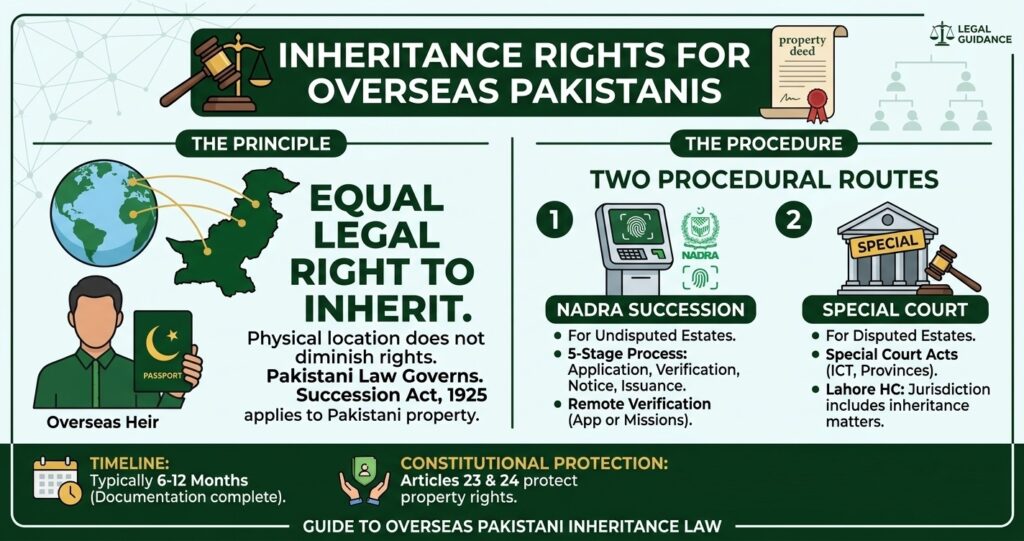
An overseas Pakistani heir holds the same legal right to inherit property in Pakistan as a resident heir. The right is not diminished by physical location. The Succession Act, 1925 confirms that succession to immovable property in Pakistan is governed by Pakistani law, regardless of where the deceased was domiciled at the time of death. Two procedural routes exist: the administrative NADRA succession process for undisputed estates, and the civil court route where a dispute arises or where a formal decree is required. Special courts established under the Establishment of Special Court (Overseas Pakistanis Property) Act, 2024 now handle property disputes involving overseas Pakistanis in the Islamabad Capital Territory, with equivalent provincial legislation in Punjab, Khyber Pakhtunkhwa, and other provinces. The process typically takes six to twelve months where documentation is complete and no objection is raised.
What the Law Says
The Governing Statutes
Inheritance in Pakistan operates on a dual-track system determined by the deceased’s religion.
For Muslim deceased persons, succession is governed by Islamic law (Sharia) as applied through the Muslim Personal Law (Shariat) Application Act, 1937, and its provincial successors, including the West Pakistan Muslim Personal Law (Shariat) Application Act, 1962. The 1937 Act provides that, notwithstanding any custom or usage, Sharia governs intestate succession. The shares of each heir are fixed under Islamic jurisprudence and are not subject to variation by the deceased’s residence or the heir’s location.
For non-Muslim deceased persons, the Succession Act, 1925 applies. Section 5 of the Act provides that succession to immovable property in Pakistan is regulated by the law of Pakistan, wherever the deceased may have had his domicile at the time of death. This provision is critical for overseas heirs: it confirms that Pakistani succession law applies to Pakistani situs property regardless of the deceased’s foreign domicile.
Constitutional Protection
Article 23 of the Constitution of the Islamic Republic of Pakistan provides that every citizen shall have the right to acquire, hold, and dispose of property in any part of Pakistan, subject to the Constitution and any reasonable restrictions imposed by law in the public interest. Article 24 further protects against deprivation of property save in accordance with law. These fundamental rights apply to overseas Pakistanis holding citizenship or NICOP status.
The Special Court Framework
The Establishment of Special Court (Overseas Pakistanis Property) Act, 2024 established dedicated special courts for adjudication of petitions in respect of immovable properties of overseas Pakistanis. The Act defines an “overseas Pakistani” as any person holding a Pakistani passport, CNIC, NICOP, POC, or OPF membership card proving nationality, who is living, working, or studying abroad permanently or temporarily for more than 182 days in a tax year.
The Act extends to the Islamabad Capital Territory. Provincial legislatures have enacted corresponding legislation, including the Punjab Establishment of Special Courts (Overseas Pakistanis Property) Act, 2025, and the Khyber Pakhtunkhwa Establishment of Special Courts (Overseas Pakistanis Property) Act. In May 2026, the Lahore High Court ruled that the jurisdiction of these special courts extends beyond possession and ownership disputes to include inheritance, partition, mutation, power of attorney, and both movable and immovable property matters involving overseas Pakistanis. The court clarified that if even one party to a dispute is an overseas Pakistani, the matter falls within the jurisdiction of a Special Court, and cases transferred from civil courts continue from the same stage without requiring fresh litigation.
Who This Applies To
This guide applies to:
-
Overseas Pakistani citizens holding a valid CNIC or NICOP;
-
Pakistan Origin Card (POC) holders who are not Pakistani citizens but retain inheritance rights under Pakistani law;
-
Non-resident heirs of a Pakistani deceased, whether Muslim or non-Muslim, claiming a share in immovable property situated in Pakistan;
-
Legal heirs residing abroad who wish to obtain a Succession Certificate or Letter of Administration through NADRA;
-
Heirs involved in a disputed estate where a civil suit or a Special Court petition is required.
It does not apply to foreign nationals who hold no Pakistani identity document or POC and whose inheritance claim is governed entirely by the law of their own domicile. It also does not apply to agricultural land in certain provinces where historical exclusions under the 1937 Shariat Act may still be argued, though subsequent provincial legislation has largely superseded those exclusions.
Practical Procedure: Two Routes
An overseas heir must first determine whether the estate is disputed. If all legal heirs agree on the shares and there is no contest, the NADRA administrative route is available. If there is any dispute, or if a court decree is required for mutation, the civil court or Special Court route must be used.
Route 1: NADRA Succession Certificate / Letter of Administration
The Ministry of Foreign Affairs circular on simplification of procedure confirms that legal heirs, whether in Pakistan or abroad, can obtain Letters of Administration (for immovable properties) and Succession Certificates (for movable properties) through a five-stage process facilitated by Succession Facilitation Units operated by NADRA.
Step 1 — Application Initiation: The applicant provides his or her National Identity Number, the deceased person’s death certificate, and the deceased’s National Identity Number. A letter of authorisation from all legal heirs authorising the applicant to file on their behalf must be submitted.
Step 2 — Legal Heirs and Assets Details: The applicant provides the relevant details of legal heirs and information pertaining to the movable and immovable assets of the deceased.
Step 3 — Verification and Consent of Legal Heirs: All legal heirs mentioned by the applicant must complete biometric verification. This can be done at a NADRA Registration Centre in Pakistan or at designated Pakistan Missions abroad where the service is offered. NADRA has also introduced remote biometric authentication through the Pak ID Mobile App for eligible applicants.
Step 4 — Publication of Notice: NADRA publishes a notice in newspapers and on its website inviting objections. If no objection is received within fourteen days of publication, the process proceeds to certificate issuance.
Step 5 — Printing and Delivery: The Succession Certificate or Letter of Administration is printed and issued to the applicant.
Important limitation: NADRA requires at least one legal heir to apply in person at a designated site in Pakistan. The process is not fully remote. However, other heirs may verify their biometrics at a Pakistani mission abroad where the service is offered, or through the Pak ID Mobile App.
Route 2: Civil Court / Special Court
Where the estate is disputed, or where NADRA cannot issue a certificate because of objections, the heir must file a succession petition in the appropriate court.
Jurisdiction: For immovable property, the petition is filed in the district court where the property is situated. For overseas Pakistanis, the Special Court established under the 2024 Act has jurisdiction over property disputes, and the Lahore High Court has confirmed that this jurisdiction includes inheritance and mutation matters.
Procedure: The petition is filed under the relevant provisions of the Succession Act, 1925, for non-Muslims, or under the civil procedure for declaration of heirship for Muslims. The court examines the evidence of lineage, the death certificate, and the family tree (shajra-e-nasab). If satisfied, the court issues a decree declaring the legal heirs and their respective shares.
Mutation: The court decree is then presented to the local land revenue office for mutation of the land record. Under the Punjab Land Revenue Act, 1967, the Circle Revenue Officer conducts a summary enquiry regarding legal heirs, determines the shares of each heir, and enters the mutation in the revenue record. A copy of the unapproved mutation is supplied to the Circle Revenue Officer, who is given a date by which it must be deposited back with the Service Centre.
Documents Required
The following documents are required for either route:
-
Certified death certificate of the deceased, issued by the relevant Pakistani authority or a foreign authority with embassy attestation.
-
Family tree (shajra-e-nasab) linking the heir to the deceased, certified by a competent authority or attested by a Pakistani embassy or consulate.
-
CNIC or NICOP of the applicant and all legal heirs.
-
Letter of authorisation from all legal heirs if one heir is applying on behalf of others.
-
Details of assets — bank accounts, property documents, share certificates, or vehicle registration.
-
Court decree (where the court route is used), for presentation to the land revenue office.
-
No-Objection Certificate (NOC) from co-heirs, where the land revenue office requests confirmation that no other heir objects to the mutation.
Documents executed abroad must be attested by the Pakistani embassy or consulate in the country of residence. In countries where Pakistan does not have a diplomatic mission, attestation by a consulate of a friendly country or apostille certification may be accepted, but this depends on the receiving authority’s practice.
Timelines
-
NADRA route: The statutory objection period is fourteen days from publication of notice. Where no objection is received, the certificate is typically issued within fifteen to thirty days thereafter. In practice, total timelines range from four to eight weeks, depending on the completeness of documentation and the availability of biometric verification slots at the relevant mission.
-
Court route: Where a civil suit is required, timelines range from six to twelve months for first-instance proceedings, depending on the court’s docket. Special Court proceedings under the 2024 Act are subject to a period for disposal of the petition, and the Khyber Pakhtunkhwa legislation provides for disposal within ninety days of filing.
-
Mutation after decree: Once the court decree is presented, the land revenue office typically completes the mutation within four to eight weeks, subject to the Circle Revenue Officer’s enquiry.
Fees and Costs
The NADRA succession certificate process itself carries no prescribed application fee under the current published guidance; costs arise from embassy attestation fees, courier charges, and advocate fees where a lawyer is engaged. Court filing fees are determined by the applicable court-fees legislation, which varies by province and by the value of the estate. Stamp duty and registration fees for the mutation are payable to the provincial revenue authority at rates set by the relevant provincial finance act. These rates are subject to periodic revision and should be confirmed with the local land revenue office at the time of filing.
Common Mistakes to Avoid
-
Assuming that physical residence abroad weakens the claim. It does not. The Succession Act, 1925 applies to the property, not to the heir’s location.
-
Attempting a fully remote NADRA application. At least one legal heir must apply in person in Pakistan. Other heirs may verify biometrics abroad where the service is offered, but the application itself must be initiated at a designated site in Pakistan.
-
Filing a civil suit when the NADRA route is available. If all heirs agree, the administrative route is faster and less expensive.
-
Failing to obtain embassy attestation of the death certificate and family tree. Unattested foreign documents are not accepted by NADRA or the courts.
-
Ignoring the fourteen-day objection period. If an objection is filed, the NADRA process is suspended and the matter must proceed to court.
-
Presenting the succession certificate directly to the land revenue office without a court decree or mutation order. The succession certificate establishes heirship; it does not itself mutate the land record. A separate mutation application is required.
-
Overlooking limitation periods. Under Article 120 of the Limitation Act, 1908, a suit for declaration, including a suit to enforce inheritance rights, is subject to a six-year limitation period from the date the right to sue accrues. Delays in asserting the claim can therefore be fatal.
Frequently Asked Questions
Can I inherit property in Pakistan if I live abroad?
Yes. The right to inherit is the same as that of a resident heir. Succession to immovable property in Pakistan is regulated by the law of Pakistan, regardless of the heir’s residence or the deceased’s domicile at the time of death.
Do I need to travel to Pakistan to claim my inheritance?
At least one legal heir must apply in person at a designated NADRA site in Pakistan. Other heirs may complete biometric verification at a Pakistani mission abroad where the service is offered, or through the Pak ID Mobile App. The process is not fully remote.
What is the difference between a Succession Certificate and a Letter of Administration?
A Succession Certificate covers movable assets such as bank balances and shares. A Letter of Administration covers immovable property such as houses, plots, and agricultural land. NADRA issues the appropriate document according to the nature of the asset.
How long does the process take?
NADRA issues a public notice with a fourteen-day objection period. If no objection is received, the certificate is typically issued within fifteen to thirty days thereafter. The court route takes six to twelve months for first-instance proceedings. Special Court proceedings are subject to a statutory period for disposal, with Khyber Pakhtunkhwa providing for ninety days.
What if other heirs contest my claim?
If an objection is filed during the NADRA process, the matter is referred to court. The court may order mediation or require additional proof of lineage. If the dispute persists, the matter proceeds to trial where each party presents evidence.
Are there any taxes on inherited property for overseas heirs?
Inheritance itself is not taxed under Pakistani law. However, stamp duty and registration fees are payable on the mutation of immovable property, at rates set by the relevant provincial finance act. These rates should be confirmed with the local land revenue office at the time of filing.
Can I use a Special Court instead of a regular civil court?
Yes. Under the Establishment of Special Court (Overseas Pakistanis Property) Act, 2024, special courts have jurisdiction over property disputes involving overseas Pakistanis, including inheritance and mutation matters. If even one party is an overseas Pakistani, the matter falls within the Special Court’s jurisdiction.
What documents do I need to obtain a succession certificate?
You need the deceased’s death certificate, a certified family tree, your CNIC or NICOP, a letter of authorisation from all legal heirs, details of the assets, and embassy attestation of foreign documents. Where a court decree is required, that decree must also be presented.
Is the succession certificate issued by NADRA recognised by banks and land offices?
Yes. The State Bank of Pakistan has recognised Succession Certificates and Letters of Administration issued by NADRA alongside traditional court-issued documentation for the purposes of remitting inherited assets.
What happens if I do not complete the mutation within the limitation period?
Under Article 120 of the Limitation Act, 1908, a suit for declaration is subject to a six-year limitation period from the date the right to sue accrues. If the limitation period expires, the claim may be barred. It is therefore important to assert the inheritance claim promptly.
Can I appoint a lawyer to act on my behalf in Pakistan?
Yes. A licensed Pakistani advocate can file the succession petition, appear before the court, liaise with the land revenue office, and handle the mutation process. A power of attorney executed abroad in favour of the advocate must be attested by the Pakistani embassy or consulate.
Do I need a No-Objection Certificate from other heirs?
Where the land revenue office requests confirmation that no other heir objects to the mutation, an NOC from co-heirs may be required. If all heirs are cooperating through the NADRA route, the fourteen-day public notice serves a similar function.
Final Takeaway
An overseas Pakistani heir’s right to inherit property in Pakistan is protected by the Succession Act, 1925, Article 23 of the Constitution, and the Establishment of Special Court (Overseas Pakistanis Property) Act, 2024. The critical practical requirement is to determine at the outset whether the estate is disputed. If it is not, the NADRA succession certificate process offers a faster administrative route with a fourteen-day objection period. If it is, the Special Court route provides a dedicated forum with statutory timelines for disposal. In both cases, embassy attestation of foreign documents and, where required, the participation of at least one legal heir in Pakistan are unavoidable steps. Delays carry real legal risk under the Limitation Act, 1908.
Pak Legal Desk CTA
Pak Legal Desk connects overseas Pakistanis with experienced Pakistani advocates who specialise in succession, inheritance, and land revenue matters. Whether you need assistance with a NADRA succession certificate application, a petition before the Special Court for Overseas Pakistanis, or the mutation of inherited land, our network can guide you through each procedural stage. Contact Pak Legal Desk to discuss your inheritance claim.
References
Establishment of Special Court (Overseas Pakistanis Property) Act, 2024, Act No. XXVIII of 2024 (Pak.).
Limitation Act, 1908, Act IX of 1908, Article 120 (Pak.).
Muslim Personal Law (Shariat) Application Act, 1937 (Pak.).
Punjab Land Revenue Act, 1967 (Pak.).
Succession Act, 1925, Act XXXIX of 1925, Section 5 (Pak.).
Constitution of the Islamic Republic of Pakistan, 1973, Articles 23–24.
National Database and Registration Authority. (n.d.). Succession Certificate. https://kpsuccession.nadra.gov.pk
Ministry of Foreign Affairs, Government of Pakistan. (2021). Simplification of Procedure for Issuance of the Letters of Administration/Succession Certificates. https://mofa.gov.pk/wp-content/uploads/2021/03/Plocy-for-Issuance-of-Succession-Certificate.pdf
Lahore High Court. (2026, May 10). LHC widens expat courts’ scope. The Express Tribune. https://tribune.com.pk/story/2607261/lhc-widens-expat-courts-scope
Legal Information Disclaimer
This article provides general information about Pakistani inheritance law and procedure as at 28 September 2026. It is not legal advice and should not be relied upon as a substitute for consultation with a qualified Pakistani advocate. Succession law, provincial land revenue procedures, and fee schedules are subject to change. The position in each case depends on the specific facts, including the religion of the deceased, the province where the property is situated, and whether the estate is disputed. Readers should obtain independent legal advice before taking any action based on this article.