

Quick Answer
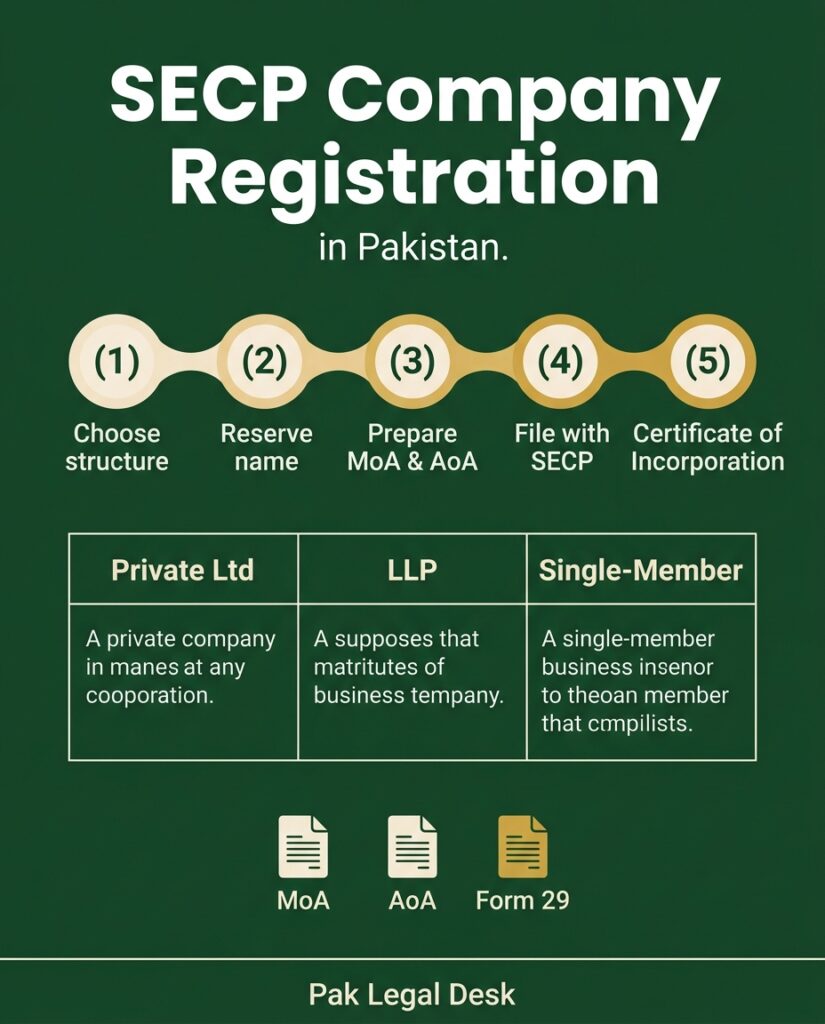
Companies in Pakistan are registered with the Securities and Exchange Commission of Pakistan (SECP) under the Companies Act, 2017. You choose a structure (for example a private limited company, single-member company or, for partners, a limited liability partnership), reserve a name, prepare constitutional documents and file the application through SECP’s online process. Exact forms, fees and requirements change, so confirm them on SECP’s website before you file.
Who This Guide Is For
Founders, small business owners and professionals deciding whether and how to incorporate.
What the Law Says
Registration creates a separate legal entity for companies. Other structures exist: a sole proprietorship is not an SECP company, and partnerships are governed by the Partnership Act, 1932 unless registered as an LLP under the Limited Liability Partnership Act, 2017.
Choosing a Structure
| Structure | In brief | Points to consider |
|---|---|---|
| Sole proprietorship | One person, no separate entity | Simple; personal liability |
| Partnership | Two or more persons | Governed by the Partnership Act, 1932; personal liability |
| LLP | Partnership with limited liability | Registered under the LLP Act, 2017 |
| Private limited company | Separate entity; shares not offered to the public | Directors and shareholders; compliance duties |
| Single-member company | Company with one member | Check current requirements |
| Public company | Shares may be offered to the public | Heavier regulation |
Documents and Information Usually Needed
Confirm the current list on SECP. Typically it includes proposed company names, identity details and addresses of subscribers and directors, the objects and structure, share capital details, a registered office address, and the memorandum and articles of association. Foreign participants may need additional documents.
Pakistan-Specific Legal Position
- Companies Act, 2017 governs incorporation, directors’ duties and filings. Verify the current text and amendments.
- SECP regulations, circulars and its online system set the practical process; these change.
- Directors’ and officers’ requirements (number, residency, eligibility) are set by the Act and rules; verify current rules before appointing.
- After incorporation, tax and other registrations (for example with the Federal Board of Revenue) are separate; check requirements for your activity.
- Sector licences may be needed for regulated activities.
Law and administrative procedures can change; verify the current position before acting.
Step-by-Step Guide
- Decide the structure and who will be members and directors.
- Choose and check name availability with SECP.
- Prepare the memorandum and articles to fit your arrangements.
- Gather identity and address documents.
- File the application through SECP’s process and pay official fees.
- Receive the certificate of incorporation.
- Complete tax and other registrations.
- Open a bank account and set up record-keeping.
- Calendar annual filings.
Common Mistakes
Using the wrong structure; copying a standard memorandum without reading it; no shareholder agreement; ignoring annual filings; not checking name restrictions; assuming incorporation covers tax registration.
When Professional Legal Advice Is Appropriate
A corporate lawyer is worth involving when there are several founders, investors, foreign participants, regulated activities, unusual share structures, or when you need a shareholder agreement or employment contracts. A simple single-founder company may need less help, but advice is still prudent.
Pak Legal Desk Solution
Per its Services page (checked 8 October 2026), Pak Legal Desk provides form-based templates for Pakistan, including partnership, shareholder, service and employment agreements, and lists drafting services on a contact-for-price basis. The page does not list an SECP registration service. For a fact-specific incorporation question, consult a qualified corporate advocate. See Pak Legal Desk’s services and templates.
Frequently Asked Questions
Which authority registers companies in Pakistan? SECP, under the Companies Act, 2017.
Can one person form a company in Pakistan? The Act allows single-member companies; confirm current requirements.
What is the difference between a company and an LLP? An LLP is a partnership with limited liability under the LLP Act, 2017; a company is a separate legal entity under the Companies Act, 2017.
Do I need a lawyer to register a company? Not always, but it helps for complex structures.
How much does registration cost? Fees are set by SECP and change; check SECP’s current schedule.
Final Takeaway
Registering a company in Pakistan is a matter of SECP process and Companies Act, 2017 requirements. Confirm current forms and fees on SECP before filing, and involve a corporate advocate for complex structures.
References
- Companies Act, 2017 (Pakistan Code)
- Limited Liability Partnership Act, 2017 (Pakistan Code)
- Partnership Act, 1932 (Pakistan Code)
- SECP website (secp.gov.pk) — confirm current forms and fees
Legal Information Disclaimer
This article provides general legal information for educational purposes and does not constitute legal advice. For advice concerning a specific matter, consult a qualified advocate.