
Quick Answer
There is no objectively best AI legal assistant for Pakistan; the right one depends on your task, your sources and your tolerance for risk. Before using any legal AI, check what sources it draws on, whether it shows citations you can verify, how it handles Urdu, what happens to the data you enter, and whether a qualified person checks the output. Treat AI output as a draft or a lead, never as the final word.
Who This Guide Is For
Advocates, in-house counsel, law students and businesses considering AI tools for research or drafting.
What the Law Says
In Pakistan, only an advocate enrolled with a Provincial Bar Council may practise the profession of law, under Sections 22 and 23 of the Legal Practitioners and Bar Councils Act, 1973. An AI tool cannot replace an advocate. The advocate who files a document remains responsible for its accuracy.
Advocates are subject to the Pakistan Legal Practitioners and Bar Councils Rules, 1976, Chapter XII. Check any court directions on the use of AI tools in filings.
What You Need to Know
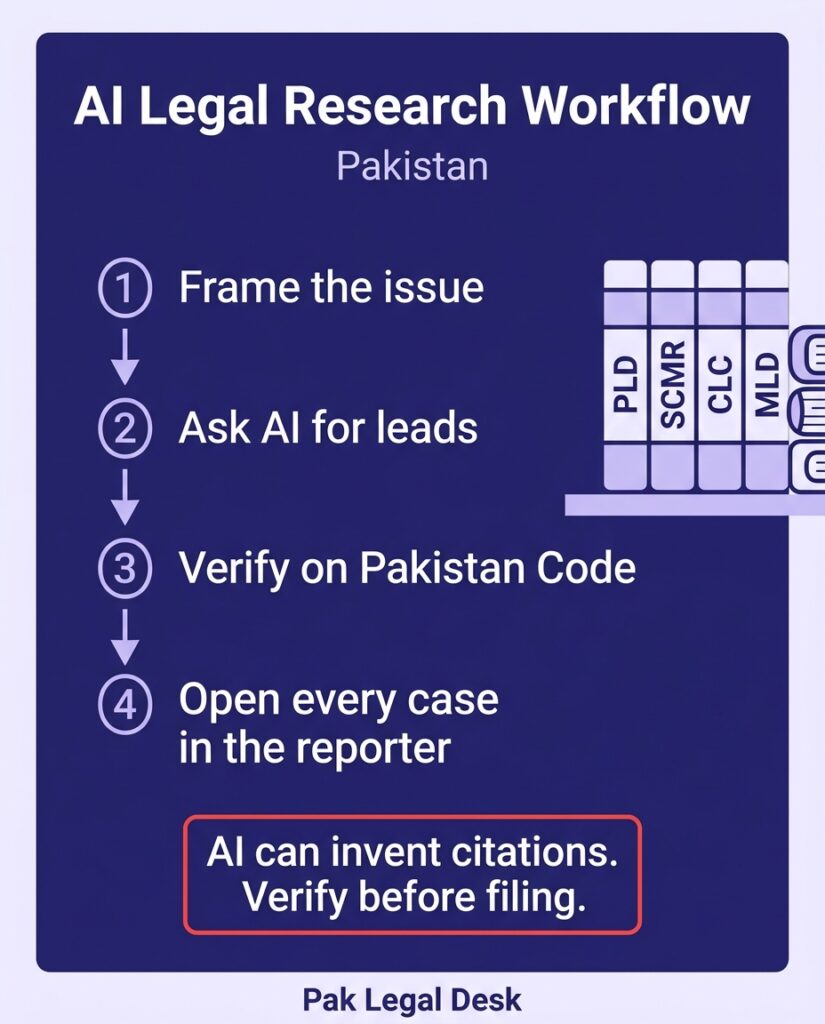
General AI models can produce fluent but wrong legal statements, including invented citations. Pakistani law adds difficulty: federal and provincial legislation sit side by side, amendments are frequent, and reported judgments use specialised citation formats. An AI tool is only as dependable as its sources and your verification.
Checklist Before You Use Legal AI
| Check | What good looks like |
|---|---|
| Sources | The tool says what it draws on (for example the Pakistan Code and reported judgments) |
| Citations | Every statutory or case reference can be traced to a primary source |
| Currency | It tells you when law was last updated; you still check for amendments |
| Federal vs provincial | It distinguishes them |
| Urdu | Works in Urdu and English on real queries |
| Confidentiality | Clear terms on storing and using your inputs |
| Limits | It says it is not legal advice and tells you when to consult an advocate |
| Human check | You can verify before you rely |
| Pricing | Clear free and paid limits |
Pakistan-Specific Position
- No Pakistani rule makes an AI answer authoritative; the advocate who files a document remains responsible for its accuracy. Check the conduct canons (Chapter XII of the 1976 Rules) and any court directions on AI.
- Statutes: confirm text and amendments on the Pakistan Code. Judgments: confirm against the court’s published judgment or the reporter.
- Privileged or sensitive client information should not be entered into a tool whose data terms you have not read.
Law and administrative procedures can change; verify the current position before acting.
Step-by-Step: Testing a Legal AI Tool
- Choose five questions you already know the answer to.
- Include one on a recent amendment and one on a provincial law.
- Ask for sources and open every one.
- Try one question in Urdu.
- Note anything it states with confidence but cannot source.
- Read the data and privacy terms.
- Decide which tasks it may support (for example first drafts) and which it may not (for example final citations).
Common Mistakes
Citing without checking; assuming fluency means accuracy; entering confidential material without reading the terms; using AI for limitation or procedure without checking the code; forgetting that platforms differ in coverage and verification.
When Professional Legal Advice Is Appropriate
For any matter with real consequences, consult a qualified advocate. AI assistance is not a substitute for advice.
Pak Legal Desk Solution
Per its product page (checked 8 October 2026), Pak Legal Desk’s AI Legal Assistant answers questions in Urdu and English, cites statutes where applicable, helps draft documents such as contracts, notices and affidavits, and offers a free tier with limited daily queries and paid plans. The page says answers are a starting point and are not legal advice. See Pak Legal Desk’s AI Legal Assistant.
Frequently Asked Questions
Can AI replace a lawyer in Pakistan? No. It can assist with research and drafting; an advocate provides advice and appears in court.
Is AI legal advice reliable? It can be a useful starting point, but must be verified against primary sources.
Can I ask legal questions in Urdu? Some tools support Urdu; test on your own queries.
Is it safe to enter client details? Only after reading the tool’s data terms.
Which AI legal tool is the best? Compare against your needs using the checklist above.
Final Takeaway
No legal AI is authoritative in Pakistan. Use it as a research assistant, verify every citation against a primary source, and keep an advocate responsible for anything filed in court.
References
- Legal Practitioners and Bar Councils Act, 1973 (Pakistan Code) — Sections 22, 23
- Pakistan Legal Practitioners and Bar Councils Rules, 1976, Chapter XII
- Pakistan Code (pakistancode.gov.pk)
- Supreme Court and High Court websites for judgments (confirm URLs)
Legal Information Disclaimer
This article provides general legal information for educational purposes and does not constitute legal advice. For advice concerning a specific matter, consult a qualified advocate.