
Quick Answer
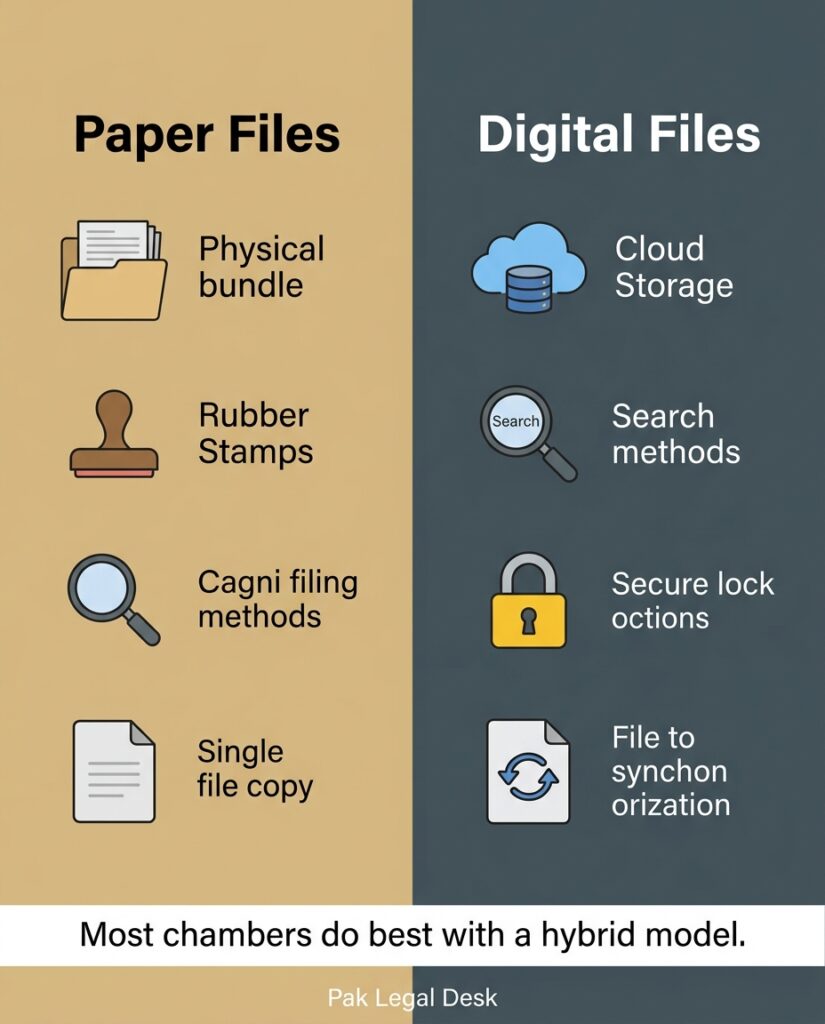
Neither approach is automatically better. Paper files are familiar, work without power or connectivity and are what courts ultimately handle. Digital case management is searchable, shareable and easier to back up, and it makes dates and deadlines harder to lose. Most chambers do best with a hybrid: originals and court-facing paper where needed, plus a digital record that holds dates, notes and scanned copies. Move in stages and keep the court’s order sheet as the source of truth.
Who This Guide Is For
Advocates and chambers weighing a move from paper diaries and bundles to software.
What the Law Says
Under the Legal Practitioners and Bar Councils Act, 1973, advocates are enrolled with Provincial Bar Councils (Sections 22 and 23). Professional confidentiality duties apply to digital storage too; see Chapter XII of the Pakistan Legal Practitioners and Bar Councils Rules, 1976.
Evidentiary questions about electronic documents are governed by the Qanun-e-Shahadat Order, 1984 and the Electronic Transactions Ordinance, 2002. Verify current provisions before relying on electronic records as evidence.
What You Need to Know
Paper wins on familiarity, no learning curve, no subscription, and no dependence on devices. Its weaknesses are loss, damage, one-copy-only access, no search, and no automatic reminders.
Digital wins on search, version history, backups, shared access with juniors, reminders and reporting. Its weaknesses are set-up time, vendor and data risks, reliance on devices, and the risk of entering wrong data.
Comparison
| Factor | Paper | Digital |
|---|---|---|
| Finding a document | Manual search | Search by name, party or number |
| Loss or damage | Single copy | Backups possible |
| Shared access | One person at a time | Several users with roles |
| Reminders | Memory or loose notes | Configurable |
| Cost | Low direct cost | Possible subscription and time cost |
| Confidentiality | Physical security | Passwords, access control, vendor security |
| Court-facing use | Original and certified copies | Scans for reference |
| Dependence | None | Device and connection |
Pakistan-Specific Legal Position
- Courts continue to work with original and certified documents; a scan is a working copy for your own reference. Check the relevant court’s rules on electronic filing before relying on any digital copy.
- Evidentiary questions about electronic documents are governed by the Qanun-e-Shahadat Order, 1984 and the Electronic Transactions Ordinance, 2002. Verify current provisions before relying on electronic records as evidence.
- Professional confidentiality duties apply to digital storage too; see Chapter XII of the 1976 Rules.
- Limitation and deadlines remain legal questions no software can answer.
Law and administrative procedures can change; verify the current position before acting.
Step-by-Step: A Safe Transition
- Start with active matters only.
- Enter parties, forum, case number, stage and next date.
- Scan key documents and name them consistently.
- Keep originals in the file.
- Run paper and digital in parallel for a few weeks.
- Compare dates weekly against the order sheet.
- Add juniors with limited access.
- Back up and test the export.
- Retire the paper diary only when you trust the routine.
Common Mistakes
Scanning everything at once; discarding originals; no backup; no naming rule; giving everyone full access; assuming a scan replaces a certified copy.
When Professional Advice Is Appropriate
Seek advice if you need to use electronic records as evidence, or if client data is held across borders.
Pak Legal Desk Solution
Per its product page (checked 8 October 2026), Pak Legal Desk’s case-management system includes a document vault with version history, a case diary, a hearing calendar, a printable case dossier and CSV import for cases, and it installs as an app on a phone. It can sit alongside paper files during a transition. See Pak Legal Desk’s case-management system.
Frequently Asked Questions
Can I go fully paperless? Courts still rely on originals and certified copies, so most chambers keep some paper.
Is a scanned copy valid in court? Treat it as a working copy and check the court’s rules.
Is digital safer than paper? Different risks: paper can be lost or damaged; digital depends on security and backups.
How do I start? Begin with active matters and run both systems in parallel.
Do I need internet access? Depends on the tool; ask whether offline use is supported.
Final Takeaway
Most chambers do best with a hybrid: paper for originals and court-facing use, digital for dates, deadlines and search. Transition in stages and keep the order sheet as the source of truth.
References
- Legal Practitioners and Bar Councils Act, 1973 — Sections 22, 23
- Pakistan Legal Practitioners and Bar Councils Rules, 1976, Chapter XII
- Qanun-e-Shahadat Order, 1984 (Pakistan Code)
- Electronic Transactions Ordinance, 2002 (Pakistan Code)
- Court websites for e-filing rules (confirm)
Legal Information Disclaimer
This article provides general legal information for educational purposes and does not constitute legal advice. For advice concerning a specific matter, consult a qualified advocate.