

Quick Answer
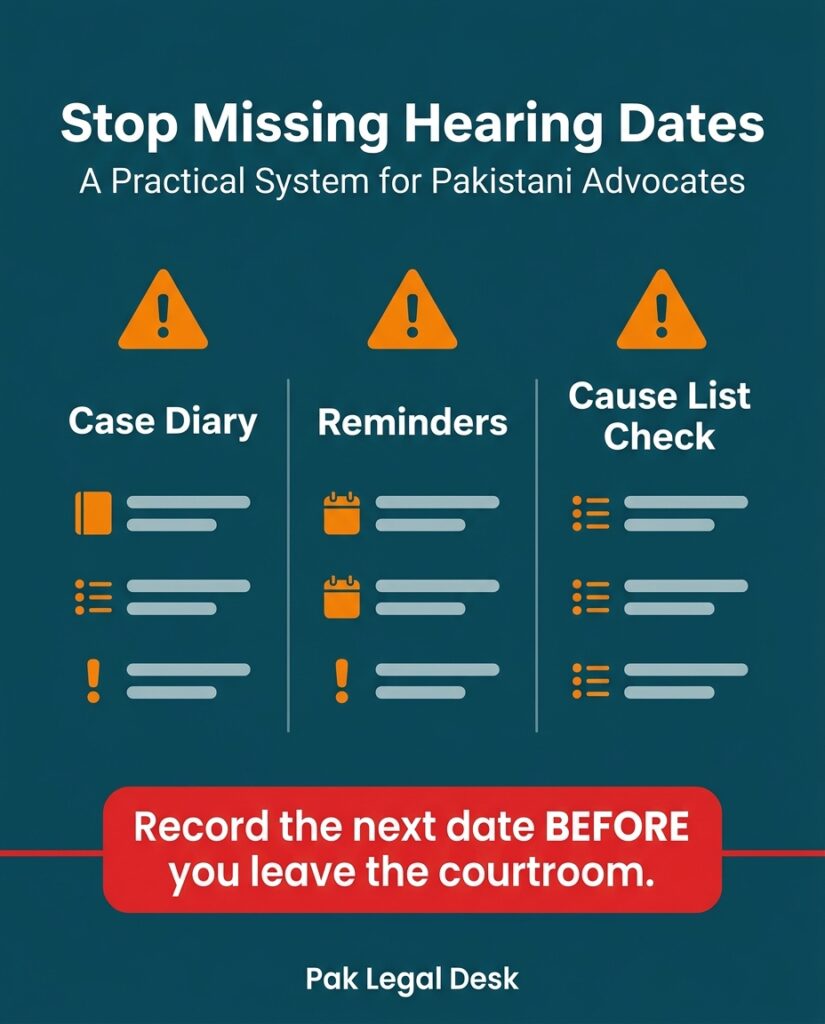
Dates are missed because the next date is recorded late, in the wrong place, or with a single reminder. The fix is a routine: record the next date before leaving court, keep hearing dates and filing deadlines as separate entries, set more than one reminder, check the cause list the evening before, and name a backup when two courts clash. A digital case diary makes this easier but does not replace the court’s own records.
Who This Guide Is For
Advocates, juniors and chamber managers who handle several matters across different courts.
What the Law Says
Under the Legal Practitioners and Bar Councils Act, 1973, advocates are enrolled with Provincial Bar Councils (Sections 22 and 23). Diligence in managing client matters is a professional expectation; the conduct canons in Chapter XII of the Pakistan Legal Practitioners and Bar Councils Rules, 1976 continue to apply.
Procedural codes provide for outcomes such as adjournment, proceeding in a party’s absence, and dismissal for default, together with remedies such as restoration or setting aside. Grounds, timelines and consequences depend on the court and the proceeding. Check the Code of Civil Procedure, 1908 and the applicable criminal and family-court procedures directly on the Pakistan Code.
What You Need to Know
Hearings are adjourned often; the new date may be announced orally or noted in the order sheet. A date written on loose paper or sent only by chat is easy to lose. Two courts may list matters on the same day, cause lists change, and a junior may attend while the senior’s diary is never updated.
A hearing date is when a court sits on the matter. A deadline is when you must file or act. A diary that mixes them hides the second kind.
Pakistan-Specific Legal Position
- The order sheet is authoritative; your diary is a working copy.
- Consequences of non-appearance vary by forum. Procedural codes provide for outcomes such as adjournment, proceeding in a party’s absence and dismissal for default, and for remedies such as restoration or setting aside. Grounds, timelines and consequences depend on the court and the proceeding. Check the Code of Civil Procedure, 1908 (rules on appearance and non-appearance) and the applicable criminal and family-court procedures directly on the Pakistan Code.
- Remedies are time-bound. If a date has been missed, take prompt advice from a qualified advocate.
- Diligence in managing client matters is a professional expectation. Review Chapter XII of the 1976 Rules.
Law and administrative procedures can change; verify the current position before acting.
Step-by-Step Guide
- Record the next date before leaving the courtroom.
- Copy it to the digital diary the same day, with court, bench and case number.
- Check it against the order sheet.
- Enter deadlines separately with their own reminders.
- Layer reminders: an earlier one for preparation and a close one for the day.
- Check the cause list the evening before; many court websites publish them, though availability and format vary.
- Resolve clashes early by briefing a junior or colleague in writing.
- Give the junior access to the same dates and notes.
- Spend ten minutes each week on the coming two weeks.
- After each hearing, log what happened and the next date.
Information to Record for Every Date
| Field | Why |
|---|---|
| Date and time | Scheduling |
| Court, bench, courtroom | Clash detection |
| Case number and title | Identification |
| Purpose of the date | Preparation |
| Who attends | Accountability |
| Source (order sheet or cause list) | Verification |
Common Mistakes
Trusting memory after a long day; a single reminder channel; not recording the purpose of the next date; ignoring cause-list changes; keeping client details in chat messages; never reviewing adjournment patterns.
When Professional Advice Is Appropriate
Organising your own diary needs no legal advice. If a date has been missed, or you are unsure of a remedy or time limit, consult a qualified advocate promptly.
Pak Legal Desk Solution
Per its product page (checked 8 October 2026), Pak Legal Desk’s case-management system includes a hearing calendar with court-conflict warnings, reminders the evening before a hearing, 7-day, 3-day and 24-hour deadline reminders, deadline templates (such as Written Statement, Rejoinder and Appeal), a case diary and team roles so a junior sees the same dates. WhatsApp reminders are click-to-chat: the system prepares a message and you press send. You enter hearing dates yourself, so confirm them against the order sheet and cause list. See Pak Legal Desk’s case-management system.
Frequently Asked Questions
What is the best way for a lawyer to track hearing dates? Record the next date immediately after every hearing, keep it in a searchable diary, add reminders and check the cause list the evening before.
What is the difference between a hearing date and a deadline? A hearing date is when the court sits; a deadline is when you must file or act. Track them separately.
Is a digital diary reliable? As reliable as the data entered. Verify against the order sheet and back up.
What happens if a lawyer misses a hearing in Pakistan? It depends on the court and proceeding. Consequences can include adjournment, an order in a party’s absence or dismissal for default, with remedies in some circumstances. Seek prompt advice.
Can WhatsApp reminders replace a case diary? No. Chat messages are not a structured record; use them as an extra reminder.
Final Takeaway
Missed dates are almost always a recording problem, not a memory problem. Record the next date before you leave court, keep deadlines separate, layer reminders, and check the cause list the evening before.
References
- Code of Civil Procedure, 1908 (Pakistan Code) — confirm the exact provisions before citing
- Legal Practitioners and Bar Councils Act, 1973 — Sections 22, 23
- Pakistan Legal Practitioners and Bar Councils Rules, 1976, Chapter XII
- Official court websites for cause lists (confirm each URL)
Legal Information Disclaimer
This article provides general legal information for educational purposes and does not constitute legal advice. For advice concerning a specific matter, consult a qualified advocate.