

Quick Answer
Start with the primary sources: the Pakistan Code for federal legislation, provincial government and assembly sites for provincial laws, and the websites of the Supreme Court, High Courts and Federal Shariat Court for judgments. Use law reporters and subscription databases to find headnoted cases quickly, then confirm against the court’s own text. Search by statute and section first, then by key terms, then by citation, and always check whether the law has since been amended.
Who This Guide Is For
Advocates, law students, in-house teams and business owners who need to find Pakistani law online.
What the Law Says
In Pakistan, the legal profession is regulated by the Legal Practitioners and Bar Councils Act, 1973. Under Sections 22 and 23, only an advocate enrolled with a Provincial Bar Council may practise the profession of law. Legal research supports that practice.
Where to Look
| Need | Primary source | Notes |
|---|---|---|
| Federal Acts and rules | Pakistan Code (pakistancode.gov.pk) | Check amendment history and current text |
| Provincial laws | Provincial government and assembly websites | Confirm each URL; availability varies |
| Supreme Court judgments | Supreme Court website (supremecourt.gov.pk) | Judgments may be posted as PDFs |
| High Court judgments | Each High Court’s site | Coverage and search tools differ |
| Federal Shariat Court | Its own website | Includes judgments and cause lists per third-party guides; confirm |
| Headnotes and reported cases | Law reporters (PLD, SCMR, CLC, MLD) | Often subscription; confirm against the judgment |
| Notifications and rules | Gazette and department websites | Check date and authority |
Pakistan-Specific Position
- After the Eighteenth Amendment, check whether the subject is federal or provincial before choosing a source.
- A reported citation follows a pattern: series, year, court, page. Confirm each element when you cite.
- Check for amendments, repeals and later notifications.
Law and administrative procedures can change; verify the current position before acting.
Step-by-Step Search Method
- Write the issue in one sentence.
- Identify the statute and section; read the current text on the Pakistan Code.
- Search for judgments on that section by key terms.
- Narrow by court and year.
- Open the judgment; read the facts, issue and decision.
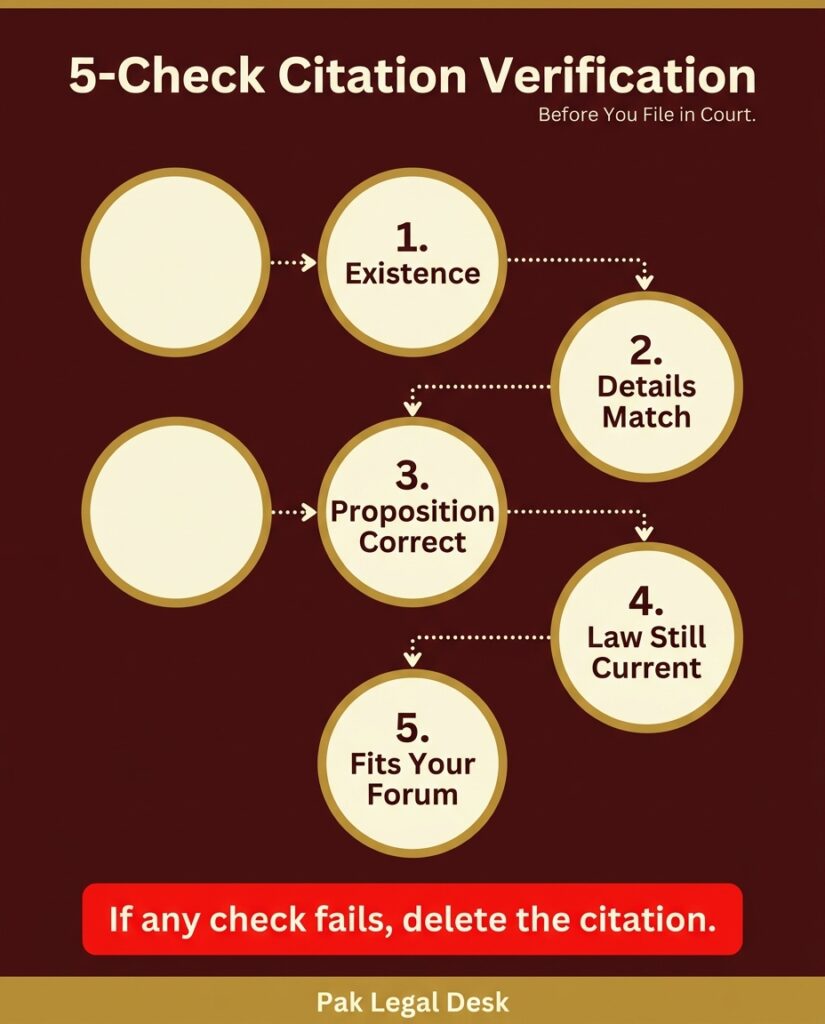
- Note the citation and confirm it.
- Check whether later judgments follow or distinguish it.
- Record your search path and date.
Search Tips
- Use the section number and the statute’s short title together.
- Try Urdu and English terms where sources are bilingual.
- Search synonyms (for example “injunction” and “stay”).
- Save the exact wording of the passage you rely on.
Common Mistakes
Relying on a blog’s summary; citing a repealed section; mixing federal and provincial law; copying a citation without opening the case; not recording the date of the search.
When Professional Legal Advice Is Appropriate
Finding law is different from applying it. Consult a qualified advocate about how authorities apply to your facts.
Pak Legal Desk Solution
Per its product page (checked 8 October 2026), Pak Legal Desk’s research service delivers structured memoranda on Pakistani legal questions, covering applicable statutes, relevant case law and procedural guidance, prepared by its research desk and delivered as PDF and Word with citations. You submit a question through the site; it is a request-based service rather than a self-service database. If you want a research memorandum rather than searching yourself, see Pak Legal Desk’s legal research service.
Frequently Asked Questions
Where can I find Pakistani laws online? The Pakistan Code (pakistancode.gov.pk) for federal legislation; provincial sites for provincial laws.
Where are Pakistani judgments published? On the websites of the Supreme Court and High Courts, and in law reporters.
What does PLD mean? It is a law-reporter series; confirm full citation details when you cite.
How do I know a law is current? Check the amendment history and any later notifications.
Can I rely on a free blog for the law? Use blogs for leads only; confirm against primary sources.
Final Takeaway
Reliable legal research starts with primary sources: the Pakistan Code for statutes and court websites for judgments. Use reporters and databases for leads, but confirm every citation against the court’s own text.
References
- Pakistan Code (pakistancode.gov.pk)
- Supreme Court of Pakistan (supremecourt.gov.pk) and High Court websites (confirm URLs)
- Law reporters: PLD, SCMR, CLC, MLD
Legal Information Disclaimer
This article provides general legal information for educational purposes and does not constitute legal advice. For advice concerning a specific matter, consult a qualified advocate.