

Quick Answer
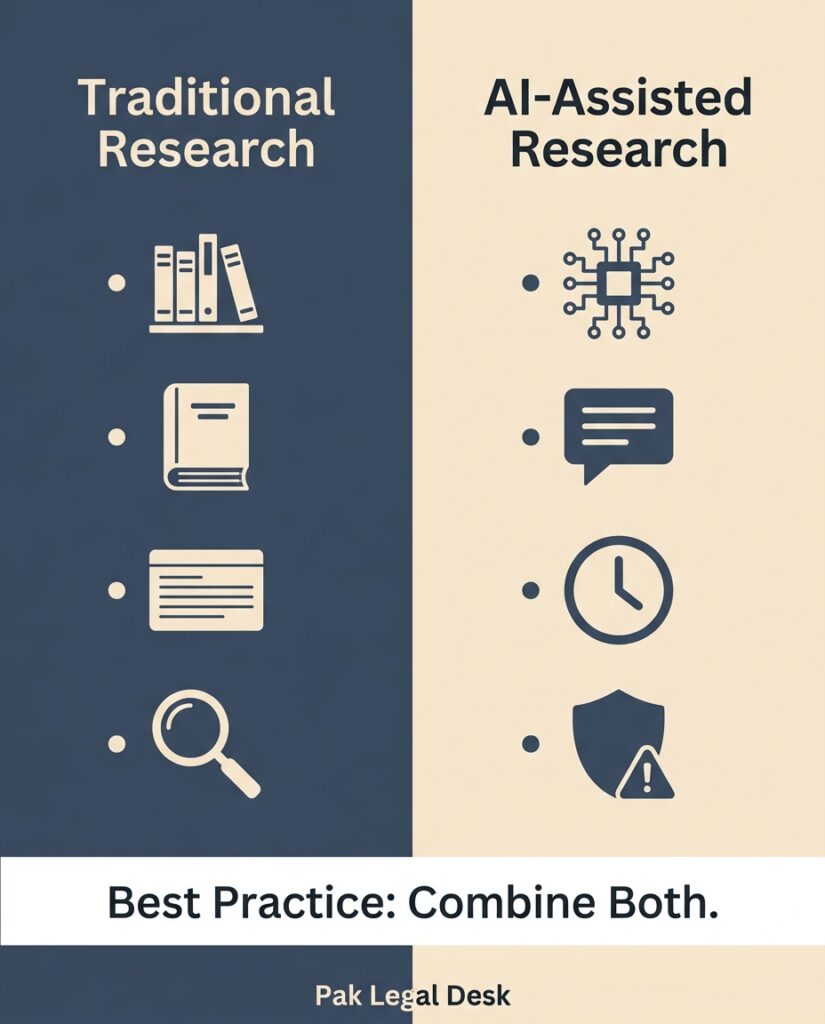
Neither is better on its own. Traditional research (reporters, digests, official sources, library work) is slower but built on checkable texts. AI-assisted research is faster at finding leads and summarising, but can produce wrong or invented references. For most advocates the best practice is a combination: use AI to find and organise, then use traditional sources to verify before relying on anything.
Who This Guide Is For
Advocates and chambers deciding how much to rely on AI tools versus conventional research.
What the Law Says
In Pakistan, only an advocate enrolled with a Provincial Bar Council may practise the profession of law under Sections 22 and 23 of the Legal Practitioners and Bar Councils Act, 1973. The advocate who files a document remains responsible for its contents.
Comparison
| Factor | Traditional | AI-assisted |
|---|---|---|
| Speed to first leads | Slower | Fast |
| Reliability of the text | Based on published sources | Depends on the tool’s sources and your checking |
| Risk of invented citations | Low | Real; must verify |
| Skill needed | Knowledge of sources and citation formats | Prompting plus verification |
| Cost | Subscriptions, library time | Free and paid tiers |
| Best for | Final authority checks | Issue-spotting, summaries, first drafts |
| Urdu | Source-dependent | Often supported; test |
Platforms differ in coverage, verification processes, features and pricing. Evaluate independently.
Pakistan-Specific Position
- The advocate who files a document is responsible for it, whatever tools were used.
- Authority comes from primary sources: legislation on the Pakistan Code and judgments of the courts or the law reporters.
- Federal and provincial layers require care; amendments are frequent.
- Check any court directions on the use of AI tools.
Law and administrative procedures can change; verify the current position before acting.
Step-by-Step: A Combined Workflow
- Use AI to list candidate statutes and issues.
- Confirm each statute on the Pakistan Code.
- Use AI or a database to find candidate judgments.
- Open each judgment; confirm the citation and the passage.
- Check later treatment of the case.
- Record what you verified and by whom.
- Draft from verified material only.
Common Mistakes
Treating speed as accuracy; skipping verification; abandoning traditional sources entirely; ignoring cost of errors; failing to log checks.
When Professional Legal Advice Is Appropriate
Either method supports advice. Consult an advocate for application to specific facts.
Pak Legal Desk Solution
Per its product pages (checked 8 October 2026), Pak Legal Desk offers both an AI Legal Assistant (Urdu and English, with statute citations where applicable and a free tier) and a research desk that delivers written memoranda with citations. The research page states that citations are verified against primary sources. See Pak Legal Desk’s AI Legal Assistant and legal research service.
Frequently Asked Questions
Is AI legal research accurate? It can be helpful but must be verified; accuracy varies by tool.
Is traditional research obsolete? No. It remains the basis for verification.
Which is cheaper? AI tools often cost less per query; verification time is the hidden cost.
Can I combine them? Yes, and most careful researchers do.
Who is responsible for errors? The advocate who relies on and files the material.
Final Takeaway
Use AI to find and organise, then use traditional sources to verify. The advocate who files the document remains responsible, whatever tools were used.
References
- Pakistan Code (pakistancode.gov.pk)
- Supreme Court of Pakistan and High Court websites (confirm URLs)
- Law reporters: PLD, SCMR, CLC, MLD
- Legal Practitioners and Bar Councils Act, 1973 — Sections 22, 23
Legal Information Disclaimer
This article provides general legal information for educational purposes and does not constitute legal advice. For advice concerning a specific matter, consult a qualified advocate.