

Quick Answer
Involve a lawyer early if there is a dispute over ownership, possession, a sale, inheritance, boundaries or tenancy, or if you have received a notice or court papers. Before meeting, gather title documents, the registered deed, revenue or land records, payment proof, correspondence, identification and a timeline. Property disputes are fact-heavy and time-sensitive, and limitation periods may apply.
Who This Guide Is For
Buyers, sellers, heirs, landlords, tenants and overseas Pakistanis with property in Pakistan.
What the Law Says
Property disputes in Pakistan are governed by a mix of federal and provincial laws. The Transfer of Property Act, 1882 and the Registration Act, 1908 deal with transfers and registration of documents; requirements vary by instrument and province.
Remedies such as specific performance or declarations are dealt with under the Specific Relief Act, 1877. Verify the current text on the Pakistan Code.
Time limits apply to property claims; see the Limitation Act, 1908. Documents are proved according to the Qanun-e-Shahadat Order, 1984.
What You Need to Know
Disputes commonly involve unclear title, double sales, forged or defective documents, delayed possession, inheritance shares, boundary disputes, or tenancy conflicts. The right remedy depends on facts: for example, a civil suit, an application to a revenue authority, a tenancy proceeding or, in some cases, criminal proceedings.
Pakistan-Specific Legal Position
- Transfer and registration. The Transfer of Property Act, 1882 and the Registration Act, 1908 deal with transfers and registration of documents; requirements vary by instrument and province.
- Revenue records. Land is recorded in provincial revenue records; terminology and forms differ between provinces (for example fard and jamabandi in Punjab; check the Sindh, Khyber Pakhtunkhwa and Balochistan equivalents). Verify locally.
- Specific relief. Remedies such as specific performance or declarations are dealt with under the Specific Relief Act, 1877; verify the current text.
- Limitation. Time limits apply; see the Limitation Act, 1908.
- Illegal dispossession. The Illegal Dispossession Act, 2005 exists as a statutory remedy in some situations; take advice on its scope and current status.
- Evidence. Documents are proved according to the Qanun-e-Shahadat Order, 1984.
- Tenancy. Rent laws are provincial; check the applicable law.
Law and administrative procedures can change; verify the current position before acting.
Step-by-Step Guide
- Write a timeline: purchase, payments, possession, disputes.
- Collect documents (below).
- Do not sign anything new until advised.
- Note any deadlines in notices or court papers.
- Consult an advocate experienced in property matters in the relevant court.
- Ask about options: negotiation, notice, suit, application, mediation.
- Agree fees and scope in writing.
- Keep originals safe; give copies unless instructed.
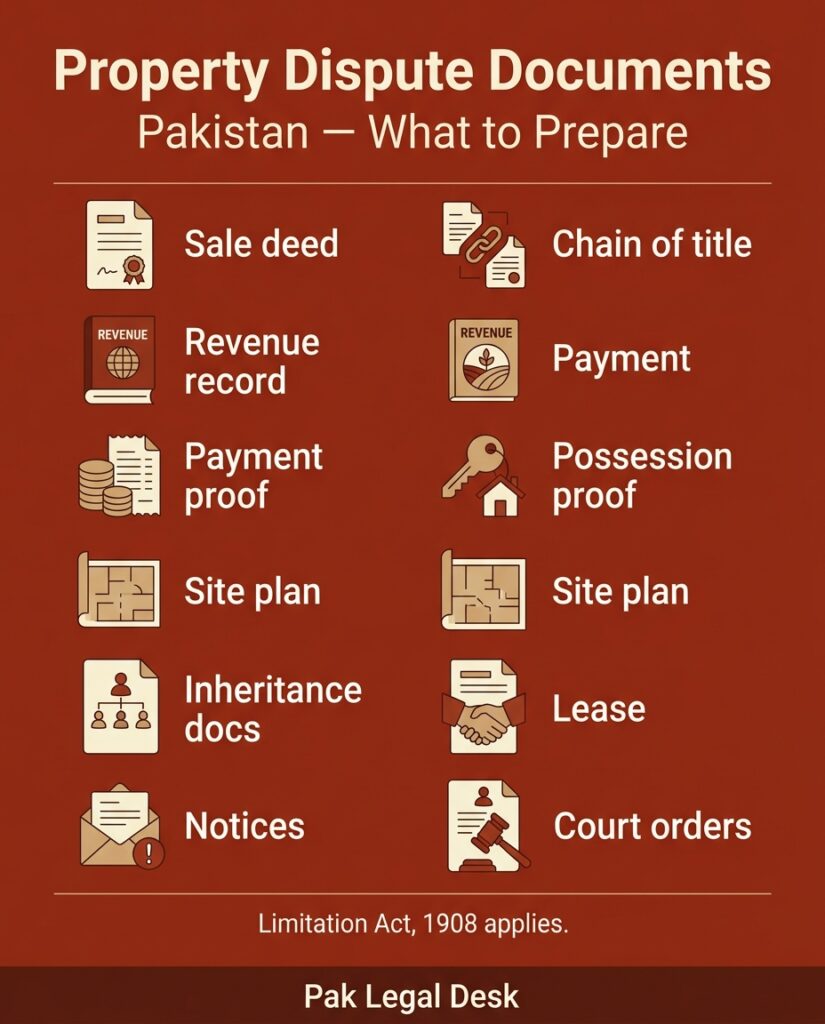
Documents to Prepare
| Document | Purpose |
|---|---|
| Sale deed or registered transfer document | Proof of title |
| Previous chain of title documents | History of ownership |
| Revenue or land record extracts | Official record of ownership and possession |
| Agreement to sell, receipts, payment proofs | Money trail |
| Possession proof (utility bills, handover letters) | Possession |
| Site plan, map, boundary details | Identification |
| Inheritance documents (death certificate, family details) | Succession |
| Lease or rent agreement | Tenancy |
| Notices and correspondence | Evidence |
| Court orders or papers | Deadlines |
| Identification and powers of attorney | Authority |
Common Mistakes
Buying without checking the record; paying cash without receipts; ignoring limitation; handing over originals; signing “compromise” papers without advice; assuming a stamp-paper agreement alone proves title.
When Professional Legal Advice Is Appropriate
Early, in nearly all contested property matters.
Pak Legal Desk Solution
Per its Services page (checked 8 October 2026), Pak Legal Desk offers Pakistan templates including a sale deed for immovable property, commercial lease and power of attorney, each to be reviewed by a qualified lawyer before use; it does not list a property-dispute service. See services and templates. [HOLD: directory link pending compliance review.]
Frequently Asked Questions
Do I need a lawyer for a property dispute in Pakistan? Often yes, especially if title or possession is contested.
What documents do I need? See the table above.
Is a stamp-paper agreement enough to prove ownership? Not by itself; registration and records matter.
Is there a time limit to sue? Yes; see the Limitation Act, 1908.
Can overseas Pakistanis handle a dispute remotely? Often through a power of attorney; take advice. See our guides on making a power of attorney from the UK and POA attestation in the UAE.
Final Takeaway
Property disputes are won on documents and timelines. Involve an advocate early, gather the papers listed above, and do not sign anything new until you have advice.
References
- Transfer of Property Act, 1882 (Pakistan Code)
- Registration Act, 1908 (Pakistan Code)
- Specific Relief Act, 1877 (Pakistan Code)
- Limitation Act, 1908 (Pakistan Code)
- Qanun-e-Shahadat Order, 1984 (Pakistan Code)
- Illegal Dispossession Act, 2005 (Pakistan Code; verify current status)
- Provincial revenue and rent laws (confirm)
Legal Information Disclaimer
This article provides general legal information for educational purposes and does not constitute legal advice. For advice concerning a specific matter, consult a qualified advocate.