

Quick Answer
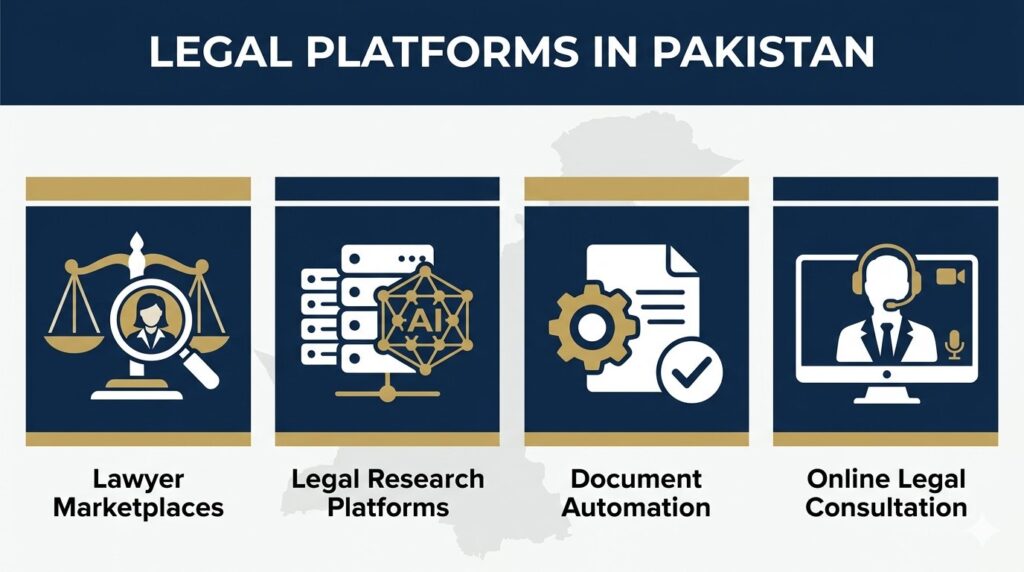
Pakistan does not regulate “legal platforms” as a distinct category. A platform is either a law firm with a digital presence, a directory or marketplace connecting users with advocates, a research tool, a document-automation tool, or a combination of these. Because the practice of law is regulated — enrolment with a provincial bar council under the Legal Practitioners and Bar Councils Act, 1973 [VERIFY] — the reliability of any platform turns on the enrolment of the advocates behind it, not on the platform’s own claims. A reader evaluating a platform should check the advocate’s enrolment with the relevant bar council, read the terms of service and privacy policy, and confirm in writing what is and is not included in any fee. No platform replaces an advocate for case-specific advice or court representation [VERIFY].
What the Law Says
The framework that governs legal services in Pakistan is a framework of professional regulation. It applies to advocates, not to software.
Legal Practitioners and Bar Councils Act, 1973. The Act constitutes the Pakistan Bar Council and the provincial bar councils and provides for the enrolment, discipline, and conduct of advocates [VERIFY]. Only an enrolled advocate may perform the activities reserved for advocates — giving case-specific legal advice and appearing before a court [VERIFY]. The Act does not recognise a “legal platform” as a category of service provider.
Pakistan Legal Practitioners and Bar Councils Rules, 1976. The Rules contain the professional-conduct provisions that bear on how advocates may be presented to the public.
- Rule 135 [VERIFY] — prohibits solicitation of professional employment by advertisement or any other means, with a limited safe harbour for conventional professional cards, name plates, and conventional directory listings containing only professional and academic qualifications and public offices currently held.
- Rule 136 [VERIFY] — prohibits employing any other person to solicit or obtain professional employment, sharing compensation with unlicensed persons, and accepting employment resulting from unlicensed persons’ activities.
- Rules 175-A and 175-B [VERIFY] — provide that non-observance or violation of these provisions constitutes professional misconduct and, in the aggravated case, gross professional misconduct.
Bar council verification portals. The provincial bar councils publish online verification pages through which a member of the public, a government body, or a court may confirm that a named individual is an enrolled advocate [VERIFY]. This is the authoritative check.
Evidence and privilege. Communications between an advocate and client are privileged under the Qanun-e-Shahadat Order, 1984 [VERIFY]. The privilege attaches to the advocate-client relationship. A form submission or a chat on a platform before a formal engagement does not by itself create that relationship, and the general law on privilege is not displaced by a platform’s terms of service.
Data protection. Pakistan does not yet have a comprehensive data-protection statute; the Personal Data Protection Bill has remained in draft form [VERIFY]. A platform’s handling of user data is governed by its own terms of service and, where applicable, general consumer-protection principles.
What the Law Does and Does Not Do
The framework does:
- Reserve the practice of law to advocates enrolled with a provincial bar council [VERIFY].
- Require that any representation of an advocate’s qualifications be capable of being verified through the relevant bar council [VERIFY].
- Preserve the advocate-client privilege under the Qanun-e-Shahadat Order, 1984 [VERIFY].
- Permit a platform to operate as a directory, a research tool, or a document-automation service without itself being a legal practice, provided it does not hold itself out as giving case-specific legal advice [VERIFY].
- Provide a disciplinary route to the bar council where an advocate’s conduct — including promotional conduct — is alleged to breach the Rules [VERIFY].
The framework does not:
- Recognise a “legal platform” as a regulated category of service provider.
- Make a platform responsible for the professional conduct of the advocates it lists, in the manner of a regulatory body.
- Extend advocate-client privilege to a user’s interaction with a platform before a formal engagement with an identified advocate.
- Require a platform to disclose its verification methodology, its pricing, or its data-handling terms, other than as its own contractual terms require.
- Regulate the accuracy of AI-assisted legal information output [VERIFY].
Who This Applies To
This article applies to individuals and businesses in Pakistan who are considering using an online platform to find an advocate, obtain legal information, or draft a document; to overseas Pakistanis engaging legal services in Pakistan through a platform [VERIFY]; to advocates and law firms considering how their own digital presence interacts with the professional-conduct rules; and to any reader who has encountered a platform that describes itself as offering “legal advice” and wishes to know what that claim does and does not mean. It does not apply to the internal governance of a law firm, or to the conduct of advocates in a jurisdiction outside Pakistan.
Procedure (step by step)
- Define the need. A legal consultation, a document draft, a property search, and a court appearance are four different needs and may be served by four different routes.
- Identify the advocate or firm providing the substantive service. A platform that does not name the advocate or firm is a directory or an information service, not a legal practice.
- Verify enrolment. Use the relevant provincial bar council’s verification page to confirm the advocate’s name, enrolment number, and licence to practise before the relevant court [VERIFY]. Do not rely on a platform’s internal “verified” badge as a substitute.
- Read the terms of service and the privacy policy. Confirm what the platform does with uploaded documents, where they are stored, and for how long.
- Confirm what is included in any fee. Ask for the scope in writing: what the fee covers, what it does not, and what disbursements will be billed separately [VERIFY].
- Confirm the position on privilege. A platform chat is not necessarily privileged. Privilege attaches when an advocate-client relationship is formed. If the matter is sensitive, confirm in writing with the advocate that the engagement has begun before sharing confidential material.
- Confirm the forum. Where the matter will proceed before a court, confirm which court has jurisdiction and whether the advocate is enrolled to appear before it [VERIFY].
- Confirm what the platform does not do. Where AI-assisted research, document review, or a first-draft generation is part of the service, confirm that a qualified advocate will review the output before it is relied on [VERIFY].
- Keep the documents. A signed engagement letter or scope, the terms of service version in force when you engaged, correspondence, receipts, and the advocate’s enrolment details.
- Where a complaint arises, use the right channel. A professional-conduct complaint against an advocate goes to the relevant bar council [VERIFY]. A complaint about a platform’s handling of user data goes, in the first instance, to the platform’s own complaint mechanism, and then — where a consumer-protection or data-protection statute applies — to the relevant authority [VERIFY].
Documents Required
- Written engagement letter or scope of work, signed by the client and the advocate [VERIFY].
- Statement of the fee and of what is and is not included.
- Schedule of disbursements that will be charged separately.
- The platform’s terms of service and privacy policy, saved as at the date of engagement [VERIFY].
- Confirmation of the advocate’s enrolment — the enrolment number and the bar council through which it can be verified [VERIFY].
- Receipts for each payment made.
- Any correspondence varying the scope or the fee.
- Where a court filing is involved, the applicable court fee receipt and the relevant court’s published schedule [VERIFY].
- For an overseas client, the attested power of attorney and any additional authorisation required by the receiving court [VERIFY].
Common Mistakes
- Treating a platform’s internal “verified” badge as a substitute for the bar council check. The authoritative verification is the provincial bar council’s portal, not the platform’s representation [VERIFY].
- Assuming a chat on a platform is privileged. Privilege attaches to the advocate-client relationship, not to the platform interface [VERIFY].
- Uploading confidential documents before checking the privacy terms. Once the document is uploaded, the platform’s terms of service govern what happens to it.
- Treating AI-assisted output as verified legal research. AI output must be verified against primary Pakistani sources before reliance [VERIFY].
- Assuming “free” means no cost. “Free” may describe a free tier, a free trial, free access to legal information, or free legal advice from a legal-aid channel — four different things.
- Not asking for the fee scope in writing. A consultation fee rarely includes drafting, court appearances, or disbursements unless the agreement says so [VERIFY].
- Relying on a ranking or a “top ten” list. Rankings are editorial choices, not professional endorsements. Verify each advocate independently.
Practical Checklist
- Need defined — consultation, drafting, research, or representation.
- Advocate or firm named and identified.
- Enrolment verified with the relevant provincial bar council [VERIFY].
- Terms of service and privacy policy read and saved.
- Scope of work agreed in writing.
- Fee and disbursements agreed in writing.
- Position on privilege confirmed with the advocate.
- Court and forum identified; advocate’s licence before that court confirmed [VERIFY].
- Any AI-assisted output reviewed by a qualified advocate before reliance [VERIFY].
- Documents and receipts retained.
Frequently Asked Questions
What is a legal platform in Pakistan?
A digital service that facilitates access to legal information, legal professionals, or legal documents through an online interface. The term is not defined in any Pakistani statute; it is a convenience label for a varied group of services.
Are legal platforms regulated in Pakistan?
Not as a category. The practice of law is regulated by the Pakistan Bar Council and the provincial bar councils under the Legal Practitioners and Bar Councils Act, 1973 [VERIFY]. A platform is regulated to the extent that it constitutes the practice of law or is operated by advocates who are themselves regulated.
How do I verify an advocate’s enrolment?
Through the relevant provincial bar council’s online verification page [VERIFY]. The bar council’s record — not the platform’s own representation — is the authoritative source.
Do platform claims of “verified lawyers” mean anything?
They mean what the platform’s own verification process means. The methodology is rarely published in detail, and platform verification is not a substitute for the bar council check. Verify independently [VERIFY].
Does the advocate-client privilege attach when I use a platform?
Privilege attaches to the advocate-client relationship, not to the platform interface [VERIFY]. Until an engagement is formed with an identified advocate, the interaction is governed by the platform’s terms of service, not by the privilege provisions of the Qanun-e-Shahadat Order, 1984.
Is it safe to upload confidential documents to a platform?
Safety depends on the platform’s data-handling terms and on the nature of the document. Read the privacy policy before uploading. Where the matter is sensitive, share the document directly with the advocate once the engagement has begun, not before [VERIFY].
Do I need a lawyer, or is a platform enough?
For case-specific advice and for court representation, an enrolled advocate is required [VERIFY]. A platform can assist with discovery, document review, and first drafts, but it does not replace the advocate.
Are “free” legal platforms genuinely free?
The word “free” describes several different things — free access, a free tier, free legal information, or free legal advice from a legal-aid channel. Read what the platform says it is offering before relying on it. Where a professional fee is payable to an advocate, no platform can make that fee disappear.
What should I look for in the terms of service?
What the platform does with uploaded documents, how long it retains them, whether it shares them with third parties, which jurisdiction’s law governs the agreement, and what the process is for resolving a dispute with the platform.
Can I complain about an advocate through a platform?
A professional-conduct complaint against an advocate goes to the relevant bar council [VERIFY]. A platform may have its own complaint mechanism, but it is not a disciplinary forum for advocates.
Are AI-assisted legal research tools reliable for Pakistani law?
They vary. Retrieval-augmented tools grounded in Pakistani primary sources are generally more reliable than general-purpose tools [VERIFY]. Every citation and every statutory reference must still be verified against the primary source.
Should I rely on a “top ten” list of platforms?
No. Rankings are editorial choices, not professional endorsements, and the methodology is often unpublished. Verify each advocate or firm independently through the bar council portal [VERIFY].
Official Fees and Where to Check Them
This article quotes no fee figure. Schedules change, and an outdated figure is worse than no figure. Where a statutory fee is payable on a court filing, the current schedule is published by the relevant High Court’s fee counter or by the provincial government’s published schedule under the Court Fees Act, 1870 [VERIFY]. Stamp duty and registration charges are published by the provincial stamp authority or the Sub-Registrar [VERIFY]. Where a fee relates to a specific statutory service — a company registration, a trade mark filing, a property registration — the schedule is published by the authority that administers that service. The advocate’s fee is not a published schedule: it is a matter of private agreement, and the agreement should be in writing before work begins. A platform’s own pricing is governed by its terms of service and is not a statutory schedule [VERIFY].
Related Reading
- Articles hub — https://paklegaldesk.com/articles/ [VERIFY]
- Verifying an advocate’s enrolment with the bar council [VERIFY]
- Legal consultation fees in Pakistan — structure and regulation [VERIFY]
- Free legal AI in Pakistan — how it works and what it cannot do [VERIFY]
- Engaging an advocate — the letter of engagement and scope of work [VERIFY]
Each URL above must be curl-checked before push; swap any that do not resolve.
What You Can Do Next
- Use the platform’s Legal Research tool to locate the current text of the Legal Practitioners and Bar Councils Act, 1973 and the Pakistan Legal Practitioners and Bar Councils Rules, 1976.
- Use the platform’s document drafting tools to prepare an engagement letter and a scope-of-work statement for a legal matter.
- Use the platform’s case management tools to log engagement dates, fee payments, correspondence, and the advocate’s enrolment details.
- Use the platform’s Legal Research tool to identify the published schedule of court fees applicable to a matter before any filing is made.
Legal Information Disclaimer
This article provides general information about how legal services and online legal platforms operate in Pakistan and about the professional-conduct framework that applies to advocates. It does not constitute legal advice. Statutes, rules, and official schedules change; platform terms of service and privacy policies change without notice. Verify every provision, fee, and figure with the relevant authority or a qualified legal professional before acting. Reading this article does not create an advocate-client relationship.