
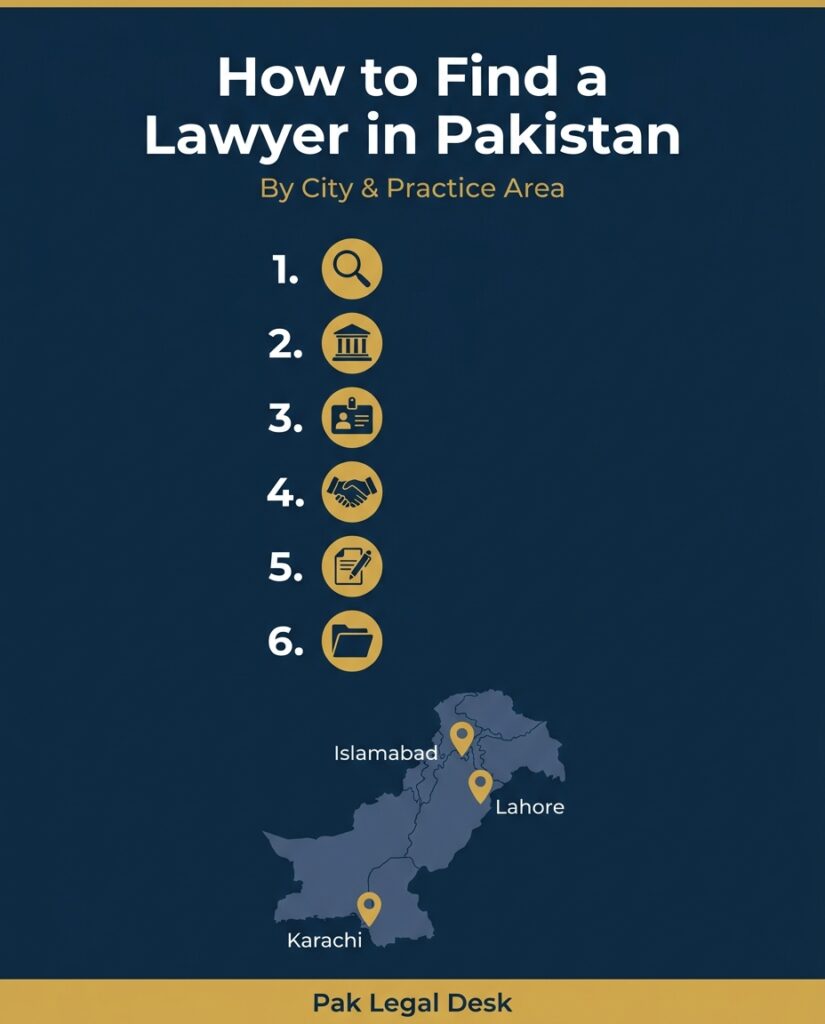

Quick Answer
To find a lawyer in Pakistan, first identify your legal
problem and the court that will hear it. Then shortlist
advocates who practise in that area and appear in that
court, verify enrolment with the relevant Bar Council
under the Legal Practitioners and Bar Councils Act, 1973,
meet more than one advocate, agree fees and scope in
writing, and sign a vakalatnama only when you are ready.
Who This Guide Is For
Individuals, families and businesses looking for an
advocate in Pakistan, including overseas Pakistanis who
need to instruct a lawyer from abroad.
What the Law Says
In Pakistan, the legal profession is regulated by the
Legal Practitioners and Bar Councils Act, 1973. Section 22
provides that no person is entitled to practise the
profession of law unless he is an advocate, and that an
advocate is entitled as of right to practise throughout
Pakistan and to appear, act and plead before any court or
tribunal in Pakistan.
Advocates are enrolled with Provincial Bar Councils
under Section 23 of the Act, which requires each
Provincial Bar Council to prepare and maintain a roll of
advocates. Section 23 further provides that an advocate
may not practise in the High Court unless he has practised
as a legal practitioner for at least two years and paid
the prescribed fee, and may not plead before the Supreme
Court unless he fulfils the prescribed conditions and has
paid the required fee to the Pakistan Bar Council.
Advocates are also bound by the Pakistan Legal
Practitioners and Bar Councils Rules, 1976, Chapter XII,
which contains the Canons of Professional Conduct and
Etiquette of Advocates. Rule 135 prohibits solicitation of
professional employment by advertisement or by any other
means. Rule 136 prohibits an advocate from employing
another person to solicit work or from sharing with an
unlicensed person any compensation arising out of
professional employment. Rule 141 provides that no
division of fees for legal services is proper except with
another advocate on a division-of-work basis.
Who Does This Apply To?
Anyone seeking legal representation in Pakistan, for a
civil, criminal, family, property, corporate or
constitutional matter. It applies equally to individuals,
small businesses, overseas Pakistanis and anyone who
needs to engage an advocate for court proceedings or
legal advice.
By Legal Problem
| Problem | Practice area | Forum |
|---|---|---|
| Family (khula, custody, maintenance) | Family law | Family Court |
| Property and tenancy | Property / civil | Civil Court, rent tribunal |
| Criminal case or FIR | Criminal | Magistrate, Sessions, High Court |
| Business or contract dispute | Commercial | Civil Court, arbitration |
| Company registration | Corporate | SECP processes |
| Constitutional or service matter | Constitutional | High Court, tribunals |
By City
Courts and Bar associations are organised locally, so
an advocate who regularly appears in your court knows its
procedures. Ask where the advocate usually appears and
whether they can attend your matter’s court on its
listing days.
Pakistan-Specific Position
- Verify enrolment. Check the relevant
Bar Council’s roll. Bar Councils maintain rolls of
advocates under the Legal Practitioners and Bar Councils
Act, 1973. Ask the advocate for their enrolment details
and verify them with the Bar Council office or its
published roll. - No solicitation. Under Rule 135 of
the 1976 Rules, advocates may not solicit work by
advertisement or any other means. - Fees. Ask for the fee arrangement in
writing. See our guide on
legal consultation fees in Pakistan
for how fees are typically structured. - Vakalatnama. A vakalatnama authorises
the advocate to act for you. Read it before signing. - Overseas clients. If you are
instructing from abroad, a power of attorney is commonly
used. See our guides on
making a power of attorney from the UK
and
POA attestation in the UAE.
Law and administrative procedures can change;
verify the current position before acting.
Step-by-Step Guide
- Write down the problem in one paragraph and gather
your documents. - Identify the practice area and the likely forum.
- Ask people you trust, and check Bar association
resources. - Shortlist two or three advocates.
- Verify enrolment with the Bar Council.
- Meet or call each advocate; explain the facts.
- Ask about their experience, communication, and fee
structure. - Get the engagement and fees in writing.
- Sign the vakalatnama only when you are ready.
- Keep copies of everything.
For city-specific guidance, see our pages on finding a
family lawyer in Islamabad,
a
corporate lawyer in Karachi,
and a
property lawyer in Lahore.
Questions to Ask at the First Meeting
What is your experience with this kind of matter? Which
courts do you appear in? What are the stages and timeline?
What fees apply, and when are they payable? What court
fees are separate? How will you update me?
Common Mistakes
Choosing on a promise of results; paying large sums
without a written arrangement; not verifying enrolment;
hiring someone who does not appear in the relevant court;
handing over originals without a record; relying on a
platform’s verification badge without checking the Bar
Council roll.
When Professional Legal Advice Is Appropriate
Always for contested, time-sensitive or high-value
matters. If you are unsure whether your situation needs an
advocate, see our guide on
when and how to consult a lawyer in Pakistan,
and our guide on
how to evaluate a legal platform.
Pak Legal Desk Solution
[HOLD — insert only after (a) the directory is
populated, (b) the verification process is documented, and
(c) the compliance review is complete.] Suggested
safe wording: “Pak Legal Desk provides a directory in
which advocates who state they are enrolled with a Bar
Council may list factual information such as
qualifications, areas of practice and contact details.
The directory is an information tool. Pak Legal Desk is
not a law firm, does not endorse or rank advocates and
does not guarantee any outcome. Check enrolment and fees
yourself.” See the
lawyer directory.
For general legal information while you decide, the
AI Legal Assistant can help
you frame your question. It is not legal advice.
Frequently Asked Questions
How do I check whether a lawyer is genuine in
Pakistan? Check enrolment on the relevant Bar
Council’s roll. Under the Legal Practitioners and Bar
Councils Act, 1973, each Provincial Bar Council
maintains a roll of advocates.
Can I find a lawyer online in Pakistan?
Yes. Online listings are an information tool, not an
endorsement. See our guide on
finding a verified online lawyer in Pakistan.
Do lawyers advertise in Pakistan?
Advocates are restricted from soliciting work under Rule
135 of the 1976 Rules.
Can a lawyer guarantee I will win? No.
Any advocate who promises an outcome should be treated
with caution.
Can I hire a lawyer remotely? Often
yes for advice. Court appearance requires a vakalatnama
and, in many cases, attendance.
What is the difference between enrolment
levels? An advocate’s right of audience depends
on the level of enrolment. Under Section 23 of the 1973
Act, advocates may be enrolled for subordinate courts,
the High Court or the Supreme Court.
Final Takeaway
Finding the right lawyer in Pakistan requires three
things: verifying enrolment, matching the advocate to
your legal problem and forum, and agreeing fees and scope
in writing.
References
- Legal Practitioners and Bar Councils Act, 1973
(Pakistan Code) — Sections 22, 23 - Pakistan Legal Practitioners and Bar Councils Rules,
1976, Chapter XII — Rules 135, 136, 141 - Pakistan Bar Council and Provincial Bar Councils
Legal Information Disclaimer
This article provides general legal information for
educational purposes and does not constitute legal
advice. For advice concerning a specific matter, consult
a qualified advocate.